



 Chat with AI
Exam 6: Supply, Demand, and Government Policies

Exam 1: Ten Principles of Economics438 Questions
Exam 2: Thinking Like an Economist620 Questions
Exam 3: Interdependence and the Gains From Trade527 Questions
Exam 4: The Market Forces of Supply and Demand700 Questions
Exam 5: Elasticity and Its Application598 Questions
Exam 6: Supply, Demand, and Government Policies648 Questions
Exam 7: Consumers, Producers, and the Efficiency of Markets547 Questions
Exam 8: Application: the Costs of Taxation514 Questions
Exam 9: Application: International Trade496 Questions
Exam 10: Measuring a Nations Income522 Questions
Exam 11: Measuring the Cost of Living545 Questions
Exam 12: Production and Growth507 Questions
Exam 13: Saving, Investment, and the Financial System567 Questions
Exam 14: The Basic Tools of Finance513 Questions
Exam 15: Unemployment699 Questions
Exam 16: The Monetary System517 Questions
Exam 17: Money Growth and Inflation487 Questions
Exam 18: Open-Economy Macroeconomics: Basic Concepts522 Questions
Exam 19: A Macroeconomic Theory of the Open Economy484 Questions
Exam 20: Aggregate Demand and Aggregate Supply563 Questions
Exam 21: The Influence of Monetary and Fiscal Policy on Aggregate Demand511 Questions
Exam 22: The Short-Run Trade-Off Between Inflation and Unemployment516 Questions
Exam 23: Six Debates Over Macroeconomic Policy372 Questions
Select questions type


Figure 6-1
Panel a) Panel b)
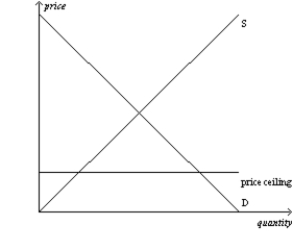
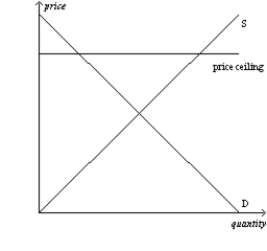 -Refer to Figure 6-1. A binding price ceiling is shown in
 (Multiple Choice)
4.9/5  (84)
(84) Figure 6-4  -Refer to Figure 6-4. Which of the following statements is not correct?
 (Multiple Choice)
4.8/5 (85)
(85) Scenario 6-2
Suppose demand for a product is given by the equation  and supply for the product is given by the equation
 -Refer to Scenario 6-2. What are the equilibrium price and equilibrium quantity in the market for this product?
and supply for the product is given by the equation
-Refer to Scenario 6-2. What are the equilibrium price and equilibrium quantity in the market for this product? (Essay)
4.8/5 (73)
(73) Figure 6-5  -Refer to Figure 6-5. Suppose the market is initially in equilibrium. Then the government imposes a price control, as represented by the horizontal line on the graph. If the price control is a price floor, then the price control
 (Multiple Choice)
4.9/5 (88)
(88) Since half of the FICA tax is paid by firms and the other half is paid by workers, the burden of the tax must fall equally on firms and workers.
(True/False)
4.9/5 (83)
(83) The tax burden will fall most heavily on buyers of the good when the demand curve
(Multiple Choice)
4.9/5 (82)
(82) At the equilibrium price, the quantity that buyers want to buy exactly equals the quantity that sellers want to sell.
(True/False)
4.8/5 (86)
(86) A tax burden falls more heavily on the side of the market that
(Multiple Choice)
4.8/5 (80)
(80) Which of the following was not a result of the luxury tax imposed by Congress in 1990?
(Multiple Choice)
4.9/5 (77)
(77) Suppose there is currently a tax of $50 per ticket on airline tickets. Sellers of airline tickets are required to pay the tax to the government. If the tax is reduced from $50 per ticket to $30 per ticket, then the
(Multiple Choice)
4.9/5 (80)
(80) Figure 6-18
The vertical distance between points A and B represents the tax in the market.  -Refer to Figure 6-18. The price that buyers pay after the tax is imposed is
 (Multiple Choice)
4.7/5 (80)
(80) Figure 6-22  -Refer to Figure 6-22. The price paid by buyers after the tax is imposed is
 (Multiple Choice)
4.9/5 (72)
(72) A price ceiling is always a binding price control, whereas a price floor may be either binding or not binding.
(True/False)
4.9/5 (90)
(90) If a tax is levied on the buyers of a product, then the demand curve will
(Multiple Choice)
4.8/5 (69)
(69) Table 6-2
 -Refer to Table 6-2. A price floor set at $5 will
 (Multiple Choice)
4.7/5 (83)
(83) A tax of $1 on buyers always decreases the equilibrium price by $1.
(True/False)
4.9/5 (86)
(86) If the demand curve is very inelastic and the supply curve is very elastic in a market, then the sellers will bear a greater burden of a tax imposed on the market, even if the tax is imposed on the buyers.
(True/False)
4.8/5 (70)
(70) 
Filters
- Essay(0)
- Multiple Choice(0)
- Short Answer(0)
- True False(0)
- Matching(0)