



 Chat with AI
Exam 6: Supply, Demand, and Government Policies

Exam 1: Ten Principles of Economics438 Questions
Exam 2: Thinking Like an Economist620 Questions
Exam 3: Interdependence and the Gains From Trade527 Questions
Exam 4: The Market Forces of Supply and Demand700 Questions
Exam 5: Elasticity and Its Application598 Questions
Exam 6: Supply, Demand, and Government Policies648 Questions
Exam 7: Consumers, Producers, and the Efficiency of Markets547 Questions
Exam 8: Application: the Costs of Taxation514 Questions
Exam 9: Application: International Trade496 Questions
Exam 10: Measuring a Nations Income522 Questions
Exam 11: Measuring the Cost of Living545 Questions
Exam 12: Production and Growth507 Questions
Exam 13: Saving, Investment, and the Financial System567 Questions
Exam 14: The Basic Tools of Finance513 Questions
Exam 15: Unemployment699 Questions
Exam 16: The Monetary System517 Questions
Exam 17: Money Growth and Inflation487 Questions
Exam 18: Open-Economy Macroeconomics: Basic Concepts522 Questions
Exam 19: A Macroeconomic Theory of the Open Economy484 Questions
Exam 20: Aggregate Demand and Aggregate Supply563 Questions
Exam 21: The Influence of Monetary and Fiscal Policy on Aggregate Demand511 Questions
Exam 22: The Short-Run Trade-Off Between Inflation and Unemployment516 Questions
Exam 23: Six Debates Over Macroeconomic Policy372 Questions
Select questions type


The price paid by buyers in a market will increase if the government i) increases a binding price floor in that market.
Ii) increases a binding price ceiling in that market.
Iii) decreases a tax on the good sold in that market.
(Multiple Choice)
4.9/5  (84)
(84) Figure 6-6  -Refer to Figure 6-6. Which of the following price ceilings would be binding in this market?
 (Multiple Choice)
4.8/5 (66)
(66) Binding price floors benefit sellers because they allow sellers to sell all the goods they want at a higher price.
(True/False)
4.8/5 (78)
(78) When a tax is placed on the buyers of a product, buyers pay
(Multiple Choice)
4.8/5 (89)
(89) Table 6-3
The following table contains the demand schedule and supply schedule for a market for a particular good. Suppose sellers of the good successfully lobby Congress to impose a price floor $2 above the equilibrium price in this market.
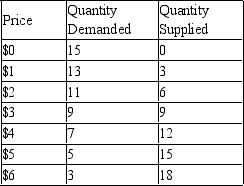 -Refer to Table 6-3. Following the imposition of a price floor $2 above the equilibrium price, irate buyers convince Congress to repeal the price floor and to impose a price ceiling $1 below the former price floor. The resulting market price is
 (Multiple Choice)
4.9/5 (76)
(76) A minimum wage that is set above a market's equilibrium wage will result in an excess
(Multiple Choice)
4.9/5 (66)
(66) Scenario 6-2
Suppose demand for a product is given by the equation  and supply for the product is given by the equation
 -Refer to Scenario 6-2. Suppose the government sets a price floor at $13 for this product. Initially, is this price floor binding? Suppose that for some reason demand were to decrease to
 Would the $13 price floor be binding after the shift in the demand curve? If so, what is the size of the resulting shortage/surplus?
and supply for the product is given by the equation
-Refer to Scenario 6-2. Suppose the government sets a price floor at $13 for this product. Initially, is this price floor binding? Suppose that for some reason demand were to decrease to Would the $13 price floor be binding after the shift in the demand curve? If so, what is the size of the resulting shortage/surplus? (Essay)
4.8/5 (81)
(81) One disadvantage of government subsidies over price controls is that subsidies
(Multiple Choice)
5.0/5 (76)
(76) Figure 6-13
This figure shows the market demand and market supply curves for good X.  -Refer to Figure 6-13. Which of the following price floors would be binding in this market?
 (Multiple Choice)
4.8/5 (79)
(79) Figure 6-18
The vertical distance between points A and B represents the tax in the market.  -Refer to Figure 6-18. The amount of the tax per unit is
 (Multiple Choice)
4.9/5 (65)
(65) If the demand curve is more price elastic than the supply curve in a particular market, will the buyers or the sellers bear a larger burden of a per-unit tax imposed on the market?
(Essay)
4.8/5 (89)
(89) Suppose there is currently a tax of $50 per ticket on airline tickets. Sellers of airline tickets are required to pay the tax to the government. If the tax is reduced from $50 per ticket to $30 per ticket, then the
(Multiple Choice)
4.9/5 (82)
(82) Figure 6-16  -Refer to Figure 6-16. In this market, a minimum wage of $2.75 is
 (Multiple Choice)
4.7/5 (66)
(66) Figure 6-28  -Refer to Figure 6-28. Suppose a tax of $4 per unit is imposed on this market. How much will buyers pay per unit after the tax is imposed?
 (Multiple Choice)
4.9/5 (79)
(79) 
Filters
- Essay(0)
- Multiple Choice(0)
- Short Answer(0)
- True False(0)
- Matching(0)