



 Chat with AI
Exam 6: Supply, Demand, and Government Policies

Exam 1: Ten Principles of Economics438 Questions
Exam 2: Thinking Like an Economist620 Questions
Exam 3: Interdependence and the Gains From Trade527 Questions
Exam 4: The Market Forces of Supply and Demand700 Questions
Exam 5: Elasticity and Its Application598 Questions
Exam 6: Supply, Demand, and Government Policies648 Questions
Exam 7: Consumers, Producers, and the Efficiency of Markets547 Questions
Exam 8: Application: the Costs of Taxation514 Questions
Exam 9: Application: International Trade496 Questions
Exam 10: Measuring a Nations Income522 Questions
Exam 11: Measuring the Cost of Living545 Questions
Exam 12: Production and Growth507 Questions
Exam 13: Saving, Investment, and the Financial System567 Questions
Exam 14: The Basic Tools of Finance513 Questions
Exam 15: Unemployment699 Questions
Exam 16: The Monetary System517 Questions
Exam 17: Money Growth and Inflation487 Questions
Exam 18: Open-Economy Macroeconomics: Basic Concepts522 Questions
Exam 19: A Macroeconomic Theory of the Open Economy484 Questions
Exam 20: Aggregate Demand and Aggregate Supply563 Questions
Exam 21: The Influence of Monetary and Fiscal Policy on Aggregate Demand511 Questions
Exam 22: The Short-Run Trade-Off Between Inflation and Unemployment516 Questions
Exam 23: Six Debates Over Macroeconomic Policy372 Questions
Select questions type


Which of the following is not a rationing mechanism used by landlords in cities with rent control?
(Multiple Choice)
4.8/5  (80)
(80) Figure 6-32  -Refer to Figure 6-32. If the government set a price ceiling at $80, would there be a shortage or surplus, and how large would be the shortage/surplus?
 (Essay)
4.9/5 (87)
(87) Suppose the equilibrium price of a tube of toothpaste is $2, and the government imposes a price floor of $3 per tube. As a result of the price floor,
(Multiple Choice)
4.8/5 (88)
(88) Figure 6-22  -Refer to Figure 6-22. The effective price sellers receive after the tax is imposed is
 (Multiple Choice)
4.7/5 (89)
(89) Figure 6-25  -Refer to Figure 6-25. Suppose the same supply and demand curves apply, and a tax of the same amount per unit as shown here is imposed. Now, however, the sellers of the good, rather than the buyers, are required to pay the tax to the government. After the sellers are required to pay the tax, relative to the case depicted in the graph, the burden on buyers will be
 (Multiple Choice)
4.8/5 (77)
(77) A price ceiling set below the equilibrium price causes a shortage in the market.
(True/False)
4.9/5 (78)
(78) Scenario 6-1
Suppose that demand in the market for good X is given by the equation  and that supply in the market for good X is given by the equation
 -Refer to Scenario 6-1. If the government set a price floor at $13, would there be a shortage or surplus, and how large would be the shortage/surplus?
and that supply in the market for good X is given by the equation
-Refer to Scenario 6-1. If the government set a price floor at $13, would there be a shortage or surplus, and how large would be the shortage/surplus? (Essay)
4.9/5 (74)
(74) Figure 6-33  -Refer to Figure 6-33. Suppose a $4 per-unit tax is imposed on the sellers of this good. How many units of this good will be sold after the tax is imposed?
 (Essay)
4.8/5 (74)
(74) Which of the following statements is correct concerning the burden of a tax imposed on take-out food?
(Multiple Choice)
4.7/5 (80)
(80) Figure 6-22
-Refer to Figure 6-22. As the figure is drawn, who sends the tax payment to the government?
-Refer to Figure 6-22. As the figure is drawn, who sends the tax payment to the government? (Multiple Choice)
4.8/5 (79)
(79) A binding price ceiling may not help all consumers, but it does not hurt any consumers.
(True/False)
4.9/5 (84)
(84) Figure 6-6  -Refer to Figure 6-6. Which of the following statements is not correct?
 (Multiple Choice)
4.9/5 (81)
(81) If the equilibrium price of an airline ticket is $400 and the government imposes a price floor of $500 on airline tickets, then fewer airline tickets will be sold than at the market equilibrium.
(True/False)
4.8/5 (68)
(68) 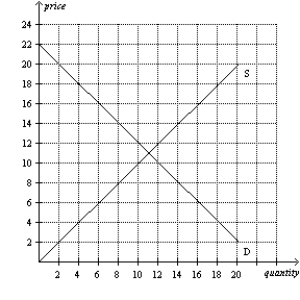 -Refer to Figure 6-10. A price ceiling set at
If a price ceiling is a binding constraint on a market, then
(Multiple Choice)
4.8/5 (85)
(85) 
Filters
- Essay(0)
- Multiple Choice(0)
- Short Answer(0)
- True False(0)
- Matching(0)