



 Chat with AI
Exam 6: Supply, Demand, and Government Policies

Exam 1: Ten Principles of Economics438 Questions
Exam 2: Thinking Like an Economist620 Questions
Exam 3: Interdependence and the Gains From Trade527 Questions
Exam 4: The Market Forces of Supply and Demand700 Questions
Exam 5: Elasticity and Its Application598 Questions
Exam 6: Supply, Demand, and Government Policies648 Questions
Exam 7: Consumers, Producers, and the Efficiency of Markets547 Questions
Exam 8: Application: the Costs of Taxation514 Questions
Exam 9: Application: International Trade496 Questions
Exam 10: Measuring a Nations Income522 Questions
Exam 11: Measuring the Cost of Living545 Questions
Exam 12: Production and Growth507 Questions
Exam 13: Saving, Investment, and the Financial System567 Questions
Exam 14: The Basic Tools of Finance513 Questions
Exam 15: Unemployment699 Questions
Exam 16: The Monetary System517 Questions
Exam 17: Money Growth and Inflation487 Questions
Exam 18: Open-Economy Macroeconomics: Basic Concepts522 Questions
Exam 19: A Macroeconomic Theory of the Open Economy484 Questions
Exam 20: Aggregate Demand and Aggregate Supply563 Questions
Exam 21: The Influence of Monetary and Fiscal Policy on Aggregate Demand511 Questions
Exam 22: The Short-Run Trade-Off Between Inflation and Unemployment516 Questions
Exam 23: Six Debates Over Macroeconomic Policy372 Questions
Select questions type


Figure 6-31  -Refer to Figure 6-31. If the government set a price floor at $15, would there be a shortage or surplus, and how large would be the shortage/surplus?
 (Essay)
4.9/5  (70)
(70) Figure 6-26  -Refer to Figure 6-26. The effective price received by sellers after the tax is imposed is
 (Multiple Choice)
4.8/5 (75)
(75) The tax burden will fall most heavily on sellers of the good when the demand curve
(Multiple Choice)
4.8/5 (91)
(91) Figure 6-9  -Refer to Figure 6-9. At which price would a price floor be binding?
 (Multiple Choice)
4.9/5 (67)
(67) In a particular market, market demand is given by the equation  and market supply is given by the equation
 Suppose a per-unit tax is imposed that reduces the number of units bought and sold in the market to 25 units. What is the size of the tax, and who bears the greater burden of the tax, buyers or sellers?
and market supply is given by the equation Suppose a per-unit tax is imposed that reduces the number of units bought and sold in the market to 25 units. What is the size of the tax, and who bears the greater burden of the tax, buyers or sellers? (Essay)
4.7/5 (80)
(80) Figure 6-14 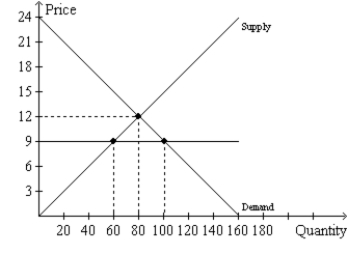 -Refer to Figure 6-14. If the horizontal line on the graph represents a price ceiling, then the price ceiling is
 (Multiple Choice)
4.8/5 (85)
(85) Figure 6-18
The vertical distance between points A and B represents the tax in the market.  -Refer to Figure 6-18. The per-unit burden of the tax on sellers is
 (Multiple Choice)
4.9/5 (90)
(90) Suppose sellers of perfume are required to send $1.00 to the government for every bottle of perfume they sell. Further, suppose this tax causes the price paid by buyers of perfume to rise by $0.60 per bottle. Which of the following statements is correct?
(Multiple Choice)
4.8/5 (75)
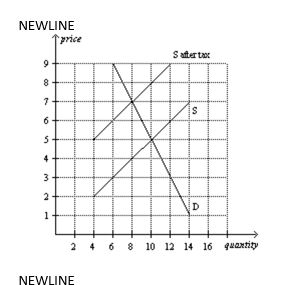
(75) Using the graph shown, answer the following questions.
a. What was the equilibrium price in this market before the tax?
b. What is the amount of the tax?
c. How much of the tax will the buyers pay?
d. How much of the tax will the sellers pay?
e. How much will the buyer pay for the product after the tax is imposed?
f. How much will the seller receive after the tax is imposed?
g. As a result of the tax, what has happened to the level of market activity?
(Essay)
4.8/5 (85)
(85) A tax of $1 on buyers shifts the demand curve downward by exactly $1.
(True/False)
4.7/5 (79)
(79) Figure 6-33  -Refer to Figure 6-33. Suppose a $3 per-unit tax is imposed on the sellers of this good. How much is the burden of this tax on the buyers in this market?
 (Essay)
4.9/5 (79)
(79) Which of the following is not a function of prices in a market system?
(Multiple Choice)
4.8/5 (87)
(87) When a binding price floor is imposed on a market to benefit sellers,
(Multiple Choice)
4.8/5 (72)
(72) Figure 6-6  -Refer to Figure 6-6. Which of the following statements is correct?
 (Multiple Choice)
4.8/5 (80)
(80) Figure 6-8  -Refer to Figure 6-8. If the government imposes a price floor of $5 on this market, then there will be
 (Multiple Choice)
4.8/5 (82)
(82) 
Filters
- Essay(0)
- Multiple Choice(0)
- Short Answer(0)
- True False(0)
- Matching(0)