



 Chat with AI
Exam 3: Where Prices Come From: the Interaction of Demand and Supply

Exam 1: Economics: Foundations and Models447 Questions
Exam 2: Trade-Offs, comparative Advantage, and the Market System492 Questions
Exam 3: Where Prices Come From: the Interaction of Demand and Supply476 Questions
Exam 4: Economic Efficiency, government Price Setting, and Taxes420 Questions
Exam 5: Externalities, environmental Policy, and Public Goods263 Questions
Exam 6: Elasticity: the Responsiveness of Demand and Supply294 Questions
Exam 7: The Economics of Health Care338 Questions
Exam 8: Firms,the Stock Market,and Corporate Governance522 Questions
Exam 9: Comparative Advantage and the Gains From International Trade377 Questions
Exam 10: Consumer Choice and Behavioral Economics300 Questions
Exam 11: Technology,production,and Costs327 Questions
Exam 12: Firms in Perfectly Competitive Markets296 Questions
Exam 13: Monopolistic Competition: the Competitive Model in a More Realistic Setting272 Questions
Exam 14: Oligopoly: Firms in Less Competitive Markets258 Questions
Exam 15: Monopoly and Antitrust Policy279 Questions
Exam 16: Pricing Strategy261 Questions
Exam 17: The Markets for Labor and Other Factors of Production281 Questions
Exam 18: Public Choice, taxes, and the Distribution of Income258 Questions
Exam 19: Gdp: Measuring Total Production and Income261 Questions
Exam 20: Unemployment and Inflation291 Questions
Exam 21: Economic Growth, the Financial System, and Business Cycles253 Questions
Exam 22: Long-Run Economic Growth: Sources and Policies262 Questions
Exam 23: Aggregate Expenditure and Output in the Short Run301 Questions
Exam 24: Aggregate Demand and Aggregate Supply Analysis286 Questions
Exam 25: Money,banks,and the Federal Reserve System281 Questions
Exam 26: Monetary Policy275 Questions
Exam 27: Fiscal Policy306 Questions
Exam 28: Inflation, unemployment, and Federal Reserve Policy257 Questions
Exam 29: Macroeconomics in an Open Economy278 Questions
Exam 30: The International Financial System258 Questions
Select questions type


Suppose that when the price of strawberries decreases,Simone increases her purchase of whipped cream.To Simone
(Multiple Choice)
4.9/5  (82)
(82) An inferior good is a good for which the quantity demanded decreases as the price increases,holding everything else constant.
(True/False)
4.9/5 (87)
(87) The cost of raising beef cattle has risen at the same time as consumer preference for beef has fallen.In the market for beef,this would be represented by the equilibrium price ________ and the equilibrium quantity ________.
(Multiple Choice)
4.7/5 (89)
(89) All else equal,the decrease in the price of complementary products for the Apple Watch,such as Sensoria's wearable technology,would
(Multiple Choice)
4.8/5 (72)
(72) How does the decreasing use of DVD players affect the market for prerecorded DVDs?
(Multiple Choice)
4.9/5 (89)
(89) All else equal,as the price of a product falls,the quantity supplied decreases.
(True/False)
4.9/5 (64)
(64) What would happen in the market for laser eye surgery if insurance companies started to cover a portion of the price of voluntary procedures?
(Multiple Choice)
4.9/5 (80)
(80) Even when the demand for one good is high,the price of the good is also affected by supply.The textbook illustrates this by comparing the price of two items that were auctioned on the same day.Which of the following describes the results of the auction?
(Multiple Choice)
5.0/5 (79)
(79) Draw a demand curve and label it D1.On the graph,illustrate an increase in demand and a decrease in demand,and label the curves D2 and D3,respectively.Starting on demand curve D1,explain the shift that would result from each of the following events:
a.an increase in income and the good is a normal good
b.an increase in income and the good is an inferior good
c.a decrease in the price of a substitute good
d.a decrease in the price of a complementary good
e.an increase in the taste for the good
f.a decrease in population
g.an increase in the expected future price of the good
(Essay)
4.9/5 (70)
(70) Suppose that when the price of hamburgers increases,the Ruiz family increases their purchases of hot dogs.To the Ruiz family
(Multiple Choice)
4.9/5 (82)
(82) Assume that the price for swimming pool maintenance services has risen and sales of these services have fallen.One can conclude that
(Multiple Choice)
4.7/5 (83)
(83) Figure 3-1 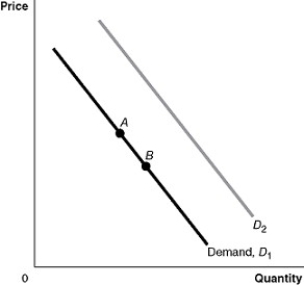 -Refer to Figure 3-1.An increase in population would be represented by a movement from
 (Multiple Choice)
4.8/5 (80)
(80) Figure 3-5  -Refer to Figure 3-5.In a free market such as that depicted above,a shortage is eliminated by
 (Multiple Choice)
4.8/5 (77)
(77) A change in quantity supplied is represented by a movement along the supply curve.
(True/False)
4.8/5 (75)
(75) An decrease in quantity supplied is represented by a leftward shift of the supply curve.
(True/False)
4.8/5 (78)
(78) Figure 3-1
-Refer to Figure 3-1.If the product represented is a normal good,a decrease in income would be represented by a movement from
-Refer to Figure 3-1.If the product represented is a normal good,a decrease in income would be represented by a movement from (Multiple Choice)
5.0/5 (74)
(74) What is the difference between a market equilibrium and a competitive market equilibrium?
(Essay)
5.0/5 (77)
(77) A decrease in the equilibrium price for a product will result
(Multiple Choice)
4.8/5 (80)
(80) Figure 3-8  -Refer to Figure 3-8.The graph in this figure illustrates an initial competitive equilibrium in the market for apples at the intersection of D1 and S1 (point A).If the price of oranges,a substitute for apples,decreases and the wages of apple workers increase,how will the equilibrium point change?
 (Multiple Choice)
4.8/5 (76)
(76) Which of the following has occurred as the millennial generation has come of age?
(Multiple Choice)
4.8/5 (87)
(87) 
Filters
- Essay(0)
- Multiple Choice(0)
- Short Answer(0)
- True False(0)
- Matching(0)