



 Chat with AI
Exam 7: The Economics of Health Care

Exam 1: Economics: Foundations and Models447 Questions
Exam 2: Trade-Offs, comparative Advantage, and the Market System492 Questions
Exam 3: Where Prices Come From: the Interaction of Demand and Supply476 Questions
Exam 4: Economic Efficiency, government Price Setting, and Taxes420 Questions
Exam 5: Externalities, environmental Policy, and Public Goods263 Questions
Exam 6: Elasticity: the Responsiveness of Demand and Supply294 Questions
Exam 7: The Economics of Health Care338 Questions
Exam 8: Firms,the Stock Market,and Corporate Governance522 Questions
Exam 9: Comparative Advantage and the Gains From International Trade377 Questions
Exam 10: Consumer Choice and Behavioral Economics300 Questions
Exam 11: Technology,production,and Costs327 Questions
Exam 12: Firms in Perfectly Competitive Markets296 Questions
Exam 13: Monopolistic Competition: the Competitive Model in a More Realistic Setting272 Questions
Exam 14: Oligopoly: Firms in Less Competitive Markets258 Questions
Exam 15: Monopoly and Antitrust Policy279 Questions
Exam 16: Pricing Strategy261 Questions
Exam 17: The Markets for Labor and Other Factors of Production281 Questions
Exam 18: Public Choice, taxes, and the Distribution of Income258 Questions
Exam 19: Gdp: Measuring Total Production and Income261 Questions
Exam 20: Unemployment and Inflation291 Questions
Exam 21: Economic Growth, the Financial System, and Business Cycles253 Questions
Exam 22: Long-Run Economic Growth: Sources and Policies262 Questions
Exam 23: Aggregate Expenditure and Output in the Short Run301 Questions
Exam 24: Aggregate Demand and Aggregate Supply Analysis286 Questions
Exam 25: Money,banks,and the Federal Reserve System281 Questions
Exam 26: Monetary Policy275 Questions
Exam 27: Fiscal Policy306 Questions
Exam 28: Inflation, unemployment, and Federal Reserve Policy257 Questions
Exam 29: Macroeconomics in an Open Economy278 Questions
Exam 30: The International Financial System258 Questions
Select questions type


Which of the following is not an advantage to an insurance company of insuring a large group of people for health insurance?
(Multiple Choice)
4.7/5  (76)
(76) For many small firms,providing health insurance for their workers
(Multiple Choice)
4.7/5 (72)
(72) The health care system in ________ is referred to as a universal health insurance system,under which every resident is required to enroll in either a private or the government-provided health insurance program.
(Multiple Choice)
4.8/5 (80)
(80) One reason why adverse selection problems arise in health insurance markets is that
(Multiple Choice)
4.8/5 (102)
(102)  Figure 7-5 represents the market for medical services with and without insurance,and the effect of a third-party payer system on the demand for medical services.
-Refer to Figure 7-5.The efficient price of medical services is
Figure 7-5 represents the market for medical services with and without insurance,and the effect of a third-party payer system on the demand for medical services.
-Refer to Figure 7-5.The efficient price of medical services is (Multiple Choice)
4.8/5 (80)
(80) Substantial co-payments are typically not required as a part of the health care system in
(Multiple Choice)
4.8/5 (76)
(76) 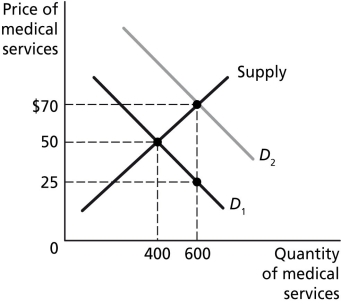 Figure 7-6 represents the supply and demand for medical services with and without a third-party payer.
-Refer to Figure 7-6.Answer the following questions:
1.What would be the equilibrium price and quantity if consumers had to pay the full price of medical services?
2.With insurance acting as a third-party payer,what price will consumers pay for medical service?
3.With insurance acting as a third-party payer,what price will doctors receive for medical service?
4.With insurance acting as a third-party payer,what will be the equilibrium quantity of medical services?
5.With insurance acting as a third-party payer,what will be the value of the deadweight loss?
Figure 7-6 represents the supply and demand for medical services with and without a third-party payer.
-Refer to Figure 7-6.Answer the following questions:
1.What would be the equilibrium price and quantity if consumers had to pay the full price of medical services?
2.With insurance acting as a third-party payer,what price will consumers pay for medical service?
3.With insurance acting as a third-party payer,what price will doctors receive for medical service?
4.With insurance acting as a third-party payer,what will be the equilibrium quantity of medical services?
5.With insurance acting as a third-party payer,what will be the value of the deadweight loss? (Essay)
4.8/5 (78)
(78) The largest government-run health care system in the world,with 1.7 million employees,is the National Health Service (NHS)in the United Kingdom.The NHS receives its funding primarily from
(Multiple Choice)
5.0/5 (73)
(73)  Figure 7-1 represents the market for vaccinations.Vaccinations are considered a benefit to society,and the figure shows both the marginal private benefit and the marginal social benefit from vaccinations.
-Refer to Figure 7-1.The efficient equilibrium price is
Figure 7-1 represents the market for vaccinations.Vaccinations are considered a benefit to society,and the figure shows both the marginal private benefit and the marginal social benefit from vaccinations.
-Refer to Figure 7-1.The efficient equilibrium price is (Multiple Choice)
4.8/5 (65)
(65) In a market with positive externalities,the market equilibrium quantity will be less than the efficient equilibrium quantity.
(True/False)
4.9/5 (65)
(65) Figure 7-5 represents the market for medical services with and without insurance,and the effect of a third-party payer system on the demand for medical services.
-Refer to Figure 7-5.With insurance and a third-party payer system,what price do consumers pay for medical services?
Figure 7-5 represents the market for medical services with and without insurance,and the effect of a third-party payer system on the demand for medical services.
-Refer to Figure 7-5.With insurance and a third-party payer system,what price do consumers pay for medical services? (Multiple Choice)
4.8/5 (85)
(85) Which of the following is not part of the "state health insurance marketplaces" provision of the Patient Protection and Affordable Care Act (ACA)?
(Multiple Choice)
4.8/5 (85)
(85) Which of the following is not an advantage of risk pooling?
(Multiple Choice)
4.8/5 (90)
(90) One effect of adverse selection in a market is that the equilibrium quantity of the product may
be smaller than it would have been if there were no asymmetric information problems.
(True/False)
4.8/5 (87)
(87) Basic supply and demand analysis indicates that having firms rather than the government provide health insurance to workers
(Multiple Choice)
4.7/5 (73)
(73) Article Summary
The Center for Medicare and Medicaid Services (CMS)projects that between 2014 and 2022,over $2.7 trillion will be spent for private insurance overhead and administering government health programs,including more than $270 billion in new administrative costs for the Affordable Care Act,which averages to $1,375 per newly insured person every year,or almost one-quarter of the total federal government expenditures for the program.Government programs account for over $100 billion of the increase in overhead,and most of that will go to private Medicaid HMOs,which will account for 59 percent of total Medicaid administrative costs in 2022.
-Refer to the Article Summary.The article discusses the rising administrative costs of health care.Even if private insurance companies were more efficient and brought administrative costs down,consumers would ________ the full cost of medical treatment.This would result in the market equilibrium price and quantity of medical services being ________ than the efficient equilibrium price and quantity.
(Multiple Choice)
4.9/5 (75)
(75) In a market with positive externalities,the market equilibrium price will be greater than the efficient equilibrium price.
(True/False)
4.8/5 (75)
(75) The provision of the Patient Protection and Affordable Care Act (ACA)which states that insurance companies are required to participate in a high-risk pool that will insure individuals with pre-existing medical conditions who have been unable to buy health insurance for at least six months is the ________ provision.
(Multiple Choice)
4.9/5 (88)
(88) Figure 7-1 represents the market for vaccinations.Vaccinations are considered a benefit to society,and the figure shows both the marginal private benefit and the marginal social benefit from vaccinations.
-Refer to Figure 7-1.The market equilibrium price is
Figure 7-1 represents the market for vaccinations.Vaccinations are considered a benefit to society,and the figure shows both the marginal private benefit and the marginal social benefit from vaccinations.
-Refer to Figure 7-1.The market equilibrium price is (Multiple Choice)
4.8/5 (79)
(79) 
Filters
- Essay(0)
- Multiple Choice(0)
- Short Answer(0)
- True False(0)
- Matching(0)