



 Chat with AI
Exam 9: Comparative Advantage and the Gains From International Trade

Exam 1: Economics: Foundations and Models447 Questions
Exam 2: Trade-Offs, comparative Advantage, and the Market System492 Questions
Exam 3: Where Prices Come From: the Interaction of Demand and Supply476 Questions
Exam 4: Economic Efficiency, government Price Setting, and Taxes420 Questions
Exam 5: Externalities, environmental Policy, and Public Goods263 Questions
Exam 6: Elasticity: the Responsiveness of Demand and Supply294 Questions
Exam 7: The Economics of Health Care338 Questions
Exam 8: Firms,the Stock Market,and Corporate Governance522 Questions
Exam 9: Comparative Advantage and the Gains From International Trade377 Questions
Exam 10: Consumer Choice and Behavioral Economics300 Questions
Exam 11: Technology,production,and Costs327 Questions
Exam 12: Firms in Perfectly Competitive Markets296 Questions
Exam 13: Monopolistic Competition: the Competitive Model in a More Realistic Setting272 Questions
Exam 14: Oligopoly: Firms in Less Competitive Markets258 Questions
Exam 15: Monopoly and Antitrust Policy279 Questions
Exam 16: Pricing Strategy261 Questions
Exam 17: The Markets for Labor and Other Factors of Production281 Questions
Exam 18: Public Choice, taxes, and the Distribution of Income258 Questions
Exam 19: Gdp: Measuring Total Production and Income261 Questions
Exam 20: Unemployment and Inflation291 Questions
Exam 21: Economic Growth, the Financial System, and Business Cycles253 Questions
Exam 22: Long-Run Economic Growth: Sources and Policies262 Questions
Exam 23: Aggregate Expenditure and Output in the Short Run301 Questions
Exam 24: Aggregate Demand and Aggregate Supply Analysis286 Questions
Exam 25: Money,banks,and the Federal Reserve System281 Questions
Exam 26: Monetary Policy275 Questions
Exam 27: Fiscal Policy306 Questions
Exam 28: Inflation, unemployment, and Federal Reserve Policy257 Questions
Exam 29: Macroeconomics in an Open Economy278 Questions
Exam 30: The International Financial System258 Questions
Select questions type


Output per hour Production and Production
of work Consumption without Trade with Trade
Clocks Hats Clocks Hats Clocks Hats Denmark 6 3 900 150 1,200 0 Belize 1 2 150 100 0 400
Denmark and Belize can produce both clocks and hats.Each country has a total of 200 available labor hours for the production of clocks and hats.Table 9-11 shows the output per hour of work,the production and consumption quantities without trade,and the production numbers with trade.
-Refer to Table 9-11.If the actual terms of trade are 1 hat for 1.8 clocks and 150 hats are traded,how many clocks will Belize consume?
(Multiple Choice)
4.9/5  (68)
(68) Berries Fish Rob 20 80 Bill 30 60 Rob Crusoe and Bill Friday spent their week-long vacation on a desert island where they had to find and prepare their own food.Rob and Bill spent one day each fishing and picking berries.The table lists the pounds of output Rob and Bill produced.
-Refer to Table 9-4.Use the table above to select the statement that accurately interprets the data in the table.
(Multiple Choice)
4.9/5 (72)
(72) If Canada imports fishing poles from Mexico and Mexico imports bacon from Canada,which of the following would explain this pattern of trade?
(Multiple Choice)
4.8/5 (85)
(85) Goods and services bought domestically but produced in other countries are referred to as
(Multiple Choice)
4.9/5 (79)
(79) Suppose that American firms claim that protectionism in Canada is on the rise as the Canadian government attempts to protect its infant industries with a "Buy Canadian" provision.This policy,similar to the original "Buy American" provision in the 2009 U.S.stimulus bill,is likely to cause
(Multiple Choice)
4.7/5 (70)
(70) A numerical limit imposed by a government on the quantity of a good that can be imported into the country is called a
(Multiple Choice)
4.8/5 (87)
(87) The World Trade Organization (WTO)promotes foreign trade and investment,or globalization.In recent years opposition to globalization has led to violent protests at meetings of the WTO.All of the following are reasons for these anti-globalization protests except
(Multiple Choice)
4.8/5 (83)
(83) In the 1930s,the United States charged an average tariff rate ________.Today,the rate is ________.
(Multiple Choice)
4.8/5 (82)
(82) Bathing Grooming Linda 60 20 Sandy 50 25 Linda and Sandy own The Preppy Puppy,a dog grooming business.Table 9-1 lists the number of dogs Linda and Sandy can each bathe and groom in one week.
-Refer to Table 9-1.Select the statement that accurately interprets the data in the table.
(Multiple Choice)
4.9/5 (70)
(70) ________ is the ability of an individual,a firm,or a country to produce a good or service at a lower opportunity cost than competitors.
(Multiple Choice)
4.8/5 (75)
(75) Foreign factories produce ________ of the shoes New Balance sells in the United States.
(Multiple Choice)
5.0/5 (76)
(76) Trade restrictions are often motivated by a desire to save domestic jobs threatened by competition from imports.Which of the following counter-arguments is made by economists who oppose trade restrictions?
(Multiple Choice)
4.9/5 (77)
(77)
Output per hour Production and Production
of work Consumption without Trade with Trade
Swords Belts Swords Belts Swords Belts Estonia 5 3 100 40 200 0 Morocco 2 2 60 60 0 120
Estonia and Morocco can produce both swords and belts.Each country has a total of 40 available labor hours for the production of swords and belts.Table 9-12 shows the output per hour of work,the production and consumption quantities without trade,and the production numbers with trade.
-Refer to Table 9-12.If the actual terms of trade are 1 belt for 1.5 swords and 50 belts are traded,how many swords will Estonia gain compared to the "without trade" numbers?
(Multiple Choice)
4.8/5 (78)
(78) 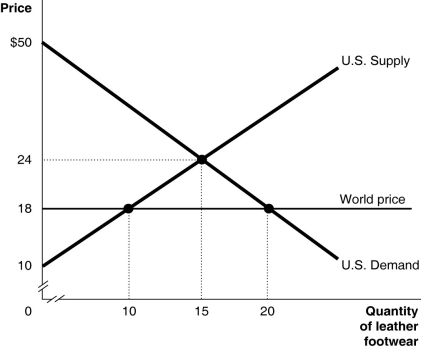 Figure 9-1 shows the U.S.demand and supply for leather footwear.
-Refer to Figure 9-1.Under autarky,the producer surplus is
Figure 9-1 shows the U.S.demand and supply for leather footwear.
-Refer to Figure 9-1.Under autarky,the producer surplus is (Multiple Choice)
4.8/5 (88)
(88) a.What is the World Trade Organization?
b.When was it established?
c.How many countries are members of the World Trade Organization?
(Essay)
4.8/5 (71)
(71) Free trade refers to trade between countries without government restrictions.
(True/False)
4.9/5 (85)
(85) In reaction to the passage of the Smoot-Hawley Tariff,Canada as well as many other U.S.trading partners
(Multiple Choice)
4.8/5 (96)
(96) In the real world,we don't observe countries completely specializing in the production of goods for which they have a comparative advantage.One reasons for this is
(Multiple Choice)
4.7/5 (69)
(69) 
Filters
- Essay(0)
- Multiple Choice(0)
- Short Answer(0)
- True False(0)
- Matching(0)