



 Chat with AI
Exam 14: Oligopoly: Firms in Less Competitive Markets

Exam 1: Economics: Foundations and Models447 Questions
Exam 2: Trade-Offs, comparative Advantage, and the Market System492 Questions
Exam 3: Where Prices Come From: the Interaction of Demand and Supply476 Questions
Exam 4: Economic Efficiency, government Price Setting, and Taxes420 Questions
Exam 5: Externalities, environmental Policy, and Public Goods263 Questions
Exam 6: Elasticity: the Responsiveness of Demand and Supply294 Questions
Exam 7: The Economics of Health Care338 Questions
Exam 8: Firms,the Stock Market,and Corporate Governance522 Questions
Exam 9: Comparative Advantage and the Gains From International Trade377 Questions
Exam 10: Consumer Choice and Behavioral Economics300 Questions
Exam 11: Technology,production,and Costs327 Questions
Exam 12: Firms in Perfectly Competitive Markets296 Questions
Exam 13: Monopolistic Competition: the Competitive Model in a More Realistic Setting272 Questions
Exam 14: Oligopoly: Firms in Less Competitive Markets258 Questions
Exam 15: Monopoly and Antitrust Policy279 Questions
Exam 16: Pricing Strategy261 Questions
Exam 17: The Markets for Labor and Other Factors of Production281 Questions
Exam 18: Public Choice, taxes, and the Distribution of Income258 Questions
Exam 19: Gdp: Measuring Total Production and Income261 Questions
Exam 20: Unemployment and Inflation291 Questions
Exam 21: Economic Growth, the Financial System, and Business Cycles253 Questions
Exam 22: Long-Run Economic Growth: Sources and Policies262 Questions
Exam 23: Aggregate Expenditure and Output in the Short Run301 Questions
Exam 24: Aggregate Demand and Aggregate Supply Analysis286 Questions
Exam 25: Money,banks,and the Federal Reserve System281 Questions
Exam 26: Monetary Policy275 Questions
Exam 27: Fiscal Policy306 Questions
Exam 28: Inflation, unemployment, and Federal Reserve Policy257 Questions
Exam 29: Macroeconomics in an Open Economy278 Questions
Exam 30: The International Financial System258 Questions
Select questions type


The four-firm concentration ratio of the aircraft industry is over 80 percent.Most economists would consider this industry an oligopoly.
(True/False)
4.9/5  (74)
(74) The people firms hire to attempt to convince state legislators and members of Congress to pass laws that are favorable to the economic interests of the firms are called
(Multiple Choice)
4.9/5 (79)
(79) The barrier to entry that allowed Alcoa to make persistent economic profits was ownership of an essential input.
(True/False)
4.7/5 (79)
(79) There are two firms in the residential paint industry,Cool Shades (C)and Warm Hues (W).They collude to share the market equally.They jointly set a monopoly price and split the quantity demanded at that price.Here are their options:
i.They continue to collude (no cheating)and make $12 million each in profits.
ii.One firm cheats and the other does not.The firm that cheats makes a profit of $14 million whereas the firm that doesn't makes a profit of $9 million.
iii.They both cheat and each firm makes a profit of $7 million.
a.Construct a payoff matrix for these two firms.
b.How does this situation relate to the prisoner's dilemma?
c.If each firm acted noncooperatively,how much profit would each make?
d.Are the firms better off colluding (with no cheating)or competing? Explain.
(Essay)
4.9/5 (82)
(82) The justification for occupational licensing laws is that they protect the public from incompetent practitioners (for example,lawyers and medical doctors),but the laws also result in
(Multiple Choice)
4.9/5 (82)
(82) Ocean Spray is considered to be an oligopoly firm because,until the 1990s,it faced little competition in the market for fresh and frozen cranberries.Why?
(Multiple Choice)
4.8/5 (98)
(98) A large majority of the personal computers (PCs)in the United States use an operating system purchased from Microsoft.Microsoft's relationship with PC manufacturers is an example of which of Porter's competitive forces?
(Multiple Choice)
4.9/5 (77)
(77)  Alistair Luggage and Baine Baggage are the only firms selling luggage in the upscale town of Montecito.Each firm must decide on whether to increase its advertising budget to compete for customers.If one firm increases its advertising budget but the other does not,then the firm with the higher advertising budget will increase its profit.Table 14-4 shows the payoff matrix for this advertising game.
-Refer to Table 14-4.If Alistair assumes that Baine would increase its advertising budget,what should it do?
Alistair Luggage and Baine Baggage are the only firms selling luggage in the upscale town of Montecito.Each firm must decide on whether to increase its advertising budget to compete for customers.If one firm increases its advertising budget but the other does not,then the firm with the higher advertising budget will increase its profit.Table 14-4 shows the payoff matrix for this advertising game.
-Refer to Table 14-4.If Alistair assumes that Baine would increase its advertising budget,what should it do? (Multiple Choice)
5.0/5 (76)
(76) Which of the following is not a characteristic of oligopoly?
(Multiple Choice)
4.9/5 (76)
(76) Why are decision trees useful to managers who plan business strategies?
(Multiple Choice)
4.8/5 (77)
(77) According to Porter's Five Competitive Forces Model,similar products produced by different firms within the industry affects a firm's ability to raise prices far more than substitutable products produced outside the industry.
(True/False)
5.0/5 (77)
(77) Figure 14-8 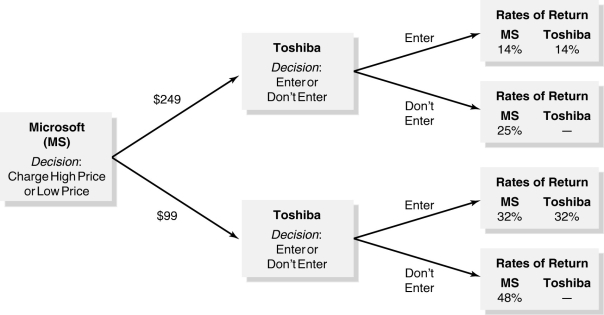 -Refer to Figure 14-8 Use the decision tree to determine whether Microsoft should deter Toshiba from entering the market for electronic book readers (e-readers).Assume that each firm must earn a 20% return on investment to break even.Explain Microsoft's decision process.
 (Essay)
4.8/5 (84)
(84) What is a sequential game? How are decision trees used to analyze sequential games?
(Essay)
4.7/5 (76)
(76) The equilibrium in the prisoner's dilemma is a dominant strategy Nash equilibrium.
(True/False)
4.9/5 (84)
(84) 
Filters
- Essay(0)
- Multiple Choice(0)
- Short Answer(0)
- True False(0)
- Matching(0)