



 Chat with AI
Exam 10: Externalities

Exam 1: Ten Principles of Economics438 Questions
Exam 2: Thinking Like an Economist620 Questions
Exam 3: Interdependence and the Gains From Trade527 Questions
Exam 4: The Market Forces of Supply and Demand700 Questions
Exam 5: Elasticity and Its Application598 Questions
Exam 6: Supply, Demand, and Government Policies648 Questions
Exam 7: Consumers, Producers, and the Efficiency of Markets550 Questions
Exam 8: Application: The Costs of Taxation514 Questions
Exam 9: Application: International Trade496 Questions
Exam 10: Externalities522 Questions
Exam 11: Public Goods and Common Resources434 Questions
Exam 12: The Costs of Production420 Questions
Exam 13: Firms in Competitive Markets543 Questions
Exam 14: Monopoly637 Questions
Exam 15: Measuring a Nations Income522 Questions
Exam 16: Measuring the Cost of Living545 Questions
Exam 17: Production and Growth507 Questions
Exam 18: Saving, Investment, and the Financial System567 Questions
Exam 19: The Basic Tools of Finance513 Questions
Exam 20: Unemployment699 Questions
Exam 21: The Monetary System518 Questions
Exam 22: Money Growth and Inflation487 Questions
Exam 23: Aggregate Demand and Aggregate Supply563 Questions
Exam 24: The Influence of Monetary and Fiscal Policy on Aggregate Demand512 Questions
Select questions type


Using a supply and demand diagram, demonstrate how a positive externality leads to market inefficiency. How might the government help to eliminate this inefficiency?
(Essay)
5.0/5  (76)
(76) Table 10-2
The following table shows the private value, private cost, and social value for a market with a positive externality.
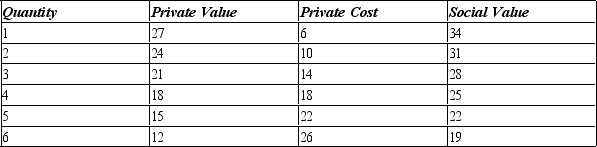 -Refer to Table 10-2. What is the socially-optimal level of output in this market?
 (Multiple Choice)
4.8/5 (89)
(89) A dentist shares an office building with a radio station. The electrical current from the dentist's drill causes static in the radio broadcast, causing the radio station to lose $10,000 in profits. The radio station could put up a shield at a cost of $30,000; the dentist could buy a new drill that causes less interference for $6,000. Either would restore the radio station's lost profits. What is the economically efficient outcome?
(Multiple Choice)
4.7/5 (73)
(73) In some circumstances, selling pollution permits may be better than levying a corrective tax.
(True/False)
4.7/5 (83)
(83) In some situations, private economic actors cannot solve the problem of externalities among themselves because of substantial costs.
(Short Answer)
4.9/5 (83)
(83) An externality arises when a person engages in an activity that influences the well-being of
(Multiple Choice)
4.8/5 (71)
(71) Karen's cat causes Danny to sneeze. Karen values her cat's companionship at $300 per year. The cost to Danny of tissues and her allergy medication is $350 per year. Based on the Coase theorem,
(Multiple Choice)
4.8/5 (90)
(90) An example of a private solution to externalities is charities. The government encourages this private solution by allowing .
(Short Answer)
4.8/5 (74)
(74) When the government intervenes in markets with externalities, it does so in order to
(Multiple Choice)
4.9/5 (76)
(76) Figure 10-4  -Refer to Figure 10-4. If this market is currently producing at Q2, then total economic well-being would increase if output
 (Multiple Choice)
4.9/5 (95)
(95) According to the Coase theorem, whatever the initial distribution of rights, the interested parties can bargain to an efficient outcome.
(True/False)
4.9/5 (85)
(85) When we identify public policies toward externalities, we contrast command-and-control policies with what other type of policies?
(Short Answer)
4.9/5 (81)
(81) Suppose that Company A's railroad cars pass through Farmer B's corn fields. The railroad causes an externality to the farmer because the railroad cars emit sparks that cause $1,500 in damage to the farmer's crops. There is a special soy-based grease that the railroad could purchase that would eliminate the damaging sparks. The grease costs $1,200. Suppose that the farmer has the right to compensation for any damage that his crops suffer. Assume that there are no transaction costs. Which of the following characterizes the efficient outcome?
(Multiple Choice)
4.9/5 (91)
(91) Figure 10-9
 -Refer to Figure 10-9, Panel c). The market equilibrium price is
 (Multiple Choice)
5.0/5 (91)
(91) Figure 10-15  -Refer to Figure 10-15. The supply of pollution permits is
 (Multiple Choice)
4.8/5 (84)
(84) Figure 10-16  -Refer to Figure 10-16. This graph shows the market for pollution when permits are issued to firms and traded in the marketplace. In the absence of a pollution permit system, the quantity of pollution would be
 (Multiple Choice)
4.9/5 (98)
(98) 
Filters
- Essay(0)
- Multiple Choice(0)
- Short Answer(0)
- True False(0)
- Matching(0)