



 Chat with AI
Exam 10: Externalities

Exam 1: Ten Principles of Economics438 Questions
Exam 2: Thinking Like an Economist620 Questions
Exam 3: Interdependence and the Gains From Trade527 Questions
Exam 4: The Market Forces of Supply and Demand700 Questions
Exam 5: Elasticity and Its Application598 Questions
Exam 6: Supply, Demand, and Government Policies648 Questions
Exam 7: Consumers, Producers, and the Efficiency of Markets550 Questions
Exam 8: Application: The Costs of Taxation514 Questions
Exam 9: Application: International Trade496 Questions
Exam 10: Externalities522 Questions
Exam 11: Public Goods and Common Resources434 Questions
Exam 12: The Costs of Production420 Questions
Exam 13: Firms in Competitive Markets543 Questions
Exam 14: Monopoly637 Questions
Exam 15: Measuring a Nations Income522 Questions
Exam 16: Measuring the Cost of Living545 Questions
Exam 17: Production and Growth507 Questions
Exam 18: Saving, Investment, and the Financial System567 Questions
Exam 19: The Basic Tools of Finance513 Questions
Exam 20: Unemployment699 Questions
Exam 21: The Monetary System518 Questions
Exam 22: Money Growth and Inflation487 Questions
Exam 23: Aggregate Demand and Aggregate Supply563 Questions
Exam 24: The Influence of Monetary and Fiscal Policy on Aggregate Demand512 Questions
Select questions type


Because there are positive externalities from higher education,
(Multiple Choice)
4.9/5  (76)
(76) Since almost all forms of transportation produce some type of pollution,
(Multiple Choice)
4.8/5 (84)
(84) Scenario 10-3
 Suppose the equation for the demand curve in a market is
where is the quantity demanded and is the price.


 Also, suppose the equation for the supply curve in the same market is ,
where is the quantity supplied.
 -Refer to Scenario 10-3. Suppose there is an external cost of $12 associated with the production of each unit of the good. What particular tax or subsidy would move the market to the social optimum?
Suppose the equation for the demand curve in a market is
where is the quantity demanded and is the price.
Also, suppose the equation for the supply curve in the same market is ,
where is the quantity supplied.
-Refer to Scenario 10-3. Suppose there is an external cost of $12 associated with the production of each unit of the good. What particular tax or subsidy would move the market to the social optimum? (Short Answer)
4.7/5 (68)
(68) If the production of computer chips yields greater technology spillovers than the production of potato chips, the government should
(Multiple Choice)
4.8/5 (81)
(81) The concept of external benefit is associated with a negative externality, but not with a positive externality.
(True/False)
4.9/5 (74)
(74) Assume that your roommate is very messy. Suppose she gets a $25 benefit from being messy but imposes a $50 cost on you. The Coase theorem would suggest that an efficient solution would be for you to
(Multiple Choice)
4.9/5 (64)
(64) Suppose a certain good provides an external benefit. If the private cost of the last unit of the good that was produced is equal to the social value of that unit, then the sum of producer and consumer surplus is maximized.
(True/False)
4.8/5 (84)
(84) The Coase theorem asserts that private economic actors can solve the problem of externalities among themselves, without government intervention, regardless of whether those actors incur significant costs in reaching and enforcing an agreement.
(True/False)
4.9/5 (86)
(86) Scenario 10-1
The demand curve for gasoline slopes downward and the supply curve for gasoline slopes upward. The production of the 1,000th gallon of gasoline entails the following:
• a private cost of $3.10;
• a social cost of $3.55;
• a value to consumers of $3.70.
-Refer to Scenario 10-1. Suppose the dollar amount of the externality, per gallon of gasoline, is constant, regardless of how much gasoline is produced. Then the externality could be internalized if producers of gasoline were
(Multiple Choice)
4.8/5 (89)
(89) Research into new technologies conveys neither negative externalities nor positive externalities.
(True/False)
4.9/5 (75)
(75) Table 10-2
The following table shows the private value, private cost, and social value for a market with a positive externality.
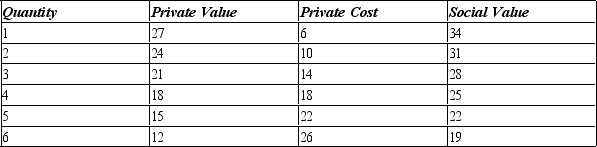 -Refer to Table 10-2. What is the equilibrium quantity of output in this market?
 (Multiple Choice)
4.9/5 (90)
(90) Suppose that electricity producers create a negative externality equal to $5 per unit. Further suppose that the government imposes a $5 per-unit tax on the producers. What is the relationship between the after-tax equilibrium quantity and the socially optimal quantity of electricity to be produced?
(Multiple Choice)
4.9/5 (89)
(89) Figure 10-4  -Refer to Figure 10-4. Without government intervention, the equilibrium quantity would be
 (Multiple Choice)
4.8/5 (87)
(87) In markets, the invisible hand allocates resources efficiently
(Multiple Choice)
4.9/5 (74)
(74) Melissa engages in an activity that influences the well-being of a bystander. In order for Melissa's activity to give rise to an externality, it must be the case that
(Multiple Choice)
4.9/5 (94)
(94) 
Filters
- Essay(0)
- Multiple Choice(0)
- Short Answer(0)
- True False(0)
- Matching(0)