



 Chat with AI
Exam 10: Externalities

Exam 1: Ten Principles of Economics438 Questions
Exam 2: Thinking Like an Economist620 Questions
Exam 3: Interdependence and the Gains From Trade527 Questions
Exam 4: The Market Forces of Supply and Demand700 Questions
Exam 5: Elasticity and Its Application598 Questions
Exam 6: Supply, Demand, and Government Policies648 Questions
Exam 7: Consumers, Producers, and the Efficiency of Markets550 Questions
Exam 8: Application: The Costs of Taxation514 Questions
Exam 9: Application: International Trade496 Questions
Exam 10: Externalities522 Questions
Exam 11: Public Goods and Common Resources434 Questions
Exam 12: The Costs of Production420 Questions
Exam 13: Firms in Competitive Markets543 Questions
Exam 14: Monopoly637 Questions
Exam 15: Measuring a Nations Income522 Questions
Exam 16: Measuring the Cost of Living545 Questions
Exam 17: Production and Growth507 Questions
Exam 18: Saving, Investment, and the Financial System567 Questions
Exam 19: The Basic Tools of Finance513 Questions
Exam 20: Unemployment699 Questions
Exam 21: The Monetary System518 Questions
Exam 22: Money Growth and Inflation487 Questions
Exam 23: Aggregate Demand and Aggregate Supply563 Questions
Exam 24: The Influence of Monetary and Fiscal Policy on Aggregate Demand512 Questions
Select questions type


Table 10-5
The following table shows the marginal costs for each of four firms A, B, C, and D) to eliminate units of pollution from their production processes. For example, for Firm A to eliminate one unit of pollution, it would cost $54, and for Firm A to eliminate a second unit of pollution it would cost an additional $67.
 -Refer to Table 10-5. If the government charged a fee of $84 per unit of pollution, how many units of pollution would the firms eliminate altogether?
 (Multiple Choice)
4.7/5  (62)
(62) Figure 10-19  -Refer to Figure 10-19. Note that the lines labeled "Demand" and "Social Value"are parallel. Also, the slopes of the lines on the graph reflect the following facts: 1) Private value and social value decrease by $1.00 with each additional unit of the good that is consumed, and 2) private cost increases by $1.40 with each additional unit of the good that is produced. Thus, when the 74th unit of the good is produced and consumed, social well-being
 (Multiple Choice)
4.9/5 (78)
(78) Social welfare can be enhanced by allowing firms to trade their rights to pollute.
(True/False)
4.8/5 (73)
(73) Figure 10-3 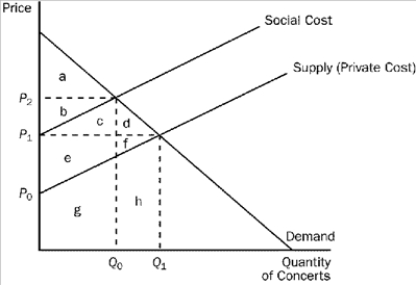 -Refer to Figure 10-3. The difference between the social cost curve and the supply curve reflects the
 (Multiple Choice)
4.8/5 (82)
(82) Using a supply and demand diagram, demonstrate how a negative externality leads to market inefficiency. How might the government help to eliminate this inefficiency?
(Essay)
4.9/5 (60)
(60) Some government policies provide incentives for private decision makers to choose to solve the problem of externalities on their own. What term do we use to describe such policies?
(Essay)
4.8/5 (74)
(74) For the purpose of protecting the environment, upon which of the following approaches do we rely more and more as time goes by?
(Multiple Choice)
4.9/5 (76)
(76) Assume each gallon of gasoline that is produced gives rise to an external cost of $1.25. On any given day, the production of the 10,000th gallon of gasoline entails a private value of $4.00 and a social cost of $3.50. What is the private cost of the 10,000th gallon?
(Essay)
4.8/5 (71)
(71) The likelihood of successful private solutions to problems caused by externalities depends, in part, upon the number of interested parties. Briefly explain.
(Essay)
4.9/5 (72)
(72) Buyers and sellers neglect the external effects of their actions when deciding how much to demand or supply.
(True/False)
5.0/5 (78)
(78) Figure 10-10  -Refer to Figure 10-10. An increase in output from 120 units to 160 units would
 (Multiple Choice)
4.9/5 (95)
(95) Figure 10-11  -Refer to Figure 10-11. Which of the following magnitudes is constant over all units of output?
 (Multiple Choice)
4.8/5 (88)
(88) Barking dogs cannot be considered an externality because externalities must be associated with some form of market exchange.
(True/False)
4.9/5 (77)
(77) Suppose that coal producers create a negative externality equal to $5 per ton of coal. What is the relationship between the equilibrium quantity of coal and the socially optimal quantity of coal?
(Multiple Choice)
4.9/5 (70)
(70) Table 10-6
The following table shows the total costs for each of four firms A, B, C, and D to eliminate units of pollution from their production processes. For example, for Firm A to eliminate one unit of pollution, it would cost $46, and for Firm A to eliminate two units of pollution, it would cost a total of $103.
 -Refer to Table 10-6. Suppose there is presently no pollution fee, and the government wishes to eliminate exactly 8 units of pollution. Which of the following fees per unit of pollution would achieve that goal?
 (Multiple Choice)
4.8/5 (80)
(80) Figure 10-11
-Refer to Figure 10-11. A benevolent social planner would prefer
-Refer to Figure 10-11. A benevolent social planner would prefer (Multiple Choice)
4.9/5 (66)
(66) When externalities are present in a market, the well-being of market participants
(Multiple Choice)
4.9/5 (80)
(80) 
Filters
- Essay(0)
- Multiple Choice(0)
- Short Answer(0)
- True False(0)
- Matching(0)