



 Chat with AI
Exam 10: Externalities

Exam 1: Ten Principles of Economics438 Questions
Exam 2: Thinking Like an Economist620 Questions
Exam 3: Interdependence and the Gains From Trade527 Questions
Exam 4: The Market Forces of Supply and Demand700 Questions
Exam 5: Elasticity and Its Application598 Questions
Exam 6: Supply, Demand, and Government Policies648 Questions
Exam 7: Consumers, Producers, and the Efficiency of Markets550 Questions
Exam 8: Application: The Costs of Taxation514 Questions
Exam 9: Application: International Trade496 Questions
Exam 10: Externalities522 Questions
Exam 11: Public Goods and Common Resources434 Questions
Exam 12: The Costs of Production420 Questions
Exam 13: Firms in Competitive Markets543 Questions
Exam 14: Monopoly637 Questions
Exam 15: Measuring a Nations Income522 Questions
Exam 16: Measuring the Cost of Living545 Questions
Exam 17: Production and Growth507 Questions
Exam 18: Saving, Investment, and the Financial System567 Questions
Exam 19: The Basic Tools of Finance513 Questions
Exam 20: Unemployment699 Questions
Exam 21: The Monetary System518 Questions
Exam 22: Money Growth and Inflation487 Questions
Exam 23: Aggregate Demand and Aggregate Supply563 Questions
Exam 24: The Influence of Monetary and Fiscal Policy on Aggregate Demand512 Questions
Select questions type


To economists, good environmental policy begins by acknowledging one of the Ten Principles of Economics:
(Multiple Choice)
4.8/5  (83)
(83) In the case of a technology spillover, internalizing a positive externality through a government subsidy will cause the industry's supply curve to
(Multiple Choice)
4.7/5 (84)
(84) Figure 10-18. The graph represents a corrective tax to reduce pollution. On the axes, Q denotes the quantity of pollution and P represents the price of pollution.  -Refer to Figure 10-18. The tax depicted on the graph
 (Multiple Choice)
5.0/5 (78)
(78) Scenario 10-2
The demand curve for restored historic buildings slopes downward and the supply curve for restored historic buildings slopes upward. The production of the 50th restored historic building entails the following:
• a private cost of $800,000;
• a private value of $650,000;
• a social value of $800,000.
-Refer to Scenario 10-2. Is there an externality associated with this market? If your answer is "Yes," is the externality positive or negative?
(Short Answer)
4.9/5 (72)
(72) Corrective taxes differ from most taxes in that corrective taxes
(Multiple Choice)
4.8/5 (79)
(79) Figure 10-2. The graph depicts the market for plastic. 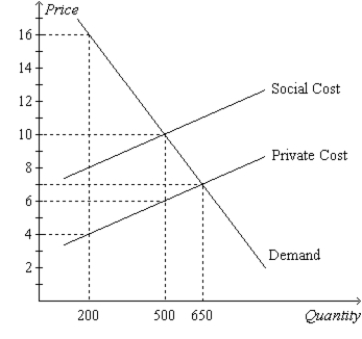 -Refer to Figure 10-2. Suppose that the production of plastic creates a social cost which is depicted in the graph above. What is the socially optimal quantity of plastic?
 (Multiple Choice)
4.8/5 (83)
(83) Figure 10-11  -Refer to Figure 10-11. Which of the following statements is correct?
 (Multiple Choice)
4.7/5 (85)
(85) In Singapore, littering fines are strictly enforced. This is an example of a policy that
(Multiple Choice)
4.9/5 (73)
(73) Government intervention in the economy with the goal of promoting technology-producing industries is known as patent policy.
(True/False)
4.8/5 (77)
(77) In summarizing the research on the externalities associated with driving cars, a 2007 Journal of Economic Literature article concluded that the optimal corrective tax on gasoline in the United States, in 2012 dollars, would be about
(Multiple Choice)
4.8/5 (84)
(84) In many cases the Coase theorem does not work well because
(Multiple Choice)
4.8/5 (88)
(88) Figure 10-9
 -Refer to Figure 10-9, Panel b) and Panel c). The installation of a scrubber in a smokestack reduces the emission of harmful chemicals from the smokestack. Therefore, the external benefit of smokestack scrubber installation is represented by
 (Multiple Choice)
4.9/5 (91)
(91) Figure 10-19  -Refer to Figure 10-19. The socially optimal quantity of output is
 (Multiple Choice)
4.9/5 (78)
(78) According to the Coase theorem, the private market will need government intervention in order to reach an efficient outcome.
(True/False)
5.0/5 (88)
(88) Figure 10-5 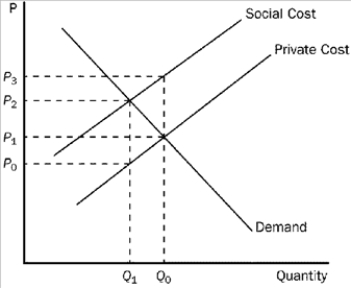 -Refer to Figure 10-5. Which price and quantity combination represents the social optimum?
 (Multiple Choice)
4.9/5 (81)
(81) The Coase theorem asserts that, if externalities are present and if private parties can bargain over the allocation of resources at no cost, then
(Multiple Choice)
4.8/5 (84)
(84) 
Filters
- Essay(0)
- Multiple Choice(0)
- Short Answer(0)
- True False(0)
- Matching(0)