



 Chat with AI
Exam 10: Externalities

Exam 1: Ten Principles of Economics438 Questions
Exam 2: Thinking Like an Economist620 Questions
Exam 3: Interdependence and the Gains From Trade527 Questions
Exam 4: The Market Forces of Supply and Demand700 Questions
Exam 5: Elasticity and Its Application598 Questions
Exam 6: Supply, Demand, and Government Policies648 Questions
Exam 7: Consumers, Producers, and the Efficiency of Markets550 Questions
Exam 8: Application: The Costs of Taxation514 Questions
Exam 9: Application: International Trade496 Questions
Exam 10: Externalities522 Questions
Exam 11: Public Goods and Common Resources434 Questions
Exam 12: The Costs of Production420 Questions
Exam 13: Firms in Competitive Markets543 Questions
Exam 14: Monopoly637 Questions
Exam 15: Measuring a Nations Income522 Questions
Exam 16: Measuring the Cost of Living545 Questions
Exam 17: Production and Growth507 Questions
Exam 18: Saving, Investment, and the Financial System567 Questions
Exam 19: The Basic Tools of Finance513 Questions
Exam 20: Unemployment699 Questions
Exam 21: The Monetary System518 Questions
Exam 22: Money Growth and Inflation487 Questions
Exam 23: Aggregate Demand and Aggregate Supply563 Questions
Exam 24: The Influence of Monetary and Fiscal Policy on Aggregate Demand512 Questions
Select questions type


Abe owns a dog; the dog's barking annoys Abe's neighbor, Jenny. Suppose that the benefit of owning the dog is worth $200 to Abe and that Jenny bears a cost of $400 from the barking. Assuming Abe has the legal right to keep the dog, a possible private solution to this problem is that
(Multiple Choice)
4.9/5  (73)
(73) Figure 10-1 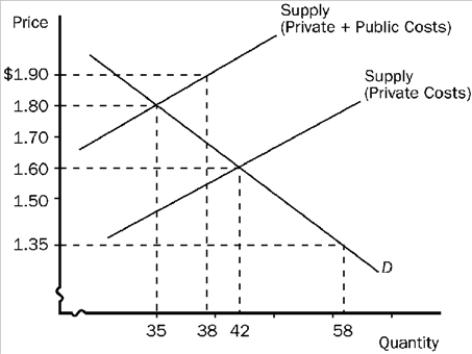 -Refer to Figure 10-1. This graph represents the tobacco industry. The industry creates
 (Multiple Choice)
4.8/5 (88)
(88) Which of the following is not a necessary condition for the Coase theorem?
(Multiple Choice)
4.8/5 (93)
(93) Since restored historic buildings convey a positive externality, local governments may choose to
(Multiple Choice)
4.9/5 (86)
(86) The Coase theorem asserts that the private market will always solve the problem of externalities and allocate resources efficiently
(Multiple Choice)
4.8/5 (74)
(74) Table 10-5
The following table shows the marginal costs for each of four firms A, B, C, and D) to eliminate units of pollution from their production processes. For example, for Firm A to eliminate one unit of pollution, it would cost $54, and for Firm A to eliminate a second unit of pollution it would cost an additional $67.
 -Refer to Table 10-5. If the government wanted to reduce pollution from 16 units to 6 units, which of the following fees per unit of pollution would achieve that goal?
 (Multiple Choice)
4.9/5 (82)
(82) Figure 10-12  -Refer to Figure 10-12. The graph, as drawn, could apply to the market for
 (Multiple Choice)
4.7/5 (75)
(75) Scenario 10-1
The demand curve for gasoline slopes downward and the supply curve for gasoline slopes upward. The production of the 1,000th gallon of gasoline entails the following:
• a private cost of $3.10;
• a social cost of $3.55;
• a value to consumers of $3.70.
-Refer to Scenario 10-1. Let Q represent the number of gallons of gasoline and let P represent the price of a gallon of gasoline. Which of the following statements is correct?
(Multiple Choice)
4.8/5 (64)
(64) Figure 10-4 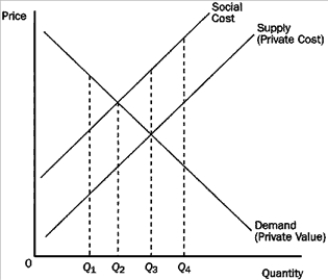 -Refer to Figure 10-4. If all external costs were internalized, then the market's equilibrium output would be
 (Multiple Choice)
5.0/5 (75)
(75) At any given quantity, the willingness to pay of the marginal buyer is the height of the _______.
(Short Answer)
4.8/5 (73)
(73) Suppose that flu shots create a positive externality equal to $12 per shot. What is the relationship between the equilibrium quantity and the socially optimal quantity of flu shots produced?
(Multiple Choice)
4.8/5 (75)
(75) Which of the following policies is the government most inclined to use when faced with a positive externality?
(Multiple Choice)
4.8/5 (77)
(77) Some environmentalists argue that we should protect the environment as much as possible, regardless of cost. Which of the following is not a likely outcome of pursuing such a course of action?
(Multiple Choice)
4.9/5 (74)
(74) Figure 10-10  -Refer to Figure 10-10. Which of the following statements is correct?
 (Multiple Choice)
4.8/5 (84)
(84) Suppose that flower gardens create a positive externality equal to $1 per plant. What is the relationship between the equilibrium quantity and the socially optimal quantity of plants grown?
(Multiple Choice)
4.9/5 (86)
(86) Which of the following illustrates the concept of a negative externality?
(Multiple Choice)
5.0/5 (93)
(93) 
Filters
- Essay(0)
- Multiple Choice(0)
- Short Answer(0)
- True False(0)
- Matching(0)