



 Chat with AI
Exam 10: Externalities

Exam 1: Ten Principles of Economics438 Questions
Exam 2: Thinking Like an Economist620 Questions
Exam 3: Interdependence and the Gains From Trade527 Questions
Exam 4: The Market Forces of Supply and Demand700 Questions
Exam 5: Elasticity and Its Application598 Questions
Exam 6: Supply, Demand, and Government Policies648 Questions
Exam 7: Consumers, Producers, and the Efficiency of Markets550 Questions
Exam 8: Application: The Costs of Taxation514 Questions
Exam 9: Application: International Trade496 Questions
Exam 10: Externalities522 Questions
Exam 11: Public Goods and Common Resources434 Questions
Exam 12: The Costs of Production420 Questions
Exam 13: Firms in Competitive Markets543 Questions
Exam 14: Monopoly637 Questions
Exam 15: Measuring a Nations Income522 Questions
Exam 16: Measuring the Cost of Living545 Questions
Exam 17: Production and Growth507 Questions
Exam 18: Saving, Investment, and the Financial System567 Questions
Exam 19: The Basic Tools of Finance513 Questions
Exam 20: Unemployment699 Questions
Exam 21: The Monetary System518 Questions
Exam 22: Money Growth and Inflation487 Questions
Exam 23: Aggregate Demand and Aggregate Supply563 Questions
Exam 24: The Influence of Monetary and Fiscal Policy on Aggregate Demand512 Questions
Select questions type


Table 10-3
 -Refer to Table 10-3. What amount of subsidy per unit of output would move the market from the equilibrium level of output to the socially optimal level of output?
 (Multiple Choice)
4.8/5  (91)
(91) Laws that are passed that either require or forbid certain behaviors are examples of command-and-control policies.
(True/False)
4.8/5 (82)
(82) Figure 10-9
 -Refer to Figure 10-9. The overuse of antibiotics leads to the development of antibiotic-resistant diseases. Therefore, the market for antibiotics is shown in
 (Multiple Choice)
4.9/5 (82)
(82) Which of the following is an example of a positive externality?
(Multiple Choice)
4.9/5 (86)
(86) Figure 10-7 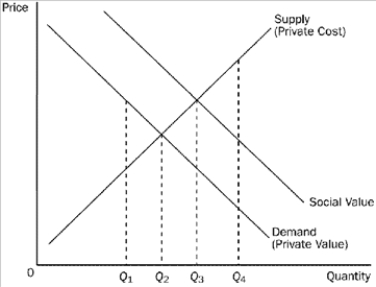 -Refer to Figure 10-7. To internalize the externality in this market, the government should
 (Multiple Choice)
4.8/5 (85)
(85) Table 10-6
The following table shows the total costs for each of four firms A, B, C, and D to eliminate units of pollution from their production processes. For example, for Firm A to eliminate one unit of pollution, it would cost $46, and for Firm A to eliminate two units of pollution, it would cost a total of $103.
 -Refer to Table 10-6. If the government charged a fee of $85 per unit of pollution, how many units of pollution would the firms eliminate altogether?
 (Multiple Choice)
4.9/5 (85)
(85) Some policies toward externalities provide incentives so that private decision makers will choose to solve the problem on their own. What name do we use for these types of policies?
(Short Answer)
4.8/5 (73)
(73) Use a graph to illustrate the quantity of pollution that would be emitted a) after a corrective tax has been imposed and b) after tradable pollution permits have been imposed. Could these two quantities ever be equivalent?
(Essay)
4.8/5 (83)
(83) Corrective taxes are more efficient than regulations for keeping the environment clean.
(True/False)
4.8/5 (66)
(66) To enhance the well-being of society, a social planner will encourage firms to increase production when
(Multiple Choice)
4.9/5 (65)
(65) Suppose the market-equilibrium quantity of good x is 5,000 units and the socially-optimal quantity of good x is 4,000 units. Then
(Multiple Choice)
5.0/5 (87)
(87) The least expensive way to clean up the environment is for all firms to reduce pollution by an equal percentage.
(True/False)
4.9/5 (87)
(87) Which of the following is an advantage of tradable pollution permits?
(Multiple Choice)
4.9/5 (86)
(86) Figure 10-15  -Refer to Figure 10-15. Which of the following is not necessary in order for the corrective tax and pollution permit to have equivalent effects?
 (Multiple Choice)
4.9/5 (71)
(71) Corrective taxes are typically advocated to correct for the effects of
(Multiple Choice)
5.0/5 (91)
(91) Table 10-3
-Refer to Table 10-3. Taking into account private and external costs, the maximum total surplus that can be achieved in this market is
-Refer to Table 10-3. Taking into account private and external costs, the maximum total surplus that can be achieved in this market is (Multiple Choice)
5.0/5 (74)
(74) 
Filters
- Essay(0)
- Multiple Choice(0)
- Short Answer(0)
- True False(0)
- Matching(0)