



 Chat with AI
Exam 2: The Chemical Context of Life

Exam 1: Introduction: Evolution and the Foundations of Biology36 Questions
Exam 2: The Chemical Context of Life137 Questions
Exam 3: Carbon and the Molecular Diversity of Life136 Questions
Exam 4: A Tour of the Cell75 Questions
Exam 5: Membrane Transport and Cell Signaling97 Questions
Exam 6: An Introduction to Metabolism79 Questions
Exam 7: Cellular Respiration and Fermentation100 Questions
Exam 8: Photosynthesis72 Questions
Exam 9: The Cell Cycle56 Questions
Exam 10: Meiosis and Sexual Life Cycles62 Questions
Exam 11: Mendel and the Gene Idea63 Questions
Exam 12: The Chromosomal Basis of Inheritance46 Questions
Exam 13: The Molecular Basis of Inheritance67 Questions
Exam 14: Gene Expression: From Gene to Protein80 Questions
Exam 15: Regulation of Gene Expression50 Questions
Exam 16: Development, Stem Cells, and Cancer34 Questions
Exam 17: Viruses35 Questions
Exam 18: Genomes and Their Evolution29 Questions
Exam 19: Descent With Modification55 Questions
Exam 20: Phylogeny60 Questions
Exam 21: The Evolution of Populations70 Questions
Exam 22: The Origin of Species67 Questions
Exam 23: Broad Patterns of Evolution45 Questions
Exam 24: Early Life and the Diversification of Prokaryotes88 Questions
Exam 25: The Origin and Diversification of Eukaryotes71 Questions
Exam 26: The Colonization of Land by Plants and Fungi126 Questions
Exam 27: The Rise of Animal Diversity88 Questions
Exam 28: Plant Structure and Growth59 Questions
Exam 29: Resource Acquisition, Nutrition, and Transport in Vascular Plants110 Questions
Exam 30: Reproduction and Domestication of Flowering Plants67 Questions
Exam 31: Plant Responses to Internal and External Signals75 Questions
Exam 32: Homeostasis and Endocrine Signaling120 Questions
Exam 33: Animal Nutrition67 Questions
Exam 34: Circulation and Gas Exchange88 Questions
Exam 35: The Immune System91 Questions
Exam 36: Reproduction and Development118 Questions
Exam 37: Neurons, Synapses, and Signaling76 Questions
Exam 38: Nervous and Sensory Systems99 Questions
Exam 39: Motor Mechanisms and Behavior79 Questions
Exam 40: Population Ecology and the Distribution of Organisms93 Questions
Exam 41: Species Interactions60 Questions
Exam 42: Ecosystems and Energy90 Questions
Exam 43: Global Ecology and Conservation Biology72 Questions
Select questions type


How would acidification of seawater affect marine organisms?
(Multiple Choice)
4.9/5  (74)
(74)  Figure 2.6
-Which of the atoms shown would be most likely to form an anion with a charge of -1?
Figure 2.6
-Which of the atoms shown would be most likely to form an anion with a charge of -1? (Multiple Choice)
4.8/5 (74)
(74) You have two beakers. One contains pure water; the other contains pure methanol (wood alcohol). The covalent bonds of methanol molecules are nonpolar, so there are no hydrogen bonds among methanol molecules. You pour crystals of table salt (NaCl) into each beaker. Predict what will happen.
(Multiple Choice)
4.7/5 (61)
(61) Sulfur is in the same column of the periodic table as oxygen but has electronegativity similar to carbon. Compared to water molecules, molecules of H2S will
(Multiple Choice)
4.9/5 (80)
(80) If acid rain has lowered the pH of a particular lake to pH 4.0, which of the following statements about this lake is true?
(Multiple Choice)
4.9/5 (81)
(81) What is the hydroxyl ion (OH-) concentration of a solution of pH 8?
(Multiple Choice)
4.7/5 (60)
(60) 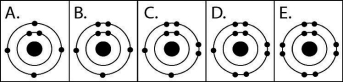 Figure 2.3
-Which drawing in Figure 2.3 depicts the electron configuration of an element with chemical properties most similar to those of helium (2He)?
Figure 2.3
-Which drawing in Figure 2.3 depicts the electron configuration of an element with chemical properties most similar to those of helium (2He)? (Multiple Choice)
4.9/5 (87)
(87)  Figure 2.4
-How many neutrons are present in the nucleus of a phosphorus-32 (32P) atom (see Figure 2.4)?
Figure 2.4
-How many neutrons are present in the nucleus of a phosphorus-32 (32P) atom (see Figure 2.4)? (Multiple Choice)
4.9/5 (79)
(79) Figure 2.4
-In Figure 2.4, how many electrons does nitrogen have in its valence shell?
Figure 2.4
-In Figure 2.4, how many electrons does nitrogen have in its valence shell? (Multiple Choice)
4.7/5 (79)
(79) How many electron pairs are shared between carbon atoms in a molecule that has the formula C2H4?
(Multiple Choice)
4.9/5 (73)
(73)  Figure 2.8
-How many grams of the compound in Figure 2.8 would be required to make 1 L of a 0.5 M solution?
(carbon = 12, oxygen = 16, hydrogen = 1)
Figure 2.8
-How many grams of the compound in Figure 2.8 would be required to make 1 L of a 0.5 M solution?
(carbon = 12, oxygen = 16, hydrogen = 1) (Multiple Choice)
5.0/5 (85)
(85) Trace elements are those required by an organism in only minute quantities. Which of the following is a trace element that is required by humans and other vertebrates?
(Multiple Choice)
4.9/5 (82)
(82) In an aqueous solution, water molecules associate with one another through which of the following?
(Multiple Choice)
4.8/5 (76)
(76) An equal volume (5 mL) of vinegar from a freshly opened bottle is added to each of the following solutions. After complete mixing, which of the mixtures will have the highest pH?
(Multiple Choice)
4.9/5 (92)
(92) Figure 2.3
-Which drawing in Figure 2.3 depicts an atom with a valence of 3?
Figure 2.3
-Which drawing in Figure 2.3 depicts an atom with a valence of 3? (Multiple Choice)
4.8/5 (86)
(86) Two atoms that have the same mass number must have the same
(Multiple Choice)
4.8/5 (85)
(85) How many glucose molecules are contained in 0.1 liter of a 10 M solution of glucose in water?
(Multiple Choice)
4.8/5 (78)
(78) 
Filters
- Essay(0)
- Multiple Choice(0)
- Short Answer(0)
- True False(0)
- Matching(0)