



 Chat with AI
Exam 22: The Origin of Species

Exam 1: Introduction: Evolution and the Foundations of Biology36 Questions
Exam 2: The Chemical Context of Life137 Questions
Exam 3: Carbon and the Molecular Diversity of Life136 Questions
Exam 4: A Tour of the Cell75 Questions
Exam 5: Membrane Transport and Cell Signaling97 Questions
Exam 6: An Introduction to Metabolism79 Questions
Exam 7: Cellular Respiration and Fermentation100 Questions
Exam 8: Photosynthesis72 Questions
Exam 9: The Cell Cycle56 Questions
Exam 10: Meiosis and Sexual Life Cycles62 Questions
Exam 11: Mendel and the Gene Idea63 Questions
Exam 12: The Chromosomal Basis of Inheritance46 Questions
Exam 13: The Molecular Basis of Inheritance67 Questions
Exam 14: Gene Expression: From Gene to Protein80 Questions
Exam 15: Regulation of Gene Expression50 Questions
Exam 16: Development, Stem Cells, and Cancer34 Questions
Exam 17: Viruses35 Questions
Exam 18: Genomes and Their Evolution29 Questions
Exam 19: Descent With Modification55 Questions
Exam 20: Phylogeny60 Questions
Exam 21: The Evolution of Populations70 Questions
Exam 22: The Origin of Species67 Questions
Exam 23: Broad Patterns of Evolution45 Questions
Exam 24: Early Life and the Diversification of Prokaryotes88 Questions
Exam 25: The Origin and Diversification of Eukaryotes71 Questions
Exam 26: The Colonization of Land by Plants and Fungi126 Questions
Exam 27: The Rise of Animal Diversity88 Questions
Exam 28: Plant Structure and Growth59 Questions
Exam 29: Resource Acquisition, Nutrition, and Transport in Vascular Plants110 Questions
Exam 30: Reproduction and Domestication of Flowering Plants67 Questions
Exam 31: Plant Responses to Internal and External Signals75 Questions
Exam 32: Homeostasis and Endocrine Signaling120 Questions
Exam 33: Animal Nutrition67 Questions
Exam 34: Circulation and Gas Exchange88 Questions
Exam 35: The Immune System91 Questions
Exam 36: Reproduction and Development118 Questions
Exam 37: Neurons, Synapses, and Signaling76 Questions
Exam 38: Nervous and Sensory Systems99 Questions
Exam 39: Motor Mechanisms and Behavior79 Questions
Exam 40: Population Ecology and the Distribution of Organisms93 Questions
Exam 41: Species Interactions60 Questions
Exam 42: Ecosystems and Energy90 Questions
Exam 43: Global Ecology and Conservation Biology72 Questions
Select questions type


Please use the following information to answer the question(s) below.
In the ocean, on either side of the Isthmus of Panama, are 30 species of snapping shrimp; some are shallow-water species, and others are adapted to deep water. There are 15 species on the Pacific side and 15 different species on the Atlantic side. The Isthmus of Panama started rising about 10 million years ago.
In Figure 22.1, the isthmus separates the Pacific Ocean on the left (side A) from the Atlantic Ocean on the right (side B). The seawater on either side of the isthmus is separated into five depth habitats (1-5), with 1 being the shallowest. 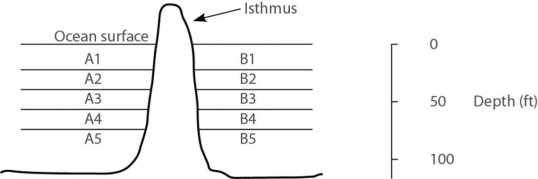 Figure 22.1
-Which of these habitats is likely to harbor the youngest species?
Figure 22.1
-Which of these habitats is likely to harbor the youngest species?
Free
(Multiple Choice)
4.8/5  (87)
(87) Correct Answer: Verified
E
There is still some controversy among biologists about whether Neanderthals should be placed within the same species as modern humans or into a separate species of their own. Most DNA sequence data analyzed so far indicate that there was probably little or no gene flow between Neanderthals and Homo sapiens. Which species concept is most applicable in this example?
Free
(Multiple Choice)
4.8/5 (78)
(78) Correct Answer:Verified
VerifiedA
Two species of frogs belonging to the same genus occasionally mate, but the offspring fail to develop and hatch. What is the mechanism for keeping the two frog species separate?
Free
(Multiple Choice)
4.8/5 (82)
(82) Correct Answer:Verified
VerifiedA
Please use the following information to answer the question(s) below.
On the Bahamian island of Andros, mosquitofish populations live in various, now-isolated, freshwater ponds that were once united. Currently, some predator-rich ponds have mosquitofish that can swim in short, fast bursts; other predator-poor ponds have mosquitofish that can swim continuously for a long time. When placed together in the same body of water, the two kinds of female mosquitofish exhibit exclusive breeding preferences.
-In the ocean, on either side of the Isthmus of Panama, are 30 species of snapping shrimp; some are shallow-water species, and others are adapted to deep water. There are 15 species on the Pacific side and 15 different species on the Atlantic side. The Isthmus of Panama started rising about 10 million years ago. The oceans were completely separated by the isthmus about 3 million years ago.
Why should deepwater shrimp on different sides of the isthmus have diverged from each other earlier than shallow-water shrimp?
(Multiple Choice)
4.8/5 (66)
(66) In a hypothetical situation, a certain species of flea feeds only on pronghorn antelopes. In rangelands of the western United States, pronghorns and cattle often associate with one another. If some of these fleas develop a strong preference for cattle blood and mate only with other fleas that prefer cattle blood, then over time which of these should occur, if the host mammal can be considered as the fleas' habitat?
1) reproductive isolation
2) sympatric speciation
3) habitat isolation
4) prezygotic barriers
(Multiple Choice)
4.9/5 (80)
(80) After geographic separation, what process would be the last step before reproductive isolation?
(Multiple Choice)
4.7/5 (77)
(77) Which of the following reproductive types of isolation illustrates postzygotic barriers?
(Multiple Choice)
4.8/5 (77)
(77) Please use the following information to answer the question(s) below.
In the ocean, on either side of the Isthmus of Panama, are 30 species of snapping shrimp; some are shallow-water species, and others are adapted to deep water. There are 15 species on the Pacific side and 15 different species on the Atlantic side. The Isthmus of Panama started rising about 10 million years ago.
In Figure 22.1, the isthmus separates the Pacific Ocean on the left (side A) from the Atlantic Ocean on the right (side B). The seawater on either side of the isthmus is separated into five depth habitats (1-5), with 1 being the shallowest. Figure 22.1
-There are currently two large, permanent bridges that span the Panama Canal. The bridges are about 8 miles apart. If snapping shrimp avoid swimming at night and avoid swimming under shadows, then what do these bridges represent for the snapping shrimp?
Figure 22.1
-There are currently two large, permanent bridges that span the Panama Canal. The bridges are about 8 miles apart. If snapping shrimp avoid swimming at night and avoid swimming under shadows, then what do these bridges represent for the snapping shrimp? (Multiple Choice)
4.9/5 (80)
(80) Which of these should decline in hybrid zones where reinforcement is occurring?
(Multiple Choice)
4.8/5 (75)
(75) Please use the following information to answer the question(s) below.
On the volcanic, equatorial West African island of Sao Tomé, two species of fruit fly exist. Drosophila yakuba inhabits the island's lowlands and is also found on the African mainland, located about 200 miles away. At higher elevations, and only on Sao Tomé, is found the very closely related Drosophila santomea. The two species can hybridize, though male hybrids are sterile. A hybrid zone exists at middle elevations, though hybrids there are greatly outnumbered by D. santomea. Studies of the two species' nuclear genomes reveal that D. yakuba on the island is more closely related to mainland D. yakuba than to D. santomea (2n = 4 in both species). Sao Tomé rose from the Atlantic Ocean about 14 million years ago.
-You find a plant that is larger than others in your wheat field. When you examine the chromosomes of this plant during cell division, you observe that the cells have double chromosome numbers of the other wheat plants. You conclude that this is an autopolyploid plant representing a new biological species in your wheat field when you observe
(Multiple Choice)
4.8/5 (90)
(90) The most likely explanation for the recent decline in cichlid species diversity in Lake Victoria is
(Multiple Choice)
4.8/5 (71)
(71) The following question(s) refer to the evolutionary tree in Figure 22.4, whose horizontal axis represents time (present time is on the far right) and whose vertical axis represents morphological change. 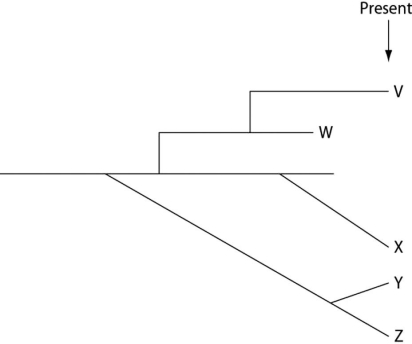 Figure 22.4
-Which of these five species is the extant (that is, not extinct) species that is most closely related to species X, and why is this so?
Figure 22.4
-Which of these five species is the extant (that is, not extinct) species that is most closely related to species X, and why is this so? (Multiple Choice)
4.9/5 (78)
(78) Which one of the following choices describes an advantage of the biological species concept?
(Multiple Choice)
4.9/5 (96)
(96) Dogs (Canis lupus familiaris) and gray wolves (Canis lupus) can interbreed to produce viable, fertile offspring. These species shared a common ancestor recently (in geologic time) and have a high degree of genetic similarity, although their anatomies vary widely. Judging from this evidence, which two species concepts are most likely to place dogs and wolves together into a single species?
(Multiple Choice)
5.0/5 (85)
(85) Which of the following factors would not contribute to allopatric speciation?
(Multiple Choice)
4.8/5 (72)
(72) The largest unit within which gene flow can readily occur is a
(Multiple Choice)
4.8/5 (82)
(82) Please use the following information to answer the question(s) below.
On the volcanic, equatorial West African island of Sao Tomé, two species of fruit fly exist. Drosophila yakuba inhabits the island's lowlands and is also found on the African mainland, located about 200 miles away. At higher elevations, and only on Sao Tomé, is found the very closely related Drosophila santomea. The two species can hybridize, though male hybrids are sterile. A hybrid zone exists at middle elevations, though hybrids there are greatly outnumbered by D. santomea. Studies of the two species' nuclear genomes reveal that D. yakuba on the island is more closely related to mainland D. yakuba than to D. santomea (2n = 4 in both species). Sao Tomé rose from the Atlantic Ocean about 14 million years ago.
-Using only the information provided in the paragraph, which of the following is the best initial hypothesis for how D. santomea descended from D. yakuba?
(Multiple Choice)
4.9/5 (71)
(71) Please use the following information to answer the question(s) below.
In the ocean, on either side of the Isthmus of Panama, are 30 species of snapping shrimp; some are shallow-water species, and others are adapted to deep water. There are 15 species on the Pacific side and 15 different species on the Atlantic side. The Isthmus of Panama started rising about 10 million years ago.
In Figure 22.1, the isthmus separates the Pacific Ocean on the left (side A) from the Atlantic Ocean on the right (side B). The seawater on either side of the isthmus is separated into five depth habitats (1-5), with 1 being the shallowest. Figure 22.1
-Which habitats should harbor snapping shrimp species with the greatest degree of genetic divergence from each other?
Figure 22.1
-Which habitats should harbor snapping shrimp species with the greatest degree of genetic divergence from each other? (Multiple Choice)
4.8/5 (65)
(65) 
Filters
- Essay(0)
- Multiple Choice(0)
- Short Answer(0)
- True False(0)
- Matching(0)