



 Chat with AI
Exam 22: The Origin of Species

Exam 1: Introduction: Evolution and the Foundations of Biology36 Questions
Exam 2: The Chemical Context of Life137 Questions
Exam 3: Carbon and the Molecular Diversity of Life136 Questions
Exam 4: A Tour of the Cell75 Questions
Exam 5: Membrane Transport and Cell Signaling97 Questions
Exam 6: An Introduction to Metabolism79 Questions
Exam 7: Cellular Respiration and Fermentation100 Questions
Exam 8: Photosynthesis72 Questions
Exam 9: The Cell Cycle56 Questions
Exam 10: Meiosis and Sexual Life Cycles62 Questions
Exam 11: Mendel and the Gene Idea63 Questions
Exam 12: The Chromosomal Basis of Inheritance46 Questions
Exam 13: The Molecular Basis of Inheritance67 Questions
Exam 14: Gene Expression: From Gene to Protein80 Questions
Exam 15: Regulation of Gene Expression50 Questions
Exam 16: Development, Stem Cells, and Cancer34 Questions
Exam 17: Viruses35 Questions
Exam 18: Genomes and Their Evolution29 Questions
Exam 19: Descent With Modification55 Questions
Exam 20: Phylogeny60 Questions
Exam 21: The Evolution of Populations70 Questions
Exam 22: The Origin of Species67 Questions
Exam 23: Broad Patterns of Evolution45 Questions
Exam 24: Early Life and the Diversification of Prokaryotes88 Questions
Exam 25: The Origin and Diversification of Eukaryotes71 Questions
Exam 26: The Colonization of Land by Plants and Fungi126 Questions
Exam 27: The Rise of Animal Diversity88 Questions
Exam 28: Plant Structure and Growth59 Questions
Exam 29: Resource Acquisition, Nutrition, and Transport in Vascular Plants110 Questions
Exam 30: Reproduction and Domestication of Flowering Plants67 Questions
Exam 31: Plant Responses to Internal and External Signals75 Questions
Exam 32: Homeostasis and Endocrine Signaling120 Questions
Exam 33: Animal Nutrition67 Questions
Exam 34: Circulation and Gas Exchange88 Questions
Exam 35: The Immune System91 Questions
Exam 36: Reproduction and Development118 Questions
Exam 37: Neurons, Synapses, and Signaling76 Questions
Exam 38: Nervous and Sensory Systems99 Questions
Exam 39: Motor Mechanisms and Behavior79 Questions
Exam 40: Population Ecology and the Distribution of Organisms93 Questions
Exam 41: Species Interactions60 Questions
Exam 42: Ecosystems and Energy90 Questions
Exam 43: Global Ecology and Conservation Biology72 Questions
Select questions type


Which of the following statements about species, as defined by the biological species concept, is (are) correct?
I. Biological species are defined by reproductive isolation.
II. Biological species are the models used for grouping extinct forms of life.
III. The biological species is the largest unit of population in which successful interbreeding is possible.
(Multiple Choice)
4.9/5  (79)
(79) The origin of a new plant species by hybridization, coupled with accidents during cell division, is an example of
(Multiple Choice)
4.9/5 (80)
(80) Please use the following information to answer the question(s) below.
On the Bahamian island of Andros, mosquitofish populations live in various, now-isolated, freshwater ponds that were once united. Currently, some predator-rich ponds have mosquitofish that can swim in short, fast bursts; other predator-poor ponds have mosquitofish that can swim continuously for a long time. When placed together in the same body of water, the two kinds of female mosquitofish exhibit exclusive breeding preferences.
-If one builds a canal linking a predator-rich pond to a predator-poor pond, then what type of selection should subsequently be most expected among the mosquitofish in the original predator-rich pond, and what type should be most expected among the mosquitofish in the formerly predator-poor pond?
(Multiple Choice)
4.9/5 (74)
(74) The following question(s) refer to the evolutionary tree in Figure 22.4, whose horizontal axis represents time (present time is on the far right) and whose vertical axis represents morphological change. 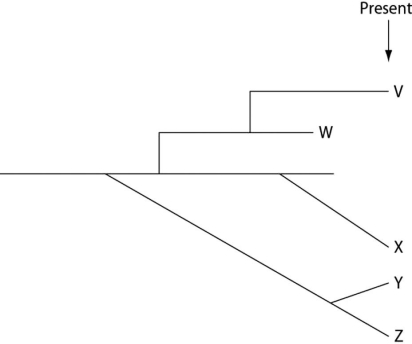 Figure 22.4
-
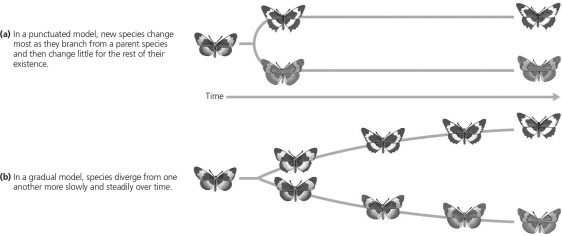 Figure 22.7
Two models for the speed of speciation are based on patterns in the fossil record. Which of the following statements describes the gradual model of evolution?
Figure 22.4
- Figure 22.7
Two models for the speed of speciation are based on patterns in the fossil record. Which of the following statements describes the gradual model of evolution? (Multiple Choice)
4.9/5 (76)
(76) You are confronted with a box of preserved grasshoppers of various species that are new to science and have not been described. Your assignment is to separate them into species. There is no accompanying information as to where or when they were collected. Which species concept will you have to use?
(Multiple Choice)
4.8/5 (65)
(65) 
Filters
- Essay(0)
- Multiple Choice(0)
- Short Answer(0)
- True False(0)
- Matching(0)