



 Chat with AI
Exam 22: The Origin of Species

Exam 1: Introduction: Evolution and the Foundations of Biology36 Questions
Exam 2: The Chemical Context of Life137 Questions
Exam 3: Carbon and the Molecular Diversity of Life136 Questions
Exam 4: A Tour of the Cell75 Questions
Exam 5: Membrane Transport and Cell Signaling97 Questions
Exam 6: An Introduction to Metabolism79 Questions
Exam 7: Cellular Respiration and Fermentation100 Questions
Exam 8: Photosynthesis72 Questions
Exam 9: The Cell Cycle56 Questions
Exam 10: Meiosis and Sexual Life Cycles62 Questions
Exam 11: Mendel and the Gene Idea63 Questions
Exam 12: The Chromosomal Basis of Inheritance46 Questions
Exam 13: The Molecular Basis of Inheritance67 Questions
Exam 14: Gene Expression: From Gene to Protein80 Questions
Exam 15: Regulation of Gene Expression50 Questions
Exam 16: Development, Stem Cells, and Cancer34 Questions
Exam 17: Viruses35 Questions
Exam 18: Genomes and Their Evolution29 Questions
Exam 19: Descent With Modification55 Questions
Exam 20: Phylogeny60 Questions
Exam 21: The Evolution of Populations70 Questions
Exam 22: The Origin of Species67 Questions
Exam 23: Broad Patterns of Evolution45 Questions
Exam 24: Early Life and the Diversification of Prokaryotes88 Questions
Exam 25: The Origin and Diversification of Eukaryotes71 Questions
Exam 26: The Colonization of Land by Plants and Fungi126 Questions
Exam 27: The Rise of Animal Diversity88 Questions
Exam 28: Plant Structure and Growth59 Questions
Exam 29: Resource Acquisition, Nutrition, and Transport in Vascular Plants110 Questions
Exam 30: Reproduction and Domestication of Flowering Plants67 Questions
Exam 31: Plant Responses to Internal and External Signals75 Questions
Exam 32: Homeostasis and Endocrine Signaling120 Questions
Exam 33: Animal Nutrition67 Questions
Exam 34: Circulation and Gas Exchange88 Questions
Exam 35: The Immune System91 Questions
Exam 36: Reproduction and Development118 Questions
Exam 37: Neurons, Synapses, and Signaling76 Questions
Exam 38: Nervous and Sensory Systems99 Questions
Exam 39: Motor Mechanisms and Behavior79 Questions
Exam 40: Population Ecology and the Distribution of Organisms93 Questions
Exam 41: Species Interactions60 Questions
Exam 42: Ecosystems and Energy90 Questions
Exam 43: Global Ecology and Conservation Biology72 Questions
Select questions type


Which of the following descriptions of polyploidy indicate speciation?
(Multiple Choice)
4.9/5  (85)
(85) Please use the following information to answer the question(s) below.
On the volcanic, equatorial West African island of Sao Tomé, two species of fruit fly exist. Drosophila yakuba inhabits the island's lowlands and is also found on the African mainland, located about 200 miles away. At higher elevations, and only on Sao Tomé, is found the very closely related Drosophila santomea. The two species can hybridize, though male hybrids are sterile. A hybrid zone exists at middle elevations, though hybrids there are greatly outnumbered by D. santomea. Studies of the two species' nuclear genomes reveal that D. yakuba on the island is more closely related to mainland D. yakuba than to D. santomea (2n = 4 in both species). Sao Tomé rose from the Atlantic Ocean about 14 million years ago.
-Which of the following reduces gene flow between the gene pools of the two species on Sao Tomé, despite the existence of hybrids?
(Multiple Choice)
4.9/5 (79)
(79) Please use the following information to answer the question(s) below.
On the Bahamian island of Andros, mosquitofish populations live in various, now-isolated, freshwater ponds that were once united. Currently, some predator-rich ponds have mosquitofish that can swim in short, fast bursts; other predator-poor ponds have mosquitofish that can swim continuously for a long time. When placed together in the same body of water, the two kinds of female mosquitofish exhibit exclusive breeding preferences.
-Which two of the following have operated to increase divergence between mosquitofish populations on Andros?
1) improved gene flow
2) bottleneck effect
3) sexual selection
4) founder effect
5) natural selection
(Multiple Choice)
4.8/5 (73)
(73) The following question(s) refer to the evolutionary tree in Figure 22.4, whose horizontal axis represents time (present time is on the far right) and whose vertical axis represents morphological change. 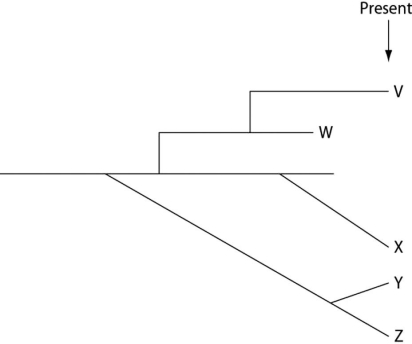 Figure 22.4
-Which of these five species originated earliest and appeared suddenly in the fossil record?
Figure 22.4
-Which of these five species originated earliest and appeared suddenly in the fossil record? (Multiple Choice)
4.8/5 (85)
(85) Rocky Mountain juniper (Juniperus scopulorum) and one-seeded juniper (J. monosperma) have overlapping ranges. If pollen grains (which contain sperm cells) from one species are unable to germinate and make pollen tubes on female ovules (which contain egg cells) of the other species, then which of these terms are applicable?
1) sympatric species
2) prezygotic isolation
3) postzygotic isolation
4) allopatric species
5) habitat isolation
6) reduced hybrid fertility
(Multiple Choice)
4.9/5 (85)
(85) Please use the following information to answer the question(s) below.
In the ocean, on either side of the Isthmus of Panama, are 30 species of snapping shrimp; some are shallow-water species, and others are adapted to deep water. There are 15 species on the Pacific side and 15 different species on the Atlantic side. The Isthmus of Panama started rising about 10 million years ago.
In Figure 22.1, the isthmus separates the Pacific Ocean on the left (side A) from the Atlantic Ocean on the right (side B). The seawater on either side of the isthmus is separated into five depth habitats (1-5), with 1 being the shallowest. 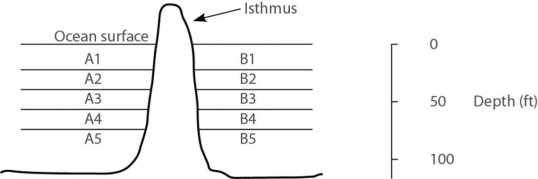 Figure 22.1
-In a hypothetical situation, the National Park Service, which administers Grand Canyon National Park in Arizona, builds a footbridge over the Colorado River at the bottom of the canyon. The footbridge permits migration to occur between populations of two closely related antelope squirrels. Previously, one type of squirrel had been restricted to the terrain south of the river, and the other type had been restricted to terrain on the north side of the river. Immediately before and 10 years after the bridge's completion, researchers collected 10 antelope squirrels from both sides of the river, took blood samples, and collected frequencies of alleles unique to the two types of antelope squirrels (see the graphs in Figures 22.2 and 22.3).
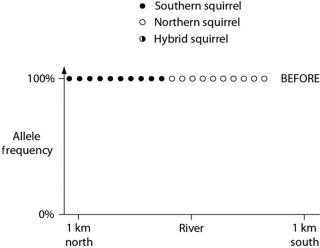 Figure 22.2
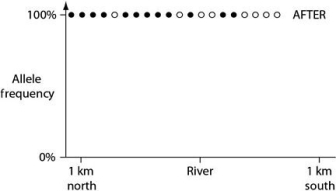 Figure 22.3
The data in these graphs indicate that
Figure 22.1
-In a hypothetical situation, the National Park Service, which administers Grand Canyon National Park in Arizona, builds a footbridge over the Colorado River at the bottom of the canyon. The footbridge permits migration to occur between populations of two closely related antelope squirrels. Previously, one type of squirrel had been restricted to the terrain south of the river, and the other type had been restricted to terrain on the north side of the river. Immediately before and 10 years after the bridge's completion, researchers collected 10 antelope squirrels from both sides of the river, took blood samples, and collected frequencies of alleles unique to the two types of antelope squirrels (see the graphs in Figures 22.2 and 22.3). Figure 22.2
Figure 22.3
The data in these graphs indicate that (Multiple Choice)
4.9/5 (87)
(87) Please use the following information to answer the question(s) below.
On the volcanic, equatorial West African island of Sao Tomé, two species of fruit fly exist. Drosophila yakuba inhabits the island's lowlands and is also found on the African mainland, located about 200 miles away. At higher elevations, and only on Sao Tomé, is found the very closely related Drosophila santomea. The two species can hybridize, though male hybrids are sterile. A hybrid zone exists at middle elevations, though hybrids there are greatly outnumbered by D. santomea. Studies of the two species' nuclear genomes reveal that D. yakuba on the island is more closely related to mainland D. yakuba than to D. santomea (2n = 4 in both species). Sao Tomé rose from the Atlantic Ocean about 14 million years ago.
-If a speciation event occurred on Sao Tomé, producing D. santomea from a parent colony of D. yakuba, then which of the following terms applies (apply)?
I. macroevolution
II allopatric speciation
III. sympatric speciation
(Multiple Choice)
4.8/5 (76)
(76) Sexual selection in cichlids occurs by female mate choice and results in reproductive isolation when
(Multiple Choice)
4.9/5 (86)
(86) Please use the following information to answer the question(s) below.
On the Bahamian island of Andros, mosquitofish populations live in various, now-isolated, freshwater ponds that were once united. Currently, some predator-rich ponds have mosquitofish that can swim in short, fast bursts; other predator-poor ponds have mosquitofish that can swim continuously for a long time. When placed together in the same body of water, the two kinds of female mosquitofish exhibit exclusive breeding preferences.
-What is the best way to promote fusion between two related populations of mosquitofish, one of which lives in a predator-rich pond, and the other of which lives in a predator-poor pond?
(Multiple Choice)
4.7/5 (71)
(71) A narrow hybrid zone separates the toad species Bombina bombina and Bombina variegata. What is true of those alleles that are unique to the parental species?
(Multiple Choice)
4.8/5 (87)
(87) Among known plant species, which of these are the two most commonly occurring phenomena that have led to the origin of new species?
1) allopatric speciation
2) sympatric speciation
3) sexual selection
4) polyploidy
(Multiple Choice)
4.8/5 (73)
(73) "Conventional wisdom holds that the development of separate species happens quickly, most often when populations become separated by a geographical barrier." This is called ________ speciation. "Even if these groups meet again and manage to mate before diverging too far from one another, their offspring will be unfit and die out." This is described as hybrid ________.
(Multiple Choice)
4.9/5 (72)
(72) Please use the following information to answer the question(s) below.
In the ocean, on either side of the Isthmus of Panama, are 30 species of snapping shrimp; some are shallow-water species, and others are adapted to deep water. There are 15 species on the Pacific side and 15 different species on the Atlantic side. The Isthmus of Panama started rising about 10 million years ago.
In Figure 22.1, the isthmus separates the Pacific Ocean on the left (side A) from the Atlantic Ocean on the right (side B). The seawater on either side of the isthmus is separated into five depth habitats (1-5), with 1 being the shallowest. Figure 22.1
-In which habitat should one find snapping shrimp most closely related to shrimp that live in habitat A4?
Figure 22.1
-In which habitat should one find snapping shrimp most closely related to shrimp that live in habitat A4? (Multiple Choice)
4.8/5 (73)
(73) Rocky Mountain juniper (Juniperus scopulorum) and one-seeded juniper (J. monosperma) have overlapping ranges. If pollen grains (which contain sperm cells) from one species are unable to germinate and make pollen tubes on female ovules (which contain egg cells) of the other species, then which of these terms is applicable?
(Multiple Choice)
4.9/5 (90)
(90) Please use the following information to answer the question(s) below.
On the volcanic, equatorial West African island of Sao Tomé, two species of fruit fly exist. Drosophila yakuba inhabits the island's lowlands and is also found on the African mainland, located about 200 miles away. At higher elevations, and only on Sao Tomé, is found the very closely related Drosophila santomea. The two species can hybridize, though male hybrids are sterile. A hybrid zone exists at middle elevations, though hybrids there are greatly outnumbered by D. santomea. Studies of the two species' nuclear genomes reveal that D. yakuba on the island is more closely related to mainland D. yakuba than to D. santomea (2n = 4 in both species). Sao Tomé rose from the Atlantic Ocean about 14 million years ago.
-The observation that island D. yakuba are more closely related to mainland D. yakuba than island D. yakuba are to D. santomea is best explained by proposing that D. santomea
(Multiple Choice)
4.9/5 (81)
(81) 
Filters
- Essay(0)
- Multiple Choice(0)
- Short Answer(0)
- True False(0)
- Matching(0)