



 Chat with AI
Exam 22: The Origin of Species

Exam 1: Introduction: Evolution and the Foundations of Biology36 Questions
Exam 2: The Chemical Context of Life137 Questions
Exam 3: Carbon and the Molecular Diversity of Life136 Questions
Exam 4: A Tour of the Cell75 Questions
Exam 5: Membrane Transport and Cell Signaling97 Questions
Exam 6: An Introduction to Metabolism79 Questions
Exam 7: Cellular Respiration and Fermentation100 Questions
Exam 8: Photosynthesis72 Questions
Exam 9: The Cell Cycle56 Questions
Exam 10: Meiosis and Sexual Life Cycles62 Questions
Exam 11: Mendel and the Gene Idea63 Questions
Exam 12: The Chromosomal Basis of Inheritance46 Questions
Exam 13: The Molecular Basis of Inheritance67 Questions
Exam 14: Gene Expression: From Gene to Protein80 Questions
Exam 15: Regulation of Gene Expression50 Questions
Exam 16: Development, Stem Cells, and Cancer34 Questions
Exam 17: Viruses35 Questions
Exam 18: Genomes and Their Evolution29 Questions
Exam 19: Descent With Modification55 Questions
Exam 20: Phylogeny60 Questions
Exam 21: The Evolution of Populations70 Questions
Exam 22: The Origin of Species67 Questions
Exam 23: Broad Patterns of Evolution45 Questions
Exam 24: Early Life and the Diversification of Prokaryotes88 Questions
Exam 25: The Origin and Diversification of Eukaryotes71 Questions
Exam 26: The Colonization of Land by Plants and Fungi126 Questions
Exam 27: The Rise of Animal Diversity88 Questions
Exam 28: Plant Structure and Growth59 Questions
Exam 29: Resource Acquisition, Nutrition, and Transport in Vascular Plants110 Questions
Exam 30: Reproduction and Domestication of Flowering Plants67 Questions
Exam 31: Plant Responses to Internal and External Signals75 Questions
Exam 32: Homeostasis and Endocrine Signaling120 Questions
Exam 33: Animal Nutrition67 Questions
Exam 34: Circulation and Gas Exchange88 Questions
Exam 35: The Immune System91 Questions
Exam 36: Reproduction and Development118 Questions
Exam 37: Neurons, Synapses, and Signaling76 Questions
Exam 38: Nervous and Sensory Systems99 Questions
Exam 39: Motor Mechanisms and Behavior79 Questions
Exam 40: Population Ecology and the Distribution of Organisms93 Questions
Exam 41: Species Interactions60 Questions
Exam 42: Ecosystems and Energy90 Questions
Exam 43: Global Ecology and Conservation Biology72 Questions
Select questions type


Plant species A has a diploid number of 12. Plant species B has a diploid number of 16. A new species, C, arises as an allopolyploid from A and B. The diploid number for species C would probably be
(Multiple Choice)
4.9/5  (89)
(89) The following question(s) refer to the evolutionary tree in Figure 22.4, whose horizontal axis represents time (present time is on the far right) and whose vertical axis represents morphological change. 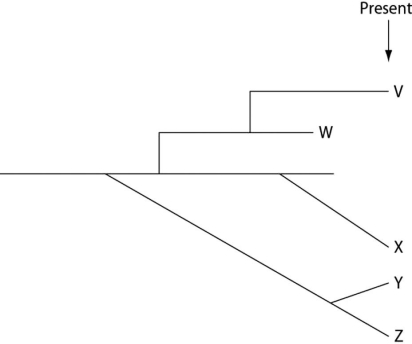 Figure 22.4
-Which species is most closely related to species W?
Figure 22.4
-Which species is most closely related to species W? (Multiple Choice)
4.8/5 (73)
(73) Please use the following information to answer the question(s) below.
On the volcanic, equatorial West African island of Sao Tomé, two species of fruit fly exist. Drosophila yakuba inhabits the island's lowlands and is also found on the African mainland, located about 200 miles away. At higher elevations, and only on Sao Tomé, is found the very closely related Drosophila santomea. The two species can hybridize, though male hybrids are sterile. A hybrid zone exists at middle elevations, though hybrids there are greatly outnumbered by D. santomea. Studies of the two species' nuclear genomes reveal that D. yakuba on the island is more closely related to mainland D. yakuba than to D. santomea (2n = 4 in both species). Sao Tomé rose from the Atlantic Ocean about 14 million years ago.
-If the low number of hybrid flies in the hybrid zone, relative to the number of D. santomea flies there, is due to the fact that hybrids are poorly adapted to conditions in the hybrid zone, and if fewer hybrid flies are produced with the passage of time, these conditions will most likely lead to
(Multiple Choice)
4.8/5 (90)
(90) Please use the following information to answer the question(s) below.
On the Bahamian island of Andros, mosquitofish populations live in various, now-isolated, freshwater ponds that were once united. Currently, some predator-rich ponds have mosquitofish that can swim in short, fast bursts; other predator-poor ponds have mosquitofish that can swim continuously for a long time. When placed together in the same body of water, the two kinds of female mosquitofish exhibit exclusive breeding preferences.
-Which type of reproductive isolation operates to keep the mosquitofish isolated, even when fish from different ponds are reunited in the same body of water?
(Multiple Choice)
4.8/5 (88)
(88) How can reproductive barriers form between sympatric populations while their members stay in contact with them?
(Multiple Choice)
4.9/5 (80)
(80) The following question(s) refer to the evolutionary tree in Figure 22.4, whose horizontal axis represents time (present time is on the far right) and whose vertical axis represents morphological change. Figure 22.4
-Which conclusion can be drawn from this evolutionary tree?
Figure 22.4
-Which conclusion can be drawn from this evolutionary tree? (Multiple Choice)
4.9/5 (78)
(78) The following question(s) refer to the evolutionary tree in Figure 22.4, whose horizontal axis represents time (present time is on the far right) and whose vertical axis represents morphological change. Figure 22.4
-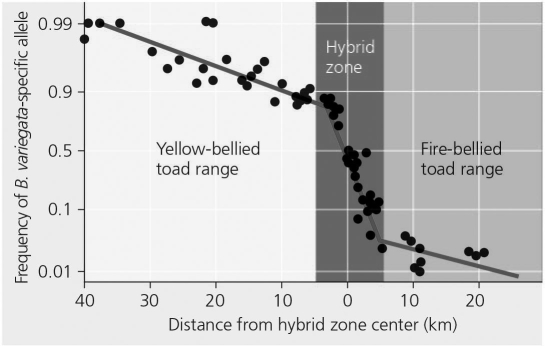 Figure 22.6
A hybrid zone is indicated by plotting the frequency of the yellow-belly allele across the distance from the center of the hybrid zone. What is the gene frequency of the fire-bellied toad 20 km from the hybrid zone center?
Figure 22.4
- Figure 22.6
A hybrid zone is indicated by plotting the frequency of the yellow-belly allele across the distance from the center of the hybrid zone. What is the gene frequency of the fire-bellied toad 20 km from the hybrid zone center? (Multiple Choice)
4.8/5 (67)
(67) Bird guides once listed the myrtle warbler and Audubon's warbler as distinct species. Recently, these birds have been reclassified as eastern and western forms of a single species, the yellow-rumped warbler. Which of the following pieces of evidence, if true, would be cause for this reclassification?
(Multiple Choice)
4.9/5 (82)
(82) The following question(s) refer to the evolutionary tree in Figure 22.4, whose horizontal axis represents time (present time is on the far right) and whose vertical axis represents morphological change. Figure 22.4
-Which species is least expected to have a good record of transitional fossils; in other words, which species' fossils, if present at all, are expected only in relatively superficial (that is, shallow) strata?
Figure 22.4
-Which species is least expected to have a good record of transitional fossils; in other words, which species' fossils, if present at all, are expected only in relatively superficial (that is, shallow) strata? (Multiple Choice)
4.7/5 (75)
(75) Which of the following criteria used in classification is the most easily evaluated by the observer?
(Multiple Choice)
4.9/5 (76)
(76) Please use the following information to answer the question(s) below.
In the ocean, on either side of the Isthmus of Panama, are 30 species of snapping shrimp; some are shallow-water species, and others are adapted to deep water. There are 15 species on the Pacific side and 15 different species on the Atlantic side. The Isthmus of Panama started rising about 10 million years ago.
In Figure 22.1, the isthmus separates the Pacific Ocean on the left (side A) from the Atlantic Ocean on the right (side B). The seawater on either side of the isthmus is separated into five depth habitats (1-5), with 1 being the shallowest. 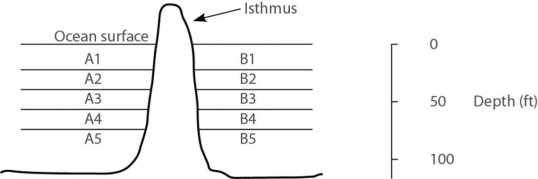 Figure 22.1
-The Panama Canal was completed in 1914, and its depth is about 50 feet. After 1914, snapping shrimp species from which habitats should be most likely to form hybrids as the result of the canal?
Figure 22.1
-The Panama Canal was completed in 1914, and its depth is about 50 feet. After 1914, snapping shrimp species from which habitats should be most likely to form hybrids as the result of the canal? (Multiple Choice)
4.7/5 (86)
(86) Males of different species of the fruit fly Drosophila that live in the same parts of the Hawaiian Islands have different elaborate courtship rituals. These rituals involve fighting other males and making stylized movements that attract females. What type of reproductive isolation does this represent?
(Multiple Choice)
4.9/5 (83)
(83) Please use the following information to answer the question(s) below.
On the volcanic, equatorial West African island of Sao Tomé, two species of fruit fly exist. Drosophila yakuba inhabits the island's lowlands and is also found on the African mainland, located about 200 miles away. At higher elevations, and only on Sao Tomé, is found the very closely related Drosophila santomea. The two species can hybridize, though male hybrids are sterile. A hybrid zone exists at middle elevations, though hybrids there are greatly outnumbered by D. santomea. Studies of the two species' nuclear genomes reveal that D. yakuba on the island is more closely related to mainland D. yakuba than to D. santomea (2n = 4 in both species). Sao Tomé rose from the Atlantic Ocean about 14 million years ago.
-Which of these evolutionary trees represents the situation described in the previous paragraph? (Note: D. yakuba (I) represents the island population, and D. yakuba (M) represents the mainland population.)
(Multiple Choice)
4.8/5 (72)
(72) The following question(s) refer to the evolutionary tree in Figure 22.4, whose horizontal axis represents time (present time is on the far right) and whose vertical axis represents morphological change. Figure 22.4
-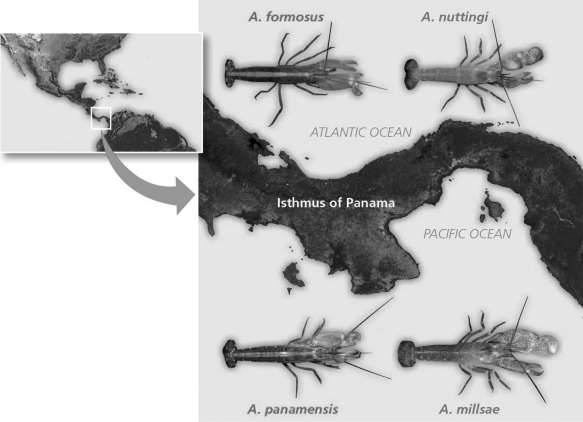 Figure 22.5
Which of the following is evidence for allopatric speciation by the formation of the Isthmus of Panama?
Figure 22.4
- Figure 22.5
Which of the following is evidence for allopatric speciation by the formation of the Isthmus of Panama? (Multiple Choice)
4.9/5 (91)
(91) Which of the following statements about speciation is correct?
(Multiple Choice)
4.7/5 (73)
(73) Which of the following activities occurs first in order to begin speciation?
(Multiple Choice)
4.8/5 (82)
(82) Please use the following information to answer the question(s) below.
On the Bahamian island of Andros, mosquitofish populations live in various, now-isolated, freshwater ponds that were once united. Currently, some predator-rich ponds have mosquitofish that can swim in short, fast bursts; other predator-poor ponds have mosquitofish that can swim continuously for a long time. When placed together in the same body of water, the two kinds of female mosquitofish exhibit exclusive breeding preferences.
-The predatory fish rely on visual cues and speed to capture mosquitofish. Mosquitofish rely on speed and visual cues to avoid the predatory fish. Which adaptation(s) might help the predators survive in ponds that are home to faster mosquitofish?
1) directional selection for increased speed
2) stabilizing selection for speed that matches that of the mosquitofish
3) change in hunting behavior that replaces reliance on visual cues with reliance on tactile cues
4) change in hunting behavior that eliminates speed in favor of better camouflage, which permits an ambush strategy
(Multiple Choice)
4.9/5 (65)
(65) Please use the following information to answer the question(s) below.
In the ocean, on either side of the Isthmus of Panama, are 30 species of snapping shrimp; some are shallow-water species, and others are adapted to deep water. There are 15 species on the Pacific side and 15 different species on the Atlantic side. The Isthmus of Panama started rising about 10 million years ago.
In Figure 22.1, the isthmus separates the Pacific Ocean on the left (side A) from the Atlantic Ocean on the right (side B). The seawater on either side of the isthmus is separated into five depth habitats (1-5), with 1 being the shallowest. Figure 22.1
-Which factor is most important for explaining why there are equal numbers of snapping shrimp species on either side of the isthmus?
Figure 22.1
-Which factor is most important for explaining why there are equal numbers of snapping shrimp species on either side of the isthmus? (Multiple Choice)
4.8/5 (82)
(82) The most likely explanation for the high rate of sympatric speciation that apparently existed among the cichlids of Lake Victoria in the past is
(Multiple Choice)
4.8/5 (75)
(75) 
Filters
- Essay(0)
- Multiple Choice(0)
- Short Answer(0)
- True False(0)
- Matching(0)