



 Chat with AI
Exam 2: The Chemical Context of Life

Exam 1: Introduction: Evolution and the Foundations of Biology36 Questions
Exam 2: The Chemical Context of Life137 Questions
Exam 3: Carbon and the Molecular Diversity of Life136 Questions
Exam 4: A Tour of the Cell75 Questions
Exam 5: Membrane Transport and Cell Signaling97 Questions
Exam 6: An Introduction to Metabolism79 Questions
Exam 7: Cellular Respiration and Fermentation100 Questions
Exam 8: Photosynthesis72 Questions
Exam 9: The Cell Cycle56 Questions
Exam 10: Meiosis and Sexual Life Cycles62 Questions
Exam 11: Mendel and the Gene Idea63 Questions
Exam 12: The Chromosomal Basis of Inheritance46 Questions
Exam 13: The Molecular Basis of Inheritance67 Questions
Exam 14: Gene Expression: From Gene to Protein80 Questions
Exam 15: Regulation of Gene Expression50 Questions
Exam 16: Development, Stem Cells, and Cancer34 Questions
Exam 17: Viruses35 Questions
Exam 18: Genomes and Their Evolution29 Questions
Exam 19: Descent With Modification55 Questions
Exam 20: Phylogeny60 Questions
Exam 21: The Evolution of Populations70 Questions
Exam 22: The Origin of Species67 Questions
Exam 23: Broad Patterns of Evolution45 Questions
Exam 24: Early Life and the Diversification of Prokaryotes88 Questions
Exam 25: The Origin and Diversification of Eukaryotes71 Questions
Exam 26: The Colonization of Land by Plants and Fungi126 Questions
Exam 27: The Rise of Animal Diversity88 Questions
Exam 28: Plant Structure and Growth59 Questions
Exam 29: Resource Acquisition, Nutrition, and Transport in Vascular Plants110 Questions
Exam 30: Reproduction and Domestication of Flowering Plants67 Questions
Exam 31: Plant Responses to Internal and External Signals75 Questions
Exam 32: Homeostasis and Endocrine Signaling120 Questions
Exam 33: Animal Nutrition67 Questions
Exam 34: Circulation and Gas Exchange88 Questions
Exam 35: The Immune System91 Questions
Exam 36: Reproduction and Development118 Questions
Exam 37: Neurons, Synapses, and Signaling76 Questions
Exam 38: Nervous and Sensory Systems99 Questions
Exam 39: Motor Mechanisms and Behavior79 Questions
Exam 40: Population Ecology and the Distribution of Organisms93 Questions
Exam 41: Species Interactions60 Questions
Exam 42: Ecosystems and Energy90 Questions
Exam 43: Global Ecology and Conservation Biology72 Questions
Select questions type


 Figure 2.4
-Based on electron configuration, which of the elements in Figure 2.4 would exhibit a chemical behavior most like that of oxygen?
Figure 2.4
-Based on electron configuration, which of the elements in Figure 2.4 would exhibit a chemical behavior most like that of oxygen? (Multiple Choice)
4.9/5  (80)
(80) Which of the following are the strongest molecular interactions?
(Multiple Choice)
5.0/5 (83)
(83) 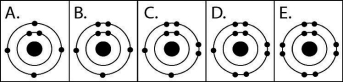 Figure 2.3
-Which drawing in Figure 2.3 depicts the electron configuration of an atom capable of forming three covalent bonds with other atoms?
Figure 2.3
-Which drawing in Figure 2.3 depicts the electron configuration of an atom capable of forming three covalent bonds with other atoms? (Multiple Choice)
4.9/5 (73)
(73) How many electron pairs are shared between carbon atoms in a molecule that has the formula C2H6?
(Multiple Choice)
4.8/5 (80)
(80) Approximately what percentage of human-generated atmospheric CO₂ is absorbed by the oceans?
(Multiple Choice)
5.0/5 (72)
(72) You have two beakers. One contains a solution of HCl at pH = 1.0. The other contains a solution of NaOH at pH = 13. Into a third beaker, you slowly and cautiously pour 20 mL of the HCl and 20 mL of the NaOH. After complete stirring, the pH of the mixture will be
(Multiple Choice)
4.9/5 (73)
(73) If a salamander clings to surfaces through hydrogen bonds, it would have the most difficulty clinging to which of the following surfaces?
(Multiple Choice)
4.7/5 (86)
(86) How many glucose molecules are contained in one liter of a 0.1 M solution of glucose in water?
(Multiple Choice)
4.8/5 (79)
(79) Carbon dioxide (CO₂) is readily soluble in water, according to the equation CO₂ + H₂O ↔ H2CO3. Carbonic acid (H2CO3) is a weak acid. Respiring cells release CO₂ into the bloodstream. What will be the effect on the pH of blood as that blood first comes in contact with respiring cells?
(Multiple Choice)
4.8/5 (82)
(82) What coefficients must be placed in the following blanks so that all atoms are accounted for in the products?
C₆H₁₂O₆ → ________ C2H6O + ________ CO₂
(Multiple Choice)
4.9/5 (72)
(72) What is the maximum number of hydrogen atoms that can be covalently bonded in a molecule containing two carbon atoms?
(Multiple Choice)
4.9/5 (82)
(82) If the cytoplasm of a cell is at pH 7, and the mitochondrial matrix is at pH 8, this means that
(Multiple Choice)
4.9/5 (94)
(94) Which of the following correctly describes chemical equilibrium?
(Multiple Choice)
4.9/5 (101)
(101) The molar mass of glucose (C₆H₁₂O₆) is 180 g/mol. Which of the following procedures should you carry out to make a 0.5 M solution of glucose?
(Multiple Choice)
4.8/5 (74)
(74) Which of the following takes place as an ice cube cools a drink?
(Multiple Choice)
4.8/5 (89)
(89) Nitrogen (N) is much more electronegative than hydrogen (H). Which of the following statements about the atoms in ammonia (NH3) is correct?
(Multiple Choice)
4.8/5 (78)
(78) Glucose has a molecular mass of 180 g/mol. How many glucose molecules are present in 90 grams of glucose?
(Multiple Choice)
4.8/5 (88)
(88)  Figure 2.6
-
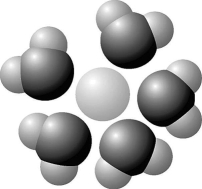 Figure 2.7
Based on your knowledge of the polarity of water molecules, the solute molecule depicted in Figure 2.7 is most likely
Figure 2.6
- Figure 2.7
Based on your knowledge of the polarity of water molecules, the solute molecule depicted in Figure 2.7 is most likely (Multiple Choice)
4.7/5 (73)
(73) 
Filters
- Essay(0)
- Multiple Choice(0)
- Short Answer(0)
- True False(0)
- Matching(0)