



 Chat with AI
Exam 2: The Chemical Context of Life

Exam 1: Introduction: Evolution and the Foundations of Biology36 Questions
Exam 2: The Chemical Context of Life137 Questions
Exam 3: Carbon and the Molecular Diversity of Life136 Questions
Exam 4: A Tour of the Cell75 Questions
Exam 5: Membrane Transport and Cell Signaling97 Questions
Exam 6: An Introduction to Metabolism79 Questions
Exam 7: Cellular Respiration and Fermentation100 Questions
Exam 8: Photosynthesis72 Questions
Exam 9: The Cell Cycle56 Questions
Exam 10: Meiosis and Sexual Life Cycles62 Questions
Exam 11: Mendel and the Gene Idea63 Questions
Exam 12: The Chromosomal Basis of Inheritance46 Questions
Exam 13: The Molecular Basis of Inheritance67 Questions
Exam 14: Gene Expression: From Gene to Protein80 Questions
Exam 15: Regulation of Gene Expression50 Questions
Exam 16: Development, Stem Cells, and Cancer34 Questions
Exam 17: Viruses35 Questions
Exam 18: Genomes and Their Evolution29 Questions
Exam 19: Descent With Modification55 Questions
Exam 20: Phylogeny60 Questions
Exam 21: The Evolution of Populations70 Questions
Exam 22: The Origin of Species67 Questions
Exam 23: Broad Patterns of Evolution45 Questions
Exam 24: Early Life and the Diversification of Prokaryotes88 Questions
Exam 25: The Origin and Diversification of Eukaryotes71 Questions
Exam 26: The Colonization of Land by Plants and Fungi126 Questions
Exam 27: The Rise of Animal Diversity88 Questions
Exam 28: Plant Structure and Growth59 Questions
Exam 29: Resource Acquisition, Nutrition, and Transport in Vascular Plants110 Questions
Exam 30: Reproduction and Domestication of Flowering Plants67 Questions
Exam 31: Plant Responses to Internal and External Signals75 Questions
Exam 32: Homeostasis and Endocrine Signaling120 Questions
Exam 33: Animal Nutrition67 Questions
Exam 34: Circulation and Gas Exchange88 Questions
Exam 35: The Immune System91 Questions
Exam 36: Reproduction and Development118 Questions
Exam 37: Neurons, Synapses, and Signaling76 Questions
Exam 38: Nervous and Sensory Systems99 Questions
Exam 39: Motor Mechanisms and Behavior79 Questions
Exam 40: Population Ecology and the Distribution of Organisms93 Questions
Exam 41: Species Interactions60 Questions
Exam 42: Ecosystems and Energy90 Questions
Exam 43: Global Ecology and Conservation Biology72 Questions
Select questions type


Which of the following statements correctly describes any chemical reaction that has reached equilibrium?
(Multiple Choice)
4.8/5  (68)
(68) We can be sure that a mole of table sugar and a mole of vitamin C are equal in their
(Multiple Choice)
4.8/5 (76)
(76) In ammonium chloride salt (NH4Cl), the anion is a single chloride ion, Cl. What is the cation of NH4Cl?
(Multiple Choice)
4.9/5 (81)
(81) Fluorine has an atomic number of 9 and a mass number of 19. How many electrons are needed to complete the valence shell of a fluorine atom?
(Multiple Choice)
4.8/5 (85)
(85) 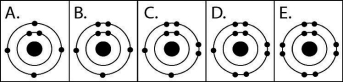 Figure 2.3
-Which drawing in Figure 2.3 depicts the electron configuration of an atom that can form covalent bonds with two hydrogen atoms?
Figure 2.3
-Which drawing in Figure 2.3 depicts the electron configuration of an atom that can form covalent bonds with two hydrogen atoms? (Multiple Choice)
4.9/5 (79)
(79)  Figure 2.8
-How many grams of the compound in Figure 2.8 would be required to make 2.5 L of a 1 M solution?
(carbon = 12, oxygen = 16, hydrogen = 1)
Figure 2.8
-How many grams of the compound in Figure 2.8 would be required to make 2.5 L of a 1 M solution?
(carbon = 12, oxygen = 16, hydrogen = 1) (Multiple Choice)
4.9/5 (89)
(89) If the pH of a solution is increased from pH 5 to pH 7, it means that the
(Multiple Choice)
4.8/5 (80)
(80) Which of the following correctly describes any reaction that has reached chemical equilibrium?
(Multiple Choice)
4.9/5 (86)
(86) What is the hydrogen ion (H+) concentration of a solution of pH 8?
(Multiple Choice)
4.8/5 (71)
(71)  Figure 2.6
-Which of the atoms shown would be most likely to form a cation with a charge of +1?
Figure 2.6
-Which of the atoms shown would be most likely to form a cation with a charge of +1? (Multiple Choice)
4.9/5 (82)
(82) Oxygen has an atomic number of 8 and a mass number of 16. What is the atomic mass of an oxygen atom?
(Multiple Choice)
4.8/5 (66)
(66) Which bond or interaction would be most difficult to disrupt when compounds are put into water?
(Multiple Choice)
4.9/5 (76)
(76) Which of the following is primarily responsible for the unique chemical properties of each element?
(Multiple Choice)
4.8/5 (91)
(91) Figure 2.6
-What is the atomic number of the cation formed in the reaction illustrated in Figure 2.6?
Figure 2.6
-What is the atomic number of the cation formed in the reaction illustrated in Figure 2.6? (Multiple Choice)
4.8/5 (75)
(75) What type of bonding or interaction is most likely to occur among a broad array of molecules with various physical properties (polar, nonpolar, hydrophilic, hydrophobic)?
(Multiple Choice)
4.8/5 (79)
(79) Identical heat lamps are arranged to shine on identical containers of water and methanol (wood alcohol) so that each liquid absorbs the same amount of energy minute by minute. The covalent bonds of methanol molecules are nonpolar, so there are no hydrogen bonds among methanol molecules. Which of the following graphs correctly describes what will happen to the temperature of the water and the methanol?
(Multiple Choice)
4.8/5 (81)
(81) When an ionic compound such as sodium chloride (NaCl) is placed in water, the component atoms of the NaCl crystal dissociate into individual sodium ions (Na+) and chloride ions (Cl-). In contrast, the atoms of covalently bonded molecules (e.g., glucose, sucrose, glycerol) do not generally dissociate when placed in aqueous solution. Which of the following solutions would be expected to contain the greatest number of solute particles (molecules or ions)?
(Multiple Choice)
5.0/5 (70)
(70) The most stable interaction between magnesium (atomic number 12) and chlorine (atomic number 17) forms
(Multiple Choice)
4.7/5 (78)
(78) A slice of pizza has 500 kcal. If we could burn the pizza and use all the heat to warm a 50-L container of cold water, what would be the approximate increase in the temperature of the water? (Note: A liter of cold water weighs about 1 kg.)
(Multiple Choice)
4.9/5 (84)
(84) 
Filters
- Essay(0)
- Multiple Choice(0)
- Short Answer(0)
- True False(0)
- Matching(0)