



 Chat with AI
Exam 2: The Chemical Context of Life

Exam 1: Introduction: Evolution and the Foundations of Biology36 Questions
Exam 2: The Chemical Context of Life137 Questions
Exam 3: Carbon and the Molecular Diversity of Life136 Questions
Exam 4: A Tour of the Cell75 Questions
Exam 5: Membrane Transport and Cell Signaling97 Questions
Exam 6: An Introduction to Metabolism79 Questions
Exam 7: Cellular Respiration and Fermentation100 Questions
Exam 8: Photosynthesis72 Questions
Exam 9: The Cell Cycle56 Questions
Exam 10: Meiosis and Sexual Life Cycles62 Questions
Exam 11: Mendel and the Gene Idea63 Questions
Exam 12: The Chromosomal Basis of Inheritance46 Questions
Exam 13: The Molecular Basis of Inheritance67 Questions
Exam 14: Gene Expression: From Gene to Protein80 Questions
Exam 15: Regulation of Gene Expression50 Questions
Exam 16: Development, Stem Cells, and Cancer34 Questions
Exam 17: Viruses35 Questions
Exam 18: Genomes and Their Evolution29 Questions
Exam 19: Descent With Modification55 Questions
Exam 20: Phylogeny60 Questions
Exam 21: The Evolution of Populations70 Questions
Exam 22: The Origin of Species67 Questions
Exam 23: Broad Patterns of Evolution45 Questions
Exam 24: Early Life and the Diversification of Prokaryotes88 Questions
Exam 25: The Origin and Diversification of Eukaryotes71 Questions
Exam 26: The Colonization of Land by Plants and Fungi126 Questions
Exam 27: The Rise of Animal Diversity88 Questions
Exam 28: Plant Structure and Growth59 Questions
Exam 29: Resource Acquisition, Nutrition, and Transport in Vascular Plants110 Questions
Exam 30: Reproduction and Domestication of Flowering Plants67 Questions
Exam 31: Plant Responses to Internal and External Signals75 Questions
Exam 32: Homeostasis and Endocrine Signaling120 Questions
Exam 33: Animal Nutrition67 Questions
Exam 34: Circulation and Gas Exchange88 Questions
Exam 35: The Immune System91 Questions
Exam 36: Reproduction and Development118 Questions
Exam 37: Neurons, Synapses, and Signaling76 Questions
Exam 38: Nervous and Sensory Systems99 Questions
Exam 39: Motor Mechanisms and Behavior79 Questions
Exam 40: Population Ecology and the Distribution of Organisms93 Questions
Exam 41: Species Interactions60 Questions
Exam 42: Ecosystems and Energy90 Questions
Exam 43: Global Ecology and Conservation Biology72 Questions
Select questions type


An atom has 6 electrons in its outer shell. How many unpaired electrons does it have?
(Multiple Choice)
4.8/5  (72)
(72)  Figure 2.4
-In Figure 2.4, how many unpaired electrons does phosphorus have in its valence shell?
Figure 2.4
-In Figure 2.4, how many unpaired electrons does phosphorus have in its valence shell? (Multiple Choice)
5.0/5 (88)
(88) One liter of a solution of pH 8 has how many more hydroxyl ions (OH-) than 1 L of a solution of pH 4?
(Multiple Choice)
4.9/5 (79)
(79) When two atoms are equally electronegative, they will interact to form
(Multiple Choice)
4.9/5 (76)
(76)  Figure 2.8
-How many grams would be equal to 1 mol of the compound shown in Figure 2.8?
(carbon = 12, oxygen = 16, hydrogen = 1)
Figure 2.8
-How many grams would be equal to 1 mol of the compound shown in Figure 2.8?
(carbon = 12, oxygen = 16, hydrogen = 1) (Multiple Choice)
5.0/5 (95)
(95) In what way are elements in the same row of the periodic table the same?
(Multiple Choice)
4.8/5 (77)
(77) 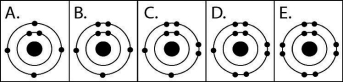 Figure 2.3
-Which drawing in Figure 2.3 depicts an atom with a valence of 2?
Figure 2.3
-Which drawing in Figure 2.3 depicts an atom with a valence of 2? (Multiple Choice)
4.7/5 (92)
(92) Research indicates that acid precipitation can damage marine corals by
(Multiple Choice)
4.8/5 (73)
(73) Increased atmospheric CO₂ concentrations will have what effect on seawater?
(Multiple Choice)
4.9/5 (75)
(75) One proposal to mitigate the effects of burning fossil fuels on atmospheric CO₂ concentrations is to pipe liquid CO₂ into the ocean at depths of 2,500 feet or greater. At the high pressures at such depths, CO₂ is heavier than water. What potential effects might result from implementing such a scheme?
(Multiple Choice)
4.9/5 (74)
(74) A dietary Calorie equals 1 kilocalorie. Which of the following statements correctly defines 1 kilocalorie?
(Multiple Choice)
4.9/5 (64)
(64) A solution contains 0.0000001(10-7) moles of hydroxyl ions (OH-) per liter. Which of the following best describes this solution?
(Multiple Choice)
4.8/5 (86)
(86) You have a freshly prepared 1 M solution of glucose in water. You carefully pour out a 100-mL sample of that solution. How many glucose molecules are included in that 100-mL sample?
(Multiple Choice)
4.9/5 (77)
(77) Phosphorus-32, a radioactive isotope of phosphorus-31 (atomic number 15), undergoes a form of radioactive decay whereby a neutron turns into a proton, which is retained in the nucleus, and emits radiation in the form of an electron. What is the product of such radioactive decay of phosphorus-32?
(Multiple Choice)
4.9/5 (85)
(85) The nutritional information on a cereal box shows that one serving of a dry cereal has 200 kilocalories. If a person were to ignite one serving of the cereal in a bowl, the amount of heat given off would be sufficient to raise the temperature of 20 kg of water how many degrees Celsius?
(Multiple Choice)
4.9/5 (80)
(80) What is the difference between covalent bonds and ionic bonds?
(Multiple Choice)
4.9/5 (82)
(82) The nucleus of a nitrogen atom contains 7 neutrons and 7 protons. Which of the following is a correct statement concerning nitrogen?
(Multiple Choice)
4.9/5 (82)
(82) The slight negative charge at one end of one water molecule is attracted to the slight positive charge of another water molecule. What is this attraction called?
(Multiple Choice)
4.8/5 (75)
(75) The atomic number of sulfur is 16. Sulfur combines with hydrogen by covalent bonding to form a compound, hydrogen sulfide. Based on the number of valence electrons in a sulfur atom, predict the molecular formula of the compound.
(Multiple Choice)
4.9/5 (78)
(78) 
Filters
- Essay(0)
- Multiple Choice(0)
- Short Answer(0)
- True False(0)
- Matching(0)