



 Chat with AI
Exam 3: Carbon and the Molecular Diversity of Life

Exam 1: Introduction: Evolution and the Foundations of Biology36 Questions
Exam 2: The Chemical Context of Life137 Questions
Exam 3: Carbon and the Molecular Diversity of Life136 Questions
Exam 4: A Tour of the Cell75 Questions
Exam 5: Membrane Transport and Cell Signaling97 Questions
Exam 6: An Introduction to Metabolism79 Questions
Exam 7: Cellular Respiration and Fermentation100 Questions
Exam 8: Photosynthesis72 Questions
Exam 9: The Cell Cycle56 Questions
Exam 10: Meiosis and Sexual Life Cycles62 Questions
Exam 11: Mendel and the Gene Idea63 Questions
Exam 12: The Chromosomal Basis of Inheritance46 Questions
Exam 13: The Molecular Basis of Inheritance67 Questions
Exam 14: Gene Expression: From Gene to Protein80 Questions
Exam 15: Regulation of Gene Expression50 Questions
Exam 16: Development, Stem Cells, and Cancer34 Questions
Exam 17: Viruses35 Questions
Exam 18: Genomes and Their Evolution29 Questions
Exam 19: Descent With Modification55 Questions
Exam 20: Phylogeny60 Questions
Exam 21: The Evolution of Populations70 Questions
Exam 22: The Origin of Species67 Questions
Exam 23: Broad Patterns of Evolution45 Questions
Exam 24: Early Life and the Diversification of Prokaryotes88 Questions
Exam 25: The Origin and Diversification of Eukaryotes71 Questions
Exam 26: The Colonization of Land by Plants and Fungi126 Questions
Exam 27: The Rise of Animal Diversity88 Questions
Exam 28: Plant Structure and Growth59 Questions
Exam 29: Resource Acquisition, Nutrition, and Transport in Vascular Plants110 Questions
Exam 30: Reproduction and Domestication of Flowering Plants67 Questions
Exam 31: Plant Responses to Internal and External Signals75 Questions
Exam 32: Homeostasis and Endocrine Signaling120 Questions
Exam 33: Animal Nutrition67 Questions
Exam 34: Circulation and Gas Exchange88 Questions
Exam 35: The Immune System91 Questions
Exam 36: Reproduction and Development118 Questions
Exam 37: Neurons, Synapses, and Signaling76 Questions
Exam 38: Nervous and Sensory Systems99 Questions
Exam 39: Motor Mechanisms and Behavior79 Questions
Exam 40: Population Ecology and the Distribution of Organisms93 Questions
Exam 41: Species Interactions60 Questions
Exam 42: Ecosystems and Energy90 Questions
Exam 43: Global Ecology and Conservation Biology72 Questions
Select questions type


Enzymes that break down DNA catalyze the hydrolysis of the covalent bonds that join nucleotides together. What would happen to DNA molecules treated with these enzymes?
(Multiple Choice)
4.8/5  (90)
(90) Research indicates that ibuprofen, a drug used to relieve inflammation and pain, is a mixture of two enantiomers, that is, molecules that
(Multiple Choice)
4.9/5 (69)
(69) Which of the following statements concerning unsaturated fats is true?
(Multiple Choice)
5.0/5 (82)
(82) Which of the following classes of biological molecules consist of both small molecules and macromolecular polymers?
(Multiple Choice)
4.8/5 (75)
(75)  Figure 3.6
-Which molecule shown in Figure 3.6 is a thiol?
Figure 3.6
-Which molecule shown in Figure 3.6 is a thiol? (Multiple Choice)
4.9/5 (78)
(78) 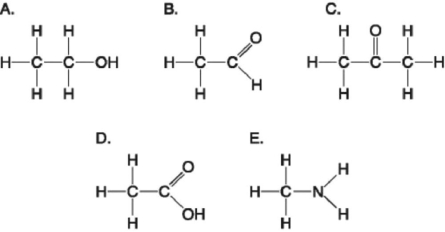 Figure 3.5
-Which molecule shown in Figure 3.5 contains a carboxyl group?
Figure 3.5
-Which molecule shown in Figure 3.5 contains a carboxyl group? (Multiple Choice)
4.9/5 (86)
(86) Interactions between the side chains (R groups) in a polypeptide are most important in stabilizing which of the following?
(Multiple Choice)
4.9/5 (85)
(85) A nutritional supplement developed for athletes is shown to contain only carbon, hydrogen, nitrogen, and oxygen. Based on these data, you may safely conclude that
(Multiple Choice)
4.9/5 (73)
(73) A scientist suspects that food in an ecosystem may have been contaminated by radioactive nitrogen over a period of several months. Which of the following should be isolated from mammals living in the ecosystem and examined for radioactivity in order to test the hypothesis?
(Multiple Choice)
4.9/5 (74)
(74) Figure 3.5
-Which molecule shown in Figure 3.5 would have a positive charge in a cell?
Figure 3.5
-Which molecule shown in Figure 3.5 would have a positive charge in a cell? (Multiple Choice)
4.8/5 (93)
(93) A new organism is discovered in the forests of Costa Rica. Scientists there determine that the polypeptide sequence of hemoglobin from the new organism has 72 amino acid differences from humans, 65 differences from a gibbon, 49 differences from a rat, and 5 differences from a frog. These data suggest that the new organism is more closely related to
(Multiple Choice)
4.8/5 (75)
(75) Normal hemoglobin is a tetramer, consisting of two molecules of β-globin and two molecules of α-globin. In sickle-cell disease, as a result of a single amino acid change, the mutant hemoglobin tetramers associate with each other and assemble into large fibers. Based on this information alone, we can conclude that sickle-cell hemoglobin exhibits
(Multiple Choice)
4.8/5 (75)
(75) The molecular formula for glucose is C₆H₁₂O₆. What would be the molecular formula for a molecule made by linking three glucose molecules together by dehydration reactions?
(Multiple Choice)
4.9/5 (85)
(85)  Figure 3.9
-The molecule shown in Figure 3.9 is a(n)

Filters
- Essay(0)
- Multiple Choice(0)
- Short Answer(0)
- True False(0)
- Matching(0)