



 Chat with AI
Exam 3: Carbon and the Molecular Diversity of Life

Exam 1: Introduction: Evolution and the Foundations of Biology36 Questions
Exam 2: The Chemical Context of Life137 Questions
Exam 3: Carbon and the Molecular Diversity of Life136 Questions
Exam 4: A Tour of the Cell75 Questions
Exam 5: Membrane Transport and Cell Signaling97 Questions
Exam 6: An Introduction to Metabolism79 Questions
Exam 7: Cellular Respiration and Fermentation100 Questions
Exam 8: Photosynthesis72 Questions
Exam 9: The Cell Cycle56 Questions
Exam 10: Meiosis and Sexual Life Cycles62 Questions
Exam 11: Mendel and the Gene Idea63 Questions
Exam 12: The Chromosomal Basis of Inheritance46 Questions
Exam 13: The Molecular Basis of Inheritance67 Questions
Exam 14: Gene Expression: From Gene to Protein80 Questions
Exam 15: Regulation of Gene Expression50 Questions
Exam 16: Development, Stem Cells, and Cancer34 Questions
Exam 17: Viruses35 Questions
Exam 18: Genomes and Their Evolution29 Questions
Exam 19: Descent With Modification55 Questions
Exam 20: Phylogeny60 Questions
Exam 21: The Evolution of Populations70 Questions
Exam 22: The Origin of Species67 Questions
Exam 23: Broad Patterns of Evolution45 Questions
Exam 24: Early Life and the Diversification of Prokaryotes88 Questions
Exam 25: The Origin and Diversification of Eukaryotes71 Questions
Exam 26: The Colonization of Land by Plants and Fungi126 Questions
Exam 27: The Rise of Animal Diversity88 Questions
Exam 28: Plant Structure and Growth59 Questions
Exam 29: Resource Acquisition, Nutrition, and Transport in Vascular Plants110 Questions
Exam 30: Reproduction and Domestication of Flowering Plants67 Questions
Exam 31: Plant Responses to Internal and External Signals75 Questions
Exam 32: Homeostasis and Endocrine Signaling120 Questions
Exam 33: Animal Nutrition67 Questions
Exam 34: Circulation and Gas Exchange88 Questions
Exam 35: The Immune System91 Questions
Exam 36: Reproduction and Development118 Questions
Exam 37: Neurons, Synapses, and Signaling76 Questions
Exam 38: Nervous and Sensory Systems99 Questions
Exam 39: Motor Mechanisms and Behavior79 Questions
Exam 40: Population Ecology and the Distribution of Organisms93 Questions
Exam 41: Species Interactions60 Questions
Exam 42: Ecosystems and Energy90 Questions
Exam 43: Global Ecology and Conservation Biology72 Questions
Select questions type


A nutritional supplement developed for athletes is shown to contain only carbon, hydrogen, and oxygen. Based on these data, you may safely conclude that
(Multiple Choice)
4.9/5  (80)
(80) How many electron pairs does carbon share in order to complete its valence shell?
(Multiple Choice)
4.8/5 (78)
(78) A carbon skeleton is covalently bonded to both an amino group and a carboxyl group. When placed in water, it
(Multiple Choice)
4.9/5 (80)
(80) Which of the following is a monomer used to build a biological polymer?
(Multiple Choice)
4.8/5 (78)
(78)  Figure 3.4
-Which of the groups shown in Figure 3.4 is a functional group that helps stabilize proteins by forming covalent cross-links within or between protein molecules?
Figure 3.4
-Which of the groups shown in Figure 3.4 is a functional group that helps stabilize proteins by forming covalent cross-links within or between protein molecules? (Multiple Choice)
4.9/5 (85)
(85) Testosterone and estradiol are male and female sex hormones, respectively, in many vertebrates. How do these molecules differ from each other?
(Multiple Choice)
4.8/5 (72)
(72) 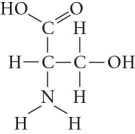
Which of the following categories includes all others in the list?
(Multiple Choice)
4.9/5 (84)
(84) Which of the following large biological molecules will self-assemble into a bilayer when mixed with water?
(Multiple Choice)
4.8/5 (83)
(83)  Figure 3.7
-
 Figure 3.8
Which of the following statements regarding the molecule illustrated in Figure 3.8 is true?
Figure 3.7
- Figure 3.8
Which of the following statements regarding the molecule illustrated in Figure 3.8 is true? (Multiple Choice)
4.7/5 (92)
(92)  Figure 3.5
-Which molecule(s) shown in Figure 3.5 is (are) ionized in a cell?
Figure 3.5
-Which molecule(s) shown in Figure 3.5 is (are) ionized in a cell? (Multiple Choice)
4.8/5 (84)
(84) How many molecules of water are needed to completely hydrolyze a polysaccharide that is 10 monomers long?
(Multiple Choice)
4.9/5 (89)
(89)  Figure 3.6
-Which molecule shown in Figure 3.6 contains an amino functional group, but is not an amino acid?
Figure 3.6
-Which molecule shown in Figure 3.6 contains an amino functional group, but is not an amino acid? (Multiple Choice)
4.8/5 (80)
(80)  Figure 3.12
-Which bond in Figure 3.12 is a peptide bond?
Choose the term that correctly describes the relationship between these two sugar molecules: 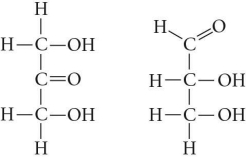
(Multiple Choice)
4.8/5 (78)
(78) Which of the following is an example of a dehydration reaction?
(Multiple Choice)
4.8/5 (76)
(76) 
Filters
- Essay(0)
- Multiple Choice(0)
- Short Answer(0)
- True False(0)
- Matching(0)