



 Chat with AI
Exam 3: Scarcity, Trade-Offs, and Production Possibilities

Exam 1: The Role and Method of Economics194 Questions
Exam 2: Eight Powerful Ideas212 Questions
Exam 3: Scarcity, Trade-Offs, and Production Possibilities182 Questions
Exam 4: Demand, Supply, and Market Equilibrium231 Questions
Exam 5: Market in Motion and Price Controls252 Questions
Exam 6: Elasticities271 Questions
Exam 7: Market Efficiency and Welfare128 Questions
Exam 8: Market Failure259 Questions
Exam 9: Public Finance and Public Choice62 Questions
Exam 10: Consumer Choice Theory206 Questions
Exam 11: The Firm: Production and Costs147 Questions
Exam 12: Firms in Perfectly Competitive Markets124 Questions
Exam 13: Monopoly and Antitrust62 Questions
Exam 14: Monopolistic Competition and Product Differentiation207 Questions
Exam 15: Oligopoly and Strategic Behavior68 Questions
Exam 16: The Markets for Labor, Capital, and Land131 Questions
Exam 17: Income, Poverty and Health Care252 Questions
Exam 18: Introduction to Macroeconomics: Unemployment, Inflation, and Economic Fluctuations152 Questions
Exam 19: Measuring Economic Performance152 Questions
Exam 20: Economic Growth in the Global Economy163 Questions
Exam 21: Financial Markets, Saving, and Investment146 Questions
Select questions type


An economy's production possibility curve will be a straight line if:
(Multiple Choice)
4.8/5  (75)
(75) A decrease in the unemployment rate from 21 percent to 17 percent can be illustrated as:
(Multiple Choice)
4.9/5 (65)
(65) Exhibit 3-13  -Refer to Exhibit 3-13. A movement from Point D to Point C:
 (Multiple Choice)
4.8/5 (68)
(68) Which of the following concepts are illustrated by the production possibilities curve?
(Multiple Choice)
4.9/5 (89)
(89) A decrease in the unemployment rate will shift an economy's production possibilities curve outward.
(True/False)
4.9/5 (80)
(80) Exhibit 3-1  -Refer to Exhibit 3-1. In the graph of the circular flow model, area B represents
 (Multiple Choice)
4.9/5 (74)
(74) The economic system of which of the following countries can be treated as an example of a command economy?
(Multiple Choice)
4.9/5 (75)
(75)  -Refer to Exhibit 3-3. At Point A:
Draw a picture of a production possibilities curve. Identify each axis as measuring either guns or butter. Select and label Point A, which is beyond the economy's ability to produce; Point B, which represents an inefficient level of production; Point C, an efficient combination of output in which more guns are produced than units of butter; and Point D, an efficient production point in which more units of butter are produced than guns. Be sure to label each clearly.
(Essay)
4.8/5 (89)
(89) Approximately two decades after a "baby boom," one could expect:
(Multiple Choice)
4.8/5 (90)
(90) In a market economy, government officials make most production decisions in a centralized manner.
(True/False)
4.8/5 (78)
(78) Which of the following will shift a production possibilities curve outward?
(Multiple Choice)
4.8/5 (83)
(83) Exhibit 3-14  -Refer to Exhibit 3-14. Assuming that the production possibilities curve extends out farther as indicated above due to technological change, which of the following observations is correct?
 (Multiple Choice)
4.8/5 (75)
(75) Exhibit 3-5  -Refer to Exhibit 3-5. If the economy depicted in the diagram above chooses to shift more of its resources into clothing, it will have to give up:
 (Multiple Choice)
4.9/5 (82)
(82) Exhibit 3-8 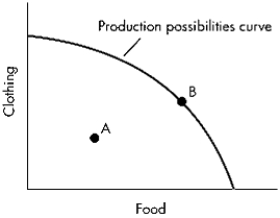 -Refer to Exhibit 3-8. At Point B in the production possibilities graph shown, the economy:
 (Multiple Choice)
4.7/5 (83)
(83) Three economic questions must be determined in all societies. What are they?
(Multiple Choice)
4.8/5 (77)
(77) Assume the economy moves from a situation with full employment to one in which the unemployment rate is higher. This can be portrayed as:
(Multiple Choice)
4.8/5 (91)
(91) 
Filters
- Essay(0)
- Multiple Choice(0)
- Short Answer(0)
- True False(0)
- Matching(0)