



 Chat with AI
Exam 3: Scarcity, Trade-Offs, and Production Possibilities

Exam 1: The Role and Method of Economics194 Questions
Exam 2: Eight Powerful Ideas212 Questions
Exam 3: Scarcity, Trade-Offs, and Production Possibilities182 Questions
Exam 4: Demand, Supply, and Market Equilibrium231 Questions
Exam 5: Market in Motion and Price Controls252 Questions
Exam 6: Elasticities271 Questions
Exam 7: Market Efficiency and Welfare128 Questions
Exam 8: Market Failure259 Questions
Exam 9: Public Finance and Public Choice62 Questions
Exam 10: Consumer Choice Theory206 Questions
Exam 11: The Firm: Production and Costs147 Questions
Exam 12: Firms in Perfectly Competitive Markets124 Questions
Exam 13: Monopoly and Antitrust62 Questions
Exam 14: Monopolistic Competition and Product Differentiation207 Questions
Exam 15: Oligopoly and Strategic Behavior68 Questions
Exam 16: The Markets for Labor, Capital, and Land131 Questions
Exam 17: Income, Poverty and Health Care252 Questions
Exam 18: Introduction to Macroeconomics: Unemployment, Inflation, and Economic Fluctuations152 Questions
Exam 19: Measuring Economic Performance152 Questions
Exam 20: Economic Growth in the Global Economy163 Questions
Exam 21: Financial Markets, Saving, and Investment146 Questions
Select questions type


The law of increasing opportunity costs implies that:

Free
(Multiple Choice)
4.9/5  (81)
(81) Correct Answer: Verified
B
Which one of the following will not cause the production possibilities curve to shift outward?
Free
(Multiple Choice)
4.9/5 (85)
(85) Correct Answer:Verified
VerifiedD
Capital-intensive production techniques tend to be utilized most commonly in countries where labor is relatively cheap.
Free
(True/False)
5.0/5 (95)
(95) Correct Answer:Verified
VerifiedFalse
Exhibit 3-2  -Refer to Exhibit 3-2. In the circular flow diagram, goods and services:
 (Multiple Choice)
4.8/5 (69)
(69) Which of the following is the most accurate statement about a production possibilities curve?
(Multiple Choice)
5.0/5 (74)
(74) Exhibit 3-12 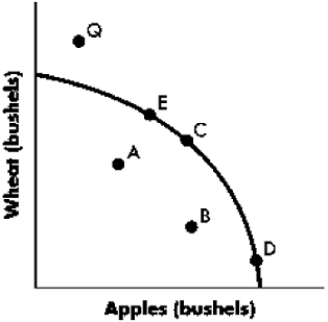 -Refer to Exhibit 3-12. Which of the following could make Point Q attainable in the production possibilities diagram?
 (Multiple Choice)
4.9/5 (89)
(89) Consumer sovereignty means that consumers vote with their dollars in a market economy, which helps determine what is produced.
(True/False)
4.9/5 (76)
(76) Exhibit 3-4  -Refer to Exhibit 3-4. Moving from Point ____ to Point ____ will result in an increase in the quantity of both capital and consumption goods produced this period.
 (Multiple Choice)
4.9/5 (69)
(69) Exhibit 3-13  -Refer to Exhibit 3-13. A movement from Point D to Point A:
 (Multiple Choice)
4.7/5 (89)
(89) Exhibit 3-4
-Refer to Exhibit 3-4. The movement from Point D to Point E:
-Refer to Exhibit 3-4. The movement from Point D to Point E: (Multiple Choice)
4.9/5 (78)
(78) High wage countries like the United States tend to use less labor-intensive production methods than low wage countries like Mexico.
(True/False)
4.9/5 (68)
(68) Exhibit 3-15 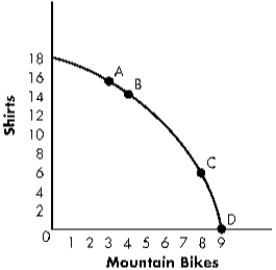 -Refer to Exhibit 3-15. Moving from Point A to Point B, what is the opportunity cost of producing a mountain bike?
 (Short Answer)
4.9/5 (81)
(81) Exhibit 3-3  -Refer to Exhibit 3-3. An economy is operating at full employment, and then workers in the bread industry are laid off. This change is portrayed in the movement from:
 (Multiple Choice)
4.9/5 (79)
(79) Which of the following will not shift the production possibilities curve outward?
(Multiple Choice)
4.8/5 (79)
(79) The use of large amounts of labor relative to capital in an economy indicates:
(Multiple Choice)
4.8/5 (78)
(78) A devastating earthquake destroys ten percent of the population in California. As a result:
(Multiple Choice)
4.7/5 (75)
(75) A production possibilities curve will be concave as opposed to straight line if
(Multiple Choice)
4.9/5 (76)
(76) 
Filters
- Essay(0)
- Multiple Choice(0)
- Short Answer(0)
- True False(0)
- Matching(0)