



 Chat with AI
Exam 3: Scarcity, Trade-Offs, and Production Possibilities

Exam 1: The Role and Method of Economics194 Questions
Exam 2: Eight Powerful Ideas212 Questions
Exam 3: Scarcity, Trade-Offs, and Production Possibilities182 Questions
Exam 4: Demand, Supply, and Market Equilibrium231 Questions
Exam 5: Market in Motion and Price Controls252 Questions
Exam 6: Elasticities271 Questions
Exam 7: Market Efficiency and Welfare128 Questions
Exam 8: Market Failure259 Questions
Exam 9: Public Finance and Public Choice62 Questions
Exam 10: Consumer Choice Theory206 Questions
Exam 11: The Firm: Production and Costs147 Questions
Exam 12: Firms in Perfectly Competitive Markets124 Questions
Exam 13: Monopoly and Antitrust62 Questions
Exam 14: Monopolistic Competition and Product Differentiation207 Questions
Exam 15: Oligopoly and Strategic Behavior68 Questions
Exam 16: The Markets for Labor, Capital, and Land131 Questions
Exam 17: Income, Poverty and Health Care252 Questions
Exam 18: Introduction to Macroeconomics: Unemployment, Inflation, and Economic Fluctuations152 Questions
Exam 19: Measuring Economic Performance152 Questions
Exam 20: Economic Growth in the Global Economy163 Questions
Exam 21: Financial Markets, Saving, and Investment146 Questions
Select questions type


Exhibit 3-3  -Refer to Exhibit 3-3. The most inefficient point depicted is:
 (Multiple Choice)
4.8/5  (78)
(78) Exhibit 3-4  -Refer to Exhibit 3-4. Moving from Point ____ to Point ____ will result in an increase in the quantity of both capital and consumption goods produced this period.
 (Multiple Choice)
4.8/5 (75)
(75) If an economy is operating inside its production possibilities curve for tanks and bread:
(Multiple Choice)
4.8/5 (72)
(72) Exhibit 3-7  -Refer to Exhibit 3-7. If the economy moves from Point C to Point A in the diagram:
 (Multiple Choice)
4.8/5 (82)
(82) Other things being constant, an economy must give up some consumer goods and services today to produce more capital goods in order to grow.
(True/False)
4.9/5 (89)
(89) In a market operating along the production possibilities curve, which of the following is inevitable if the production of one of the goods is increased?
(Multiple Choice)
4.9/5 (83)
(83) Exhibit 3-9 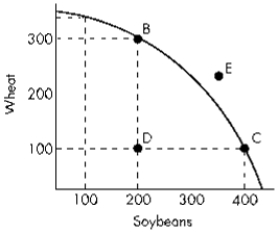 -Refer to Exhibit 3-9. In order to move from Point B to Point C, the economy will have to:
 (Multiple Choice)
5.0/5 (82)
(82) Exhibit 3-13  -Refer to Exhibit 3-13. A movement from Point D to Point F:
 (Multiple Choice)
4.8/5 (75)
(75) A system of economic organization in which the ownership and control of productive capital assets rests with the state and resources are allocated through central planning and political decision making is called:
(Multiple Choice)
4.9/5 (77)
(77) A production possibilities curve that is linear (a straight line):
(Multiple Choice)
4.9/5 (78)
(78) The position of a country's production possibilities curve in the future will be affected by:
(Multiple Choice)
4.8/5 (72)
(72) Which of the following is most limited in scope under a pure market economy?
(Multiple Choice)
5.0/5 (81)
(81) A technological advance that increases the productivity of all inputs is best illustrated as:
(Multiple Choice)
4.8/5 (80)
(80) Explain how each of the following could discourage economic growth:
a.The government closes all of the schools so that more people will be available for work.
b.The country fears military invasion and spends half of its income on military goods.
(Essay)
4.9/5 (94)
(94) Workers in the 1800s building railroads by hand was an example of a(n) ____ intensive form of production.
(Multiple Choice)
4.9/5 (86)
(86) Exhibit 3-7
-Refer to Exhibit 3-7. The diagram represents a tradeoff in an economy between prison cells and classrooms. Which position represents the choice to allocate the greatest amount of resources to producing prison cells?
-Refer to Exhibit 3-7. The diagram represents a tradeoff in an economy between prison cells and classrooms. Which position represents the choice to allocate the greatest amount of resources to producing prison cells? (Multiple Choice)
4.8/5 (82)
(82) 
Filters
- Essay(0)
- Multiple Choice(0)
- Short Answer(0)
- True False(0)
- Matching(0)