



 Chat with AI
Exam 7: Market Efficiency and Welfare

Exam 1: The Role and Method of Economics194 Questions
Exam 2: Eight Powerful Ideas212 Questions
Exam 3: Scarcity, Trade-Offs, and Production Possibilities182 Questions
Exam 4: Demand, Supply, and Market Equilibrium231 Questions
Exam 5: Market in Motion and Price Controls252 Questions
Exam 6: Elasticities271 Questions
Exam 7: Market Efficiency and Welfare128 Questions
Exam 8: Market Failure259 Questions
Exam 9: Public Finance and Public Choice62 Questions
Exam 10: Consumer Choice Theory206 Questions
Exam 11: The Firm: Production and Costs147 Questions
Exam 12: Firms in Perfectly Competitive Markets124 Questions
Exam 13: Monopoly and Antitrust62 Questions
Exam 14: Monopolistic Competition and Product Differentiation207 Questions
Exam 15: Oligopoly and Strategic Behavior68 Questions
Exam 16: The Markets for Labor, Capital, and Land131 Questions
Exam 17: Income, Poverty and Health Care252 Questions
Exam 18: Introduction to Macroeconomics: Unemployment, Inflation, and Economic Fluctuations152 Questions
Exam 19: Measuring Economic Performance152 Questions
Exam 20: Economic Growth in the Global Economy163 Questions
Exam 21: Financial Markets, Saving, and Investment146 Questions
Select questions type


How does the deadweight loss occur in a deficiency payment program?

Free
(Essay)
4.8/5  (79)
(79) Correct Answer: Verified
The deadweight loss occurs because the program increases the output beyond the efficient level of output. From the efficient level of output to the new level of output, the marginal cost to sellers for producing the good is greater than the marginal benefit to consumers.
Exhibit 7-8  -Refer to Exhibit 7-8. When the price is P2, the producer surplus is equal to area:
Free
(Multiple Choice)
4.8/5 (84)
(84) Correct Answer:Verified
VerifiedC
If James is willing to sell an extra concert ticket for $40 and actually sells it for $100, his consumer surplus is $60.
Free
(True/False)
4.7/5 (89)
(89) Correct Answer:Verified
VerifiedFalse
Ceteris paribus, a decrease in the price of a good will cause the:
(Multiple Choice)
4.8/5 (69)
(69) Exhibit 7-11  -Refer to Exhibit 7-11. The deadweight loss from the price ceiling is area:
 (Multiple Choice)
4.9/5 (70)
(70) Producer surplus is always the total area below the demand curve and above the supply curve.
(True/False)
4.7/5 (72)
(72) Exhibit 7-3 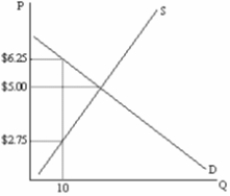 -Refer to Exhibit 7-3. What is the producer surplus of the 10th unit bought/sold?
 (Multiple Choice)
4.9/5 (86)
(86) The difference between the value of a good to consumers and its price is known as:
(Multiple Choice)
5.0/5 (76)
(76) Producer surplus from a unit of output is the difference between the market price and the seller's cost of producing that unit.
(True/False)
4.8/5 (78)
(78) Exhibit 7-12  -Refer to Exhibit 7-12. The deadweight loss when the government buys the surplus is:
 (Multiple Choice)
4.8/5 (82)
(82) A deadweight loss occurs as a result of a per-unit tax because:
(Multiple Choice)
4.9/5 (84)
(84) Exhibit 7-9  -Refer to Exhibit 7-9. The deadweight loss of a tax is area:
 (Multiple Choice)
4.8/5 (85)
(85) A government payment to producers for the difference between a target price and the price at which producers were able to sell their goods is known as a:
(Multiple Choice)
4.9/5 (81)
(81) Ceteris paribus, an increase in the price of a good will cause the:
(Multiple Choice)
4.8/5 (80)
(80) Exhibit 7-12
-Refer to Exhibit 7-12. Producer surplus before the price floor is area:
-Refer to Exhibit 7-12. Producer surplus before the price floor is area: (Multiple Choice)
4.9/5 (75)
(75) Exhibit 7-6 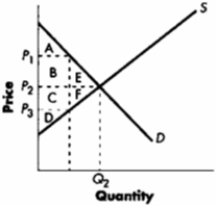 -Refer to Exhibit 7-6. If the market is in equilibrium and then the government imposes a price floor equal to P1, society suffers a deadweight loss equal to area:
 (Multiple Choice)
4.9/5 (67)
(67) Exhibit 7-14  -Refer to Exhibit 7-14. Identify the areas of consumer and producer surplus when a price floor equal to $30 is imposed.
 (Essay)
4.8/5 (85)
(85) Exhibit 7-7 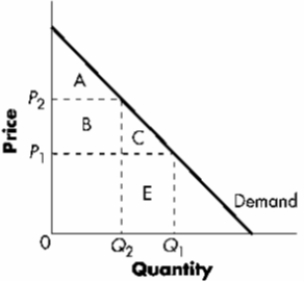 -Refer to Exhibit 7-7. When the price is P1, the consumer surplus is equal to the area:
 (Multiple Choice)
5.0/5 (97)
(97) 
Filters
- Essay(0)
- Multiple Choice(0)
- Short Answer(0)
- True False(0)
- Matching(0)