



 Chat with AI
Exam 18: Introduction to Macroeconomics: Unemployment, Inflation, and Economic Fluctuations

Exam 1: The Role and Method of Economics194 Questions
Exam 2: Eight Powerful Ideas212 Questions
Exam 3: Scarcity, Trade-Offs, and Production Possibilities182 Questions
Exam 4: Demand, Supply, and Market Equilibrium231 Questions
Exam 5: Market in Motion and Price Controls252 Questions
Exam 6: Elasticities271 Questions
Exam 7: Market Efficiency and Welfare128 Questions
Exam 8: Market Failure259 Questions
Exam 9: Public Finance and Public Choice62 Questions
Exam 10: Consumer Choice Theory206 Questions
Exam 11: The Firm: Production and Costs147 Questions
Exam 12: Firms in Perfectly Competitive Markets124 Questions
Exam 13: Monopoly and Antitrust62 Questions
Exam 14: Monopolistic Competition and Product Differentiation207 Questions
Exam 15: Oligopoly and Strategic Behavior68 Questions
Exam 16: The Markets for Labor, Capital, and Land131 Questions
Exam 17: Income, Poverty and Health Care252 Questions
Exam 18: Introduction to Macroeconomics: Unemployment, Inflation, and Economic Fluctuations152 Questions
Exam 19: Measuring Economic Performance152 Questions
Exam 20: Economic Growth in the Global Economy163 Questions
Exam 21: Financial Markets, Saving, and Investment146 Questions
Select questions type


When money demand increases, the Fed cannot keep both the money supply from rising and the interest rate from rising.

Free
(True/False)
4.9/5  (89)
(89) Correct Answer: Verified
True
Which of the following is not a limitation to monetary policy?
Free
(Multiple Choice)
4.8/5 (94)
(94) Correct Answer:Verified
VerifiedC
When the supply of money is vertical, changes in money demand will not change the equilibrium quantity of money in existence.
Free
(True/False)
4.9/5 (82)
(82) Correct Answer:Verified
VerifiedTrue
If economic recovery has already occurred by the time the effects of expansionary monetary policy are felt, it could cause an inflation problem rather than curing a recession problem.
(True/False)
5.0/5 (81)
(81) According to the growth version of the quantiy theory of money, the growth rate of the money supply equals the inflation rate plus the growth rate of real output.
(True/False)
4.9/5 (78)
(78) Above the equilibrium nominal interest rate, there is a surplus of money.
(True/False)
4.8/5 (85)
(85) When Fed policy is being used to offset a contractionary gap, which of the following variables decreases as a result?
(Multiple Choice)
4.8/5 (89)
(89) If the Fed sells bonds, the short run impact of this policy will tend to include:
(Multiple Choice)
5.0/5 (69)
(69) If commercial banks are increasing their borrowing from the Fed while the Fed is selling government securities, the borrowing of the commercial banks from the Fed will tend to:
(Multiple Choice)
4.9/5 (80)
(80) The quantity of money demanded varies ____ with the nominal interest rate, but the supply of money is almost perfectly ____ with respect to nominal interest rates.
(Multiple Choice)
5.0/5 (78)
(78) If the demand for money decreases, but the Fed keeps the money supply the same:
(Multiple Choice)
4.8/5 (78)
(78) The money supply and money demand curves are _____ and ______ respectively.
(Multiple Choice)
4.8/5 (81)
(81) Ceteris paribus, which of the following situations would result in the largest quantity of money demanded?
(Multiple Choice)
4.9/5 (70)
(70) When the economy is on the flatter part of the short run aggregate supply curve, efforts to change inflation with monetary policy will be ____ successful and efforts to stimulate the economy will be ____ successful.
(Multiple Choice)
4.8/5 (69)
(69) If inflation is the major problem in the economy, which of the following would be an appropriate monetary policy response?
(Multiple Choice)
4.8/5 (83)
(83) Based on the situation depicted in the graph below, which of the following would be an appropriate monetary policy response? 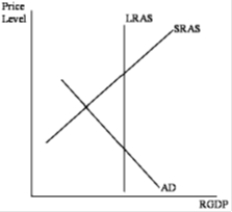
(Multiple Choice)
4.8/5 (66)
(66) If the economy's real GDP is growing at 3 percent each year and velocity is constant, for the price level to increase:
(Multiple Choice)
4.8/5 (63)
(63) The Fed can force the banking system to decrease the money supply by tightening monetary policy, but it cannot force the banking system to increase the money supply by loosening monetary policy.
(True/False)
5.0/5 (89)
(89) Quantitative easing involved Fed purchases of long term securities rather than short term securities.
(True/False)
4.8/5 (91)
(91) 
Filters
- Essay(0)
- Multiple Choice(0)
- Short Answer(0)
- True False(0)
- Matching(0)