



 Chat with AI
Exam 18: Introduction to Macroeconomics: Unemployment, Inflation, and Economic Fluctuations

Exam 1: The Role and Method of Economics194 Questions
Exam 2: Eight Powerful Ideas212 Questions
Exam 3: Scarcity, Trade-Offs, and Production Possibilities182 Questions
Exam 4: Demand, Supply, and Market Equilibrium231 Questions
Exam 5: Market in Motion and Price Controls252 Questions
Exam 6: Elasticities271 Questions
Exam 7: Market Efficiency and Welfare128 Questions
Exam 8: Market Failure259 Questions
Exam 9: Public Finance and Public Choice62 Questions
Exam 10: Consumer Choice Theory206 Questions
Exam 11: The Firm: Production and Costs147 Questions
Exam 12: Firms in Perfectly Competitive Markets124 Questions
Exam 13: Monopoly and Antitrust62 Questions
Exam 14: Monopolistic Competition and Product Differentiation207 Questions
Exam 15: Oligopoly and Strategic Behavior68 Questions
Exam 16: The Markets for Labor, Capital, and Land131 Questions
Exam 17: Income, Poverty and Health Care252 Questions
Exam 18: Introduction to Macroeconomics: Unemployment, Inflation, and Economic Fluctuations152 Questions
Exam 19: Measuring Economic Performance152 Questions
Exam 20: Economic Growth in the Global Economy163 Questions
Exam 21: Financial Markets, Saving, and Investment146 Questions
Select questions type


In an open economy, when the Fed increases the supply of money, it will increase net exports and aggregate demand.
(True/False)
4.8/5  (68)
(68) Which of the following pairs of policies have inconsistent effects on aggregate demand?
(Multiple Choice)
4.8/5 (74)
(74) If money supply increases, P will rise as long as V and Q remain constant.
(True/False)
4.9/5 (83)
(83) If velocity is growing by 2 percent per year and real output is growing 6 percent per year, according to the equation of exchange, in order to maintain stable prices, the money supply would have to:
(Multiple Choice)
4.8/5 (76)
(76) People hold money for transactions purposes, precautionary reasons, and asset purposes.
(True/False)
5.0/5 (88)
(88) If nominal interest rates rise, what will happen to demand for money?
(Multiple Choice)
4.9/5 (74)
(74) When money demand shifts, the Fed must choose between targeting the money supply and targeting the interest rate; it cannot target both.
(True/False)
4.8/5 (82)
(82) In the equation of exchange, an increase in M of 8 percent could be accompanied by changes in velocity, the price level and real GDP of:
(Multiple Choice)
4.8/5 (77)
(77) Based on the situation depicted in the graph below, which of the following would be an appropriate monetary policy response? 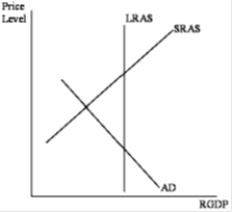
(Multiple Choice)
4.8/5 (69)
(69) Other things equal, in an open economy, monetary policy to offset a contractionary gap will tend to
(Multiple Choice)
4.8/5 (71)
(71) There are several motives for holding assets in the form of money. What are they? Provide an example of each.
(Essay)
4.9/5 (98)
(98) When the economy is far below the natural rate of real output, efforts to change inflation with monetary policy will be ____ successful and efforts to stimulate the economy will be ____ successful.
(Multiple Choice)
4.9/5 (85)
(85) If the money supply increased by 4 percent and velocity increased by 4 percent:
(Multiple Choice)
4.7/5 (77)
(77) Explain why the Fed must choose between targeting the money supply or targeting interest rates when money demand increases.
(Essay)
5.0/5 (74)
(74) Which of the following is not one variable in the equation of exchange?
(Multiple Choice)
4.7/5 (72)
(72) 
Filters
- Essay(0)
- Multiple Choice(0)
- Short Answer(0)
- True False(0)
- Matching(0)