



 Chat with AI
Exam 18: Introduction to Macroeconomics: Unemployment, Inflation, and Economic Fluctuations

Exam 1: The Role and Method of Economics194 Questions
Exam 2: Eight Powerful Ideas212 Questions
Exam 3: Scarcity, Trade-Offs, and Production Possibilities182 Questions
Exam 4: Demand, Supply, and Market Equilibrium231 Questions
Exam 5: Market in Motion and Price Controls252 Questions
Exam 6: Elasticities271 Questions
Exam 7: Market Efficiency and Welfare128 Questions
Exam 8: Market Failure259 Questions
Exam 9: Public Finance and Public Choice62 Questions
Exam 10: Consumer Choice Theory206 Questions
Exam 11: The Firm: Production and Costs147 Questions
Exam 12: Firms in Perfectly Competitive Markets124 Questions
Exam 13: Monopoly and Antitrust62 Questions
Exam 14: Monopolistic Competition and Product Differentiation207 Questions
Exam 15: Oligopoly and Strategic Behavior68 Questions
Exam 16: The Markets for Labor, Capital, and Land131 Questions
Exam 17: Income, Poverty and Health Care252 Questions
Exam 18: Introduction to Macroeconomics: Unemployment, Inflation, and Economic Fluctuations152 Questions
Exam 19: Measuring Economic Performance152 Questions
Exam 20: Economic Growth in the Global Economy163 Questions
Exam 21: Financial Markets, Saving, and Investment146 Questions
Select questions type


When the Fed is pursuing contractionary monetary policy it will tend to depreciate the value of the dollar and hence increase net exports, other things equal.
(True/False)
4.9/5  (74)
(74) When Fed policy is being used to offset an inflationary gap, which of the following variables increases as a result?
(Multiple Choice)
4.7/5 (82)
(82) An unexpected change in nominal interest rate changes real interest rate by ____ in the short run.
(Multiple Choice)
4.7/5 (73)
(73) The implementation lag is _____ for fiscal than for monetary policy; the lag before the effects of monetary policy on real output and unemployment is ____ than for its effects on real output and unemployment:
(Multiple Choice)
5.0/5 (72)
(72) Other things equal, monetary policy to offset a contractionary gap will tend to
(Multiple Choice)
4.8/5 (84)
(84) If the velocity of money (V) and real output (Q) were increasing at approximately the same rate, then:
(Multiple Choice)
4.9/5 (82)
(82) Based on the situation depicted in the graph below, which of the following would be an appropriate monetary policy response? 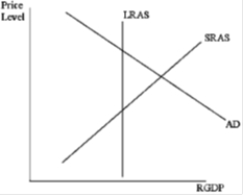
(Multiple Choice)
4.9/5 (91)
(91) If there is currently an inflationary gap in the economy the Fed could work toward recovery through an open market sale of government securities.
(True/False)
4.8/5 (92)
(92) When choosing how much money they wish to hold in their financial portfolios, people trade off money's advantage of liquidity against the opportunity cost of holding money rather than other financial assets.
(True/False)
4.8/5 (83)
(83) The problem of time lags in making policy changes is less acute for monetary policy than it is for fiscal policy.
(True/False)
4.8/5 (76)
(76) What is the equation of exchange? What are the variables, which are in it, and how do they relate to each other?
(Essay)
4.7/5 (77)
(77) If the Fed wanted to reduce the federal funds interest rate, it might:
(Multiple Choice)
4.9/5 (89)
(89) At a higher nominal interest rate, the demand for money decreases.
(True/False)
4.8/5 (89)
(89) When there is a liquidity trap, when the Fed adds bank reserves, there is a large effect on borrowing, investment and aggregate demand.
(True/False)
4.8/5 (83)
(83) Why is the time lag for making fiscal policy changes longer than for making monetary policy changes?
(Essay)
4.9/5 (85)
(85) 
Filters
- Essay(0)
- Multiple Choice(0)
- Short Answer(0)
- True False(0)
- Matching(0)