



 Chat with AI
Exam 18: Introduction to Macroeconomics: Unemployment, Inflation, and Economic Fluctuations

Exam 1: The Role and Method of Economics194 Questions
Exam 2: Eight Powerful Ideas212 Questions
Exam 3: Scarcity, Trade-Offs, and Production Possibilities182 Questions
Exam 4: Demand, Supply, and Market Equilibrium231 Questions
Exam 5: Market in Motion and Price Controls252 Questions
Exam 6: Elasticities271 Questions
Exam 7: Market Efficiency and Welfare128 Questions
Exam 8: Market Failure259 Questions
Exam 9: Public Finance and Public Choice62 Questions
Exam 10: Consumer Choice Theory206 Questions
Exam 11: The Firm: Production and Costs147 Questions
Exam 12: Firms in Perfectly Competitive Markets124 Questions
Exam 13: Monopoly and Antitrust62 Questions
Exam 14: Monopolistic Competition and Product Differentiation207 Questions
Exam 15: Oligopoly and Strategic Behavior68 Questions
Exam 16: The Markets for Labor, Capital, and Land131 Questions
Exam 17: Income, Poverty and Health Care252 Questions
Exam 18: Introduction to Macroeconomics: Unemployment, Inflation, and Economic Fluctuations152 Questions
Exam 19: Measuring Economic Performance152 Questions
Exam 20: Economic Growth in the Global Economy163 Questions
Exam 21: Financial Markets, Saving, and Investment146 Questions
Select questions type


Policy makers have adequate information to know what appropriate monetary policies to adopt.
(True/False)
4.9/5  (78)
(78) The interest rate that the Fed currently targets is the federal funds rate.
(True/False)
4.8/5 (75)
(75) The supply-of-money curve is almost perfectly inelastic because:
(Multiple Choice)
4.7/5 (88)
(88) In the long run, inflation results from increases in a nation's money supply that exceed increases in its output of goods and services.
(True/False)
4.8/5 (81)
(81) When Fed policy is being used to offset an inflationary gap, which of interest rates, investment, net exports and aggregate demand moves in the opposite direction from the others?
(Multiple Choice)
5.0/5 (76)
(76) When the Fed unexpectedly increases the money supply, it will cause an increase in aggregate demand because:
(Multiple Choice)
4.7/5 (87)
(87) During the sixteenth century, Spanish conquistadors like Hernando Cortes overwhelmed the Aztecs and other indigenous peoples in America by pillaging their cities, and taking their gold and silver. The gold and silver was sent back to Spain, causing its money supply to increase tenfold. Assuming V remained stable and Q increased slightly, what do you think happened to prices in Spain during this period?
(Essay)
4.7/5 (79)
(79) In the equation of exchange, an increase in M of 8 percent could be accompanied by changes in velocity, the price level and real GDP of:
(Multiple Choice)
4.9/5 (73)
(73) If the monetary authorities persistently expand the money supply at a rapid rate, the probable result will be:
(Multiple Choice)
4.7/5 (58)
(58) The Fed sometimes works to partly offset or even neutralize the effects of fiscal policy with monetary policy
(True/False)
4.9/5 (70)
(70) What effects does operating in an open economy add to expansionary monetary policy? To contractionary monetary policy?
(Essay)
4.8/5 (69)
(69) If there is currently a recessionary gap in the economy the Fed could work toward recovery by increasing the money supply and decreasing the interest rate.
(True/False)
4.7/5 (78)
(78) When the Fed is pursuing expansionary monetary policy it will tend to reduce the demand for the dollar and increase net exports, other things equal.
(True/False)
4.9/5 (74)
(74) If the demand for money increases, but the Fed keeps the money supply the same:
(Multiple Choice)
4.9/5 (75)
(75) The Fed would engage in ____ it wanted to address an inflationary gap.
(Multiple Choice)
4.9/5 (82)
(82) Based on the situation depicted in the graph below, which of the following would be an appropriate monetary policy response? 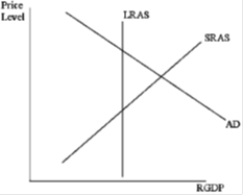
(Multiple Choice)
4.7/5 (81)
(81) The steeper the short-run aggregate supply curve over the relevant range, the more contractionary monetary policy will reduce prices and the less it will decrease real output.
(True/False)
4.9/5 (81)
(81) An expansionary monetary policy is likely to increase real output more than just temporarily:
(Multiple Choice)
4.9/5 (97)
(97) When the money supply decreases, other things being equal,
(Multiple Choice)
4.8/5 (65)
(65) 
Filters
- Essay(0)
- Multiple Choice(0)
- Short Answer(0)
- True False(0)
- Matching(0)