



 Chat with AI
Exam 7: Market Efficiency and Welfare

Exam 1: The Role and Method of Economics194 Questions
Exam 2: Eight Powerful Ideas212 Questions
Exam 3: Scarcity, Trade-Offs, and Production Possibilities182 Questions
Exam 4: Demand, Supply, and Market Equilibrium231 Questions
Exam 5: Market in Motion and Price Controls252 Questions
Exam 6: Elasticities271 Questions
Exam 7: Market Efficiency and Welfare128 Questions
Exam 8: Market Failure259 Questions
Exam 9: Public Finance and Public Choice62 Questions
Exam 10: Consumer Choice Theory206 Questions
Exam 11: The Firm: Production and Costs147 Questions
Exam 12: Firms in Perfectly Competitive Markets124 Questions
Exam 13: Monopoly and Antitrust62 Questions
Exam 14: Monopolistic Competition and Product Differentiation207 Questions
Exam 15: Oligopoly and Strategic Behavior68 Questions
Exam 16: The Markets for Labor, Capital, and Land131 Questions
Exam 17: Income, Poverty and Health Care252 Questions
Exam 18: Introduction to Macroeconomics: Unemployment, Inflation, and Economic Fluctuations152 Questions
Exam 19: Measuring Economic Performance152 Questions
Exam 20: Economic Growth in the Global Economy163 Questions
Exam 21: Financial Markets, Saving, and Investment146 Questions
Select questions type


Exhibit 7-6 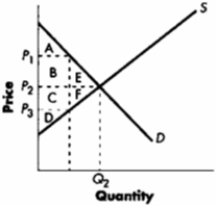 -Refer to Exhibit 7-6. If the market is in equilibrium and then the government imposes a price ceiling equal to P3, society suffers a deadweight loss equal to area:
 (Multiple Choice)
4.7/5  (83)
(83) Exhibit 7-6
-Refer to Exhibit 7-6. If the market is in equilibrium and then the government imposes a price ceiling equal to P3, sellers lose producer surplus equal to area:
-Refer to Exhibit 7-6. If the market is in equilibrium and then the government imposes a price ceiling equal to P3, sellers lose producer surplus equal to area: (Multiple Choice)
4.8/5 (74)
(74) If the world supply of diamonds increases, the market price of diamonds decreases, and the consumer surplus derived by diamond consumers increases.
(True/False)
4.7/5 (74)
(74) Total welfare gains from trade to the economy can be measured:
(Multiple Choice)
4.8/5 (71)
(71) Exhibit 7-13  -Refer to Exhibit 7-13. Under this program, the producers will sell all they can at ____.
 (Multiple Choice)
4.7/5 (77)
(77) The net loss to society from a tax on a product can be measured as:
(Multiple Choice)
4.7/5 (83)
(83) Exhibit 7-14  -Refer to Exhibit 7-14. Identify the deadweight loss in the above diagram when a price floor equal to $30 is imposed.
 (Essay)
4.8/5 (77)
(77) Fred's demand schedule for movie DVDs is as follows: At $60, he would buy 1; at $50, he would buy two; at $30, he would buy 3; and at $20, he would buy 4. If the price of movie DVDs equals $40, the consumer surplus Fred receives from purchasing movie DVDs would be:
(Multiple Choice)
4.8/5 (64)
(64) Exhibit 7-8  -Refer to Exhibit 7-8. When the price falls from P2 to P1, producer surplus:
 (Multiple Choice)
4.8/5 (70)
(70) Exhibit 7-11  -Refer to Exhibit 7-11. The producer surplus after the price ceiling is area
 (Multiple Choice)
4.9/5 (88)
(88) If Stephanie buys a laptop for $700 and the maximum she would have paid was $1,000, which of the following is true?
(Multiple Choice)
4.9/5 (68)
(68) Exhibit 7-10  -Refer to Exhibit 7-10. The deadweight loss from the subsidy is area
 (Multiple Choice)
4.8/5 (81)
(81) A subsidy in an industry would be likely to increase the consumer surplus for buyers in that industry and increase the producer surplus for sellers in that industry.
(True/False)
4.8/5 (74)
(74) Consumer surplus increases whenever the price of a good increases.
(True/False)
4.8/5 (74)
(74) Which of the following best explains the source of consumer surplus for Good A?
(Multiple Choice)
4.9/5 (87)
(87) Exhibit 7-9  -Refer to Exhibit 7-9. The amount of tax revenue after the tax is area:
 (Multiple Choice)
5.0/5 (72)
(72) Phil and Kelly have always wanted to take a cruise. Although willing to pay $5,000 for a Caribbean cruise for two, they were able to purchase a cruise vacation for two for $3,500. Their total consumer surplus amounted to:
(Multiple Choice)
4.9/5 (71)
(71) Exhibit 7-9
-Refer to Exhibit 7-9. The amount of producer surplus after the tax is area:
-Refer to Exhibit 7-9. The amount of producer surplus after the tax is area: (Multiple Choice)
5.0/5 (75)
(75) 
Filters
- Essay(0)
- Multiple Choice(0)
- Short Answer(0)
- True False(0)
- Matching(0)