



 Chat with AI
Exam 3: Scarcity, Trade-Offs, and Production Possibilities

Exam 1: The Role and Method of Economics194 Questions
Exam 2: Eight Powerful Ideas212 Questions
Exam 3: Scarcity, Trade-Offs, and Production Possibilities182 Questions
Exam 4: Demand, Supply, and Market Equilibrium231 Questions
Exam 5: Market in Motion and Price Controls252 Questions
Exam 6: Elasticities271 Questions
Exam 7: Market Efficiency and Welfare128 Questions
Exam 8: Market Failure259 Questions
Exam 9: Public Finance and Public Choice62 Questions
Exam 10: Consumer Choice Theory206 Questions
Exam 11: The Firm: Production and Costs147 Questions
Exam 12: Firms in Perfectly Competitive Markets124 Questions
Exam 13: Monopoly and Antitrust62 Questions
Exam 14: Monopolistic Competition and Product Differentiation207 Questions
Exam 15: Oligopoly and Strategic Behavior68 Questions
Exam 16: The Markets for Labor, Capital, and Land131 Questions
Exam 17: Income, Poverty and Health Care252 Questions
Exam 18: Introduction to Macroeconomics: Unemployment, Inflation, and Economic Fluctuations152 Questions
Exam 19: Measuring Economic Performance152 Questions
Exam 20: Economic Growth in the Global Economy163 Questions
Exam 21: Financial Markets, Saving, and Investment146 Questions
Select questions type


What are the factors that can cause a shift in the production possibilities curve?
(Essay)
4.7/5  (84)
(84) Suppose Freeland produces few consumption goods and many investment goods while Liberty Nation produces few investment goods and many consumption goods. Other things equal, you would expect
(Multiple Choice)
4.9/5 (70)
(70) Exhibit 3-13  -Refer to Exhibit 3-13. The opportunity cost of producing an additional cake:
 (Multiple Choice)
4.9/5 (86)
(86) Which of the following is NOT illustrated by a production possibility curve?
(Multiple Choice)
4.9/5 (75)
(75) Exhibit 3-4  -Refer to Exhibit 3-4. The opportunity cost of one more unit of a capital good is greater at Point ____ than at Point ____.
 (Multiple Choice)
4.8/5 (80)
(80) Excessive unemployment of resources is illustrated using a production possibilities curve by:
(Multiple Choice)
4.9/5 (71)
(71) Along a production possibilities curve that is concave to the origin, the opportunity cost of production of the good on the horizontal axis ____ as we move down along the curve.
(Multiple Choice)
4.8/5 (82)
(82) The main reason economists are concerned about the problem of idle or unemployed resources is that:
(Multiple Choice)
4.9/5 (69)
(69) Given its production possibilities curve, the optimal combination of outputs for a society:
(Multiple Choice)
5.0/5 (81)
(81) Alex must prepare for exams in both biology and economics this week. Assume that the production possibilities curve showing the tradeoff between exam scores in biology and economics is concave toward the origin. As Alex moves along the curve spending more of his time studying for economics, the opportunity cost of an hour of preparation for economics:
(Multiple Choice)
4.7/5 (72)
(72) Exhibit 3-4
-Refer to Exhibit 3-4. For this economy, the most preferred point at which to produce is:
-Refer to Exhibit 3-4. For this economy, the most preferred point at which to produce is: (Multiple Choice)
4.9/5 (80)
(80) Which of the following distinguishes a "straight-line" production possibilities curve from one that is "bowed out"?
(Multiple Choice)
4.8/5 (81)
(81) Exhibit 3-15 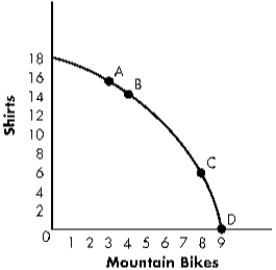 -Refer to Exhibit 3-15. Moving from Point C to Point D, what is the opportunity cost of producing a mountain bike?
 (Short Answer)
4.9/5 (87)
(87) Exhibit 3-3  -Refer to Exhibit 3-3. A movement from Point G to Point F:
 (Multiple Choice)
4.8/5 (84)
(84) Consider a production possibilities curve for an economy producing bicycles and video game players. It is possible to increase the production of bicycles without sacrificing video game players if:
(Multiple Choice)
4.9/5 (72)
(72) An improvement in technology will tend to cause a society's production possibilities curve to shift outward.
(True/False)
4.9/5 (65)
(65) The simple circular flow model shows that workers and owners of land and capital offer their services through:
(Multiple Choice)
4.9/5 (81)
(81) The circular flow model indicates that income flows from households to firms through product markets and back from firms to households through factor markets. Is the total amount spent by all households equal to the total income that flows back to all households? Why or why not? Is the amount spent by each individual household equal to the amount that flows back to that specific household? Why or why not?
(Essay)
4.9/5 (84)
(84) 
Filters
- Essay(0)
- Multiple Choice(0)
- Short Answer(0)
- True False(0)
- Matching(0)