



 Chat with AI
Exam 3: Scarcity, Trade-Offs, and Production Possibilities

Exam 1: The Role and Method of Economics194 Questions
Exam 2: Eight Powerful Ideas212 Questions
Exam 3: Scarcity, Trade-Offs, and Production Possibilities182 Questions
Exam 4: Demand, Supply, and Market Equilibrium231 Questions
Exam 5: Market in Motion and Price Controls252 Questions
Exam 6: Elasticities271 Questions
Exam 7: Market Efficiency and Welfare128 Questions
Exam 8: Market Failure259 Questions
Exam 9: Public Finance and Public Choice62 Questions
Exam 10: Consumer Choice Theory206 Questions
Exam 11: The Firm: Production and Costs147 Questions
Exam 12: Firms in Perfectly Competitive Markets124 Questions
Exam 13: Monopoly and Antitrust62 Questions
Exam 14: Monopolistic Competition and Product Differentiation207 Questions
Exam 15: Oligopoly and Strategic Behavior68 Questions
Exam 16: The Markets for Labor, Capital, and Land131 Questions
Exam 17: Income, Poverty and Health Care252 Questions
Exam 18: Introduction to Macroeconomics: Unemployment, Inflation, and Economic Fluctuations152 Questions
Exam 19: Measuring Economic Performance152 Questions
Exam 20: Economic Growth in the Global Economy163 Questions
Exam 21: Financial Markets, Saving, and Investment146 Questions
Select questions type


Exhibit 3-9 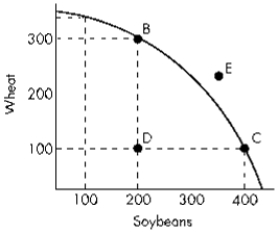 -Refer to Exhibit 3-9. In order to move from Point D to Point C, the economy will have to give up:
 (Multiple Choice)
4.8/5  (73)
(73) Which of the following would be likely to shift a nation's production possibilities curve outward?
(Multiple Choice)
4.8/5 (83)
(83) The production possibilities curve marks the boundary between attainable and unattainable combinations of output.
(True/False)
4.9/5 (75)
(75) Exhibit 3-2  -Refer to Exhibit 3-2. In the circular flow diagram, payments for goods and services:
 (Multiple Choice)
4.8/5 (81)
(81) Exhibit 3-9
-Refer to Exhibit 3-9. Assume the economy is operating at Point D in the figure. The opportunity cost of moving to Point B is:
-Refer to Exhibit 3-9. Assume the economy is operating at Point D in the figure. The opportunity cost of moving to Point B is: (Multiple Choice)
4.8/5 (86)
(86) Exhibit 3-7  -Refer to Exhibit 3-7. The diagram represents a tradeoff in an economy between prison cells and classrooms. Which position represents the choice to allocate the greatest amount of resources to producing classrooms?
 (Multiple Choice)
4.9/5 (71)
(71) Which of the following best distinguishes a "command economy" from a "market economy?"
(Multiple Choice)
4.9/5 (83)
(83) Exhibit 3-14  -Refer to Exhibit 3-14. Which move to the new production possibilities curve will lead to more food and the same level of housing?
 (Multiple Choice)
4.9/5 (77)
(77) Exhibit 3-4  -Refer to Exhibit 3-4. Currently, Point ____ is impossible to achieve.
 (Multiple Choice)
4.8/5 (63)
(63) A market economy answers the question "what" goods will be produced by focusing on
(Multiple Choice)
4.8/5 (83)
(83) Which of the following would be likely to expand a production possibilities curve?
(Multiple Choice)
4.9/5 (78)
(78) A move from an abnormally high rate of unemployment toward a more typical level of unemployment would:
(Multiple Choice)
4.8/5 (73)
(73) Exhibit 3-6  -Refer to Exhibit 3-6. In the diagram, Point A is:
 (Multiple Choice)
4.8/5 (86)
(86) Exhibit 3-13  -Refer to Exhibit 3-13. The opportunity cost of producing an additional cupcake equals:
 (Multiple Choice)
4.9/5 (72)
(72) Exhibit 3-4
-Refer to Exhibit 3-4. The opportunity cost of one more unit of a consumption good is greater at Point ____ than at Point ____.
-Refer to Exhibit 3-4. The opportunity cost of one more unit of a consumption good is greater at Point ____ than at Point ____. (Multiple Choice)
4.9/5 (81)
(81) Exhibit 3-4
-Refer to Exhibit 3-4. Considering only points on the frontier, the economy will experience the least amount of economic growth over time (ceteris paribus) if it chooses to produce at:
-Refer to Exhibit 3-4. Considering only points on the frontier, the economy will experience the least amount of economic growth over time (ceteris paribus) if it chooses to produce at: (Multiple Choice)
4.7/5 (83)
(83) The opportunity cost of a particular good tends to increase with its rate of output because some resources cannot be easily adapted from the production of one good or service to another.
(True/False)
4.8/5 (79)
(79) 
Filters
- Essay(0)
- Multiple Choice(0)
- Short Answer(0)
- True False(0)
- Matching(0)