



 Chat with AI
Exam 3: Scarcity, Trade-Offs, and Production Possibilities

Exam 1: The Role and Method of Economics194 Questions
Exam 2: Eight Powerful Ideas212 Questions
Exam 3: Scarcity, Trade-Offs, and Production Possibilities182 Questions
Exam 4: Demand, Supply, and Market Equilibrium231 Questions
Exam 5: Market in Motion and Price Controls252 Questions
Exam 6: Elasticities271 Questions
Exam 7: Market Efficiency and Welfare128 Questions
Exam 8: Market Failure259 Questions
Exam 9: Public Finance and Public Choice62 Questions
Exam 10: Consumer Choice Theory206 Questions
Exam 11: The Firm: Production and Costs147 Questions
Exam 12: Firms in Perfectly Competitive Markets124 Questions
Exam 13: Monopoly and Antitrust62 Questions
Exam 14: Monopolistic Competition and Product Differentiation207 Questions
Exam 15: Oligopoly and Strategic Behavior68 Questions
Exam 16: The Markets for Labor, Capital, and Land131 Questions
Exam 17: Income, Poverty and Health Care252 Questions
Exam 18: Introduction to Macroeconomics: Unemployment, Inflation, and Economic Fluctuations152 Questions
Exam 19: Measuring Economic Performance152 Questions
Exam 20: Economic Growth in the Global Economy163 Questions
Exam 21: Financial Markets, Saving, and Investment146 Questions
Select questions type


An increase in an economy's capital stock increases its future productive capacity.
(True/False)
4.8/5  (79)
(79) When collective decision making is utilized to resolve economic questions regarding the allocation of resources, then:
(Multiple Choice)
4.8/5 (85)
(85) Is increased capital spending the only way for an economy to expand its production possibilities curve?
(Multiple Choice)
4.9/5 (77)
(77) Capital accumulation causes the production possibilities curve to shift inward over time.
(True/False)
4.9/5 (69)
(69) Which of the following is not an example of a consumption good?
(Multiple Choice)
4.9/5 (67)
(67) In a command economy, decisions about how to allocate resources are made:
(Multiple Choice)
4.7/5 (69)
(69) An inefficient allocation of resources or unusually high unemployment:
(Multiple Choice)
4.8/5 (75)
(75) Exhibit 3-3  -Refer to Exhibit 3-3. A movement from Point C to Point B:
 (Multiple Choice)
5.0/5 (92)
(92) Exhibit 3-10 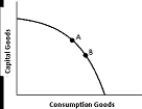 -Refer to Exhibit 3-10. If Points A and B indicate consumption goods and capital goods for two different economies, other things held constant, which of the economies is likely to grow more rapidly?
 (Multiple Choice)
4.8/5 (86)
(86) Assume that, given factors of production and existing knowledge and technology, it is not possible to produce more of one good without foregoing the opportunity to produce some of another good. Economists would characterize this situation as:
(Multiple Choice)
4.8/5 (75)
(75) Which of the following is not a payment made to households in exchange for the use of factors of production?
(Multiple Choice)
4.9/5 (91)
(91) The production possibilities curve for an economy that experiences a constant opportunity cost of production is linear (a straight line).
(True/False)
4.9/5 (71)
(71) The degree of government involvement in the economy is greatest in
(Multiple Choice)
4.8/5 (79)
(79) Exhibit 3-3
-Refer to Exhibit 3-3. A movement from Point B to Point C:
-Refer to Exhibit 3-3. A movement from Point B to Point C: (Multiple Choice)
4.7/5 (88)
(88) Which of the following would mostly likely shift the production possibilities curve in an outward direction?
(Multiple Choice)
4.9/5 (69)
(69) Which of the following would be most likely to shift a country's production possibilities curve outward?
(Multiple Choice)
4.8/5 (90)
(90) Exhibit 3-15 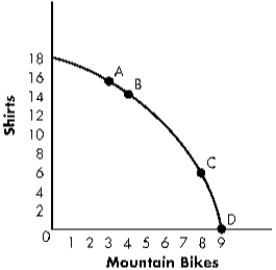 -Refer to Exhibit 3-15. Why is the opportunity cost of producing a mountain bike different when moving from Point A to Point B than when moving from Point C to Point D along the production possibilities curve?
 (Essay)
4.8/5 (66)
(66) In the graph of the circular flow model below, area C represents 
(Multiple Choice)
4.9/5 (84)
(84) How can we measure the opportunity cost of producing a good? Using a bowed outward production possibilities curve between ice cream and hammers, identify graphically the opportunity cost of obtaining an additional hammer.
(Essay)
4.7/5 (83)
(83) 
Filters
- Essay(0)
- Multiple Choice(0)
- Short Answer(0)
- True False(0)
- Matching(0)