



 Chat with AI
Exam 5: Perception

Exam 1: Research Methods104 Questions
Exam 2: Evolutionary and Genetic Influences on Behavior142 Questions
Exam 3: The Brain and the Nervous System260 Questions
Exam 4: Sensation247 Questions
Exam 5: Perception180 Questions
Exam 6: Consciousness161 Questions
Exam 7: Learning192 Questions
Exam 8: Memory202 Questions
Exam 9: Thinking200 Questions
Exam 10: Language206 Questions
Exam 11: Intelligence201 Questions
Exam 12: Motivation and Emotion202 Questions
Exam 13: Social Psychology157 Questions
Exam 14: Development204 Questions
Exam 15: Personality150 Questions
Exam 16: Psychopathology142 Questions
Exam 17: Treatment of Mental Disorders127 Questions
Select questions type


In one study, research participants were shown a luminous rectangular frame in an otherwise darkened room. Inside the frame was a luminous dot. The rectangle moved to the right while the dot stayed stationary. But the subjects "saw" the dot moving to the left, in a direction opposite that of the frame's motion. This result confirms the idea that __________.
(Multiple Choice)
4.9/5  (91)
(91) Animated neon signs seem to move even though there is no actual physical movement. Of what is this illusion an example?
(Multiple Choice)
5.0/5 (71)
(71) Which of the following statements about dichotic listening tasks, in which different signals are delivered to each ear, is true?
(Multiple Choice)
4.7/5 (84)
(84) Let's say you are trying to look into a window but your view is blocked by a flag hanging from the deck fence. When our view of one object is occluded by another, we use that fact as a means of judging distance. In other words, we rely on a cue known as __________.
(Multiple Choice)
4.7/5 (68)
(68) What is problematic with the idea that processing for object recognition occurs in a serial fashion (figure-ground segregation geons meaning)?
(Multiple Choice)
4.7/5 (86)
(86) According to the gestalt grouping factor of good continuation, how would someone who had never before seen an "X" most likely describe it?
(Multiple Choice)
4.7/5 (76)
(76) In a dichotic listening task, different stimuli are delivered to each ear. The subject is told to attend to one signal over the other. Which of the following is most likely to be noticed in the unattended ear?
(Multiple Choice)
4.8/5 (79)
(79) Which of the following makes the strongest argument against the view that perceptual constancy depends solely on higher-order relationships?
(Multiple Choice)
4.9/5 (74)
(74) Let's say that, as we look at a still-life painting, a log seems to divide the tree behind it in half-yet what we perceive is an intact log, not two separate log slices. The way we organize scenes according to their constituent objects is called __________.
(Multiple Choice)
5.0/5 (79)
(79) As a passenger, you look out the windshield as the car is backed out of the garage. As the car moves farther away, an old tire hanging on the back wall of the garage gets smaller and smaller until you can barely make out the words GOODYEAR TIRE CO. on it. From what does this phenomenon result?
(Multiple Choice)
4.7/5 (80)
(80) People are apt to see the following figure as an outline square covered in its lower right corner by a white line rather than as a rearrangement of the two separate figures on the right. What grouping factor of perceptual organization best explains this? 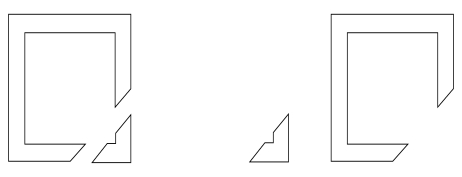
(Multiple Choice)
4.9/5 (85)
(85) What concept is described by the fact that we attend to specific aspects of the total stimulus array?
(Multiple Choice)
4.9/5 (73)
(73) The gestalt laws of perceptual organization include __________.
(Multiple Choice)
4.9/5 (83)
(83) 
Filters
- Essay(0)
- Multiple Choice(0)
- Short Answer(0)
- True False(0)
- Matching(0)