



 Chat with AI
Exam 5: Perception

Exam 1: Research Methods104 Questions
Exam 2: Evolutionary and Genetic Influences on Behavior142 Questions
Exam 3: The Brain and the Nervous System260 Questions
Exam 4: Sensation247 Questions
Exam 5: Perception180 Questions
Exam 6: Consciousness161 Questions
Exam 7: Learning192 Questions
Exam 8: Memory202 Questions
Exam 9: Thinking200 Questions
Exam 10: Language206 Questions
Exam 11: Intelligence201 Questions
Exam 12: Motivation and Emotion202 Questions
Exam 13: Social Psychology157 Questions
Exam 14: Development204 Questions
Exam 15: Personality150 Questions
Exam 16: Psychopathology142 Questions
Exam 17: Treatment of Mental Disorders127 Questions
Select questions type


Breaking the stimulus into uniform parts is the process called __________.
(Multiple Choice)
4.8/5  (90)
(90) Certain devices, like the child's View-Master toy, make photographs look like three-dimensional images. How are they able to do this?
(Multiple Choice)
4.8/5 (86)
(86) What type of pattern recognition starts with features and gradually builds up to more complex structures, such as letters, words, and phrases?
(Multiple Choice)
4.9/5 (71)
(71) In the accompanying figure, the 13s in the top and bottom rows are identical, but the one on top is perceived as a letter while the one on the bottom is perceived as a number. Why might this difference in perception occur? 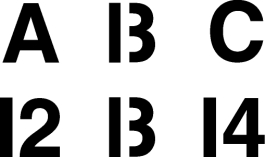
(Multiple Choice)
4.9/5 (80)
(80) Which of the following depth cues requires the use of two eyes?
(Multiple Choice)
4.9/5 (87)
(87) There are a number of depth cues, and we rely on all of them depending on the situation in which we find ourselves as perceivers. Why, according to some theorists, did natural selection favor a system influenced by so many cues, especially given that the information provided by these cues is so often redundant?
(Multiple Choice)
5.0/5 (80)
(80) Gestalt psychologists take which of the following positions with respect to perception?
(Multiple Choice)
4.8/5 (79)
(79) When looking down a rocky beach, you see individual stones nearby, but farther away you can see only a rough-looking terrain. What does this example best illustrate?
(Multiple Choice)
4.7/5 (89)
(89) Jasmine has visual agnosia. She is holding a long-stem red rose. What will Jasmine be unable to do?
(Multiple Choice)
4.8/5 (65)
(65) What does the proximity law of perceptual organization assert?
(Multiple Choice)
5.0/5 (79)
(79) What is true of a situation in which we attempt to interpret an ambiguous figure?
(Multiple Choice)
4.8/5 (88)
(88) A hierarchy of feature detectors are typically referred to as __________.
(Multiple Choice)
4.8/5 (84)
(84) Looking out the window while seated on a stationary train, Rebecca sees another stationary train on the next track. One of the trains begins to move, and Rebecca is not sure whether her train is moving or if the other train is moving. What phenomenon is responsible for this confusion?
(Multiple Choice)
4.9/5 (66)
(66) What inference is most reasonable from studies of visual searches where the target stimulus "pops out" when placed in an array of stimuli that differ from the target in one specific way?
(Multiple Choice)
5.0/5 (89)
(89) When perception is largely data-driven, determined by the incoming stimulus information, it is said to be __________.
(Multiple Choice)
4.9/5 (93)
(93) A person with only one eye could perceive depth by using which cue(s)?
(Multiple Choice)
4.8/5 (67)
(67) A patient with visual agnosia is looking at his house key. What will he most likely have difficulty with?
(Multiple Choice)
4.9/5 (88)
(88) When perceiving an image, what is the most important element or feature?
(Multiple Choice)
4.8/5 (74)
(74) 
Filters
- Essay(0)
- Multiple Choice(0)
- Short Answer(0)
- True False(0)
- Matching(0)