



 Chat with AI
Exam 26: Tax Practice and Ethics

Exam 1: An Introduction to Taxation and Understanding the Federal Tax Law211 Questions
Exam 2: Working with the Tax Law102 Questions
Exam 3: Computing the Tax180 Questions
Exam 4: Gross Income: Concepts and Inclusions125 Questions
Exam 5: Gross Income: Exclusions113 Questions
Exam 6: Deductions and Losses: In General156 Questions
Exam 7: Deductions and Losses: Certain Business Expenses and Losses94 Questions
Exam 8: Depreciation, Cost Recovery, Amortization, and Depletion120 Questions
Exam 9: Deductions: Employee and Self-Employed-Related Expenses153 Questions
Exam 10: Deductions and Losses: Certain Itemized Deductions104 Questions
Exam 11: Investor Losses130 Questions
Exam 12: Tax Credits and Payments111 Questions
Exam 13: Property Transactions: Determination of Gain or Loss, Basis Considerations, and Nontaxable Exchanges285 Questions
Exam 14: Property Transactions: Capital Gains and Losses, Section 1231, and Recapture Provisions167 Questions
Exam 15: Taxing Business Income60 Questions
Exam 16: Accounting Periods and Methods88 Questions
Exam 17: Corporations: Introduction and Operating Rules108 Questions
Exam 18: Corporations: Organization and Capital Structure109 Questions
Exam 19: Corporations: Distributions Not in Complete Liquidation185 Questions
Exam 20: Corporations: Distributions in Complete Liquidation and an Overview of Reorganizations71 Questions
Exam 21: Partnerships248 Questions
Exam 22: S Corporations129 Questions
Exam 23: Exempt Entities153 Questions
Exam 24: Multistate Corporate Taxation204 Questions
Exam 25: Taxation of International Transactions146 Questions
Exam 26: Tax Practice and Ethics184 Questions
Exam 27: The Federal Gift and Estate Taxes141 Questions
Exam 28: Income Taxation of Trusts and Estates161 Questions
Select questions type


Quon filed his Federal income tax return on time, but he did not remit the full balance due. Compute Quon's failure to pay penalty in each of the following cases. The IRS has not yet issued a deficiency notice.
a. Three months late, $5,000 additional tax due.
b. Nine months late, $5,000 additional tax due.
c. Five years late, $5,000 additional tax due.
(Essay)
4.9/5  (83)
(83) An individual is not subject to an underpayment penalty until more than ________________$ is due and unpaid through estimated taxes.
(Short Answer)
4.9/5 (73)
(73) The IRS can require that the taxpayer produce its financial accounting records, to determine if taxable income is computed correctly.
(True/False)
4.8/5 (78)
(78) An IRS "office audit" takes place at the headquarters office of the corporate taxpayer.
(True/False)
5.0/5 (78)
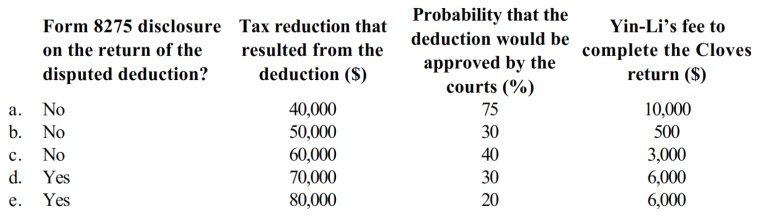
(78) Yin-Li is the preparer of the Form 1120 for Cloves Corporation. On the return, Cloves claimed a deduction that the IRS later disallowed on audit. Compute the tax preparer penalty that could be assessed against Yin-Li in each of the following independent situations.
(Essay)
4.9/5 (82)
(82) Singh has agreed with the IRS that she owes $70,000 in delinquent tax, penalties, and interest. As to Singh's application for an installment agreement by which to pay the amounts due:
(Multiple Choice)
4.8/5 (82)
(82) Recently, the overall Federal income tax audit rate for the Form 1040 has been under 1%.
(True/False)
4.9/5 (75)
(75) Georgio, a calendar year taxpayer subject to a 32% marginal Federal income tax rate, claimed a Form 1040 charitable contribution deduction of $300,000 for a sculpture that the IRS later valued at $120,000. The applicable overvaluation penalty is:
(Multiple Choice)
4.8/5 (93)
(93) Minnie, a calendar year taxpayer, filed a return correctly showing a zero Federal income tax liability for last year, because her Form 1040 showed various deductions and credits. For this tax year, Minnie's AGI is $120,000 and her tax liability is $20,000. To avoid a penalty for the current year, Minnie must make aggregate estimated tax payments of at least:
(Multiple Choice)
4.7/5 (79)
(79) Specific factors that are used in selecting tax returns for audit, and the weights for such factors, are not released to the public. Summarize the public information about tax audit selection? how might a tax return's chances of audit increase above national norms?
(Essay)
4.7/5 (76)
(76) The usual three-year statute of limitations on additional tax assessments applies in the following situation(s).
(Multiple Choice)
4.8/5 (84)
(84) Currently, the IRS charges a ________________ % interest rate on taxes that the taxpayer underpays.
(Short Answer)
4.8/5 (63)
(63) Vera is audited by the IRS for three tax years. Her returns were prepared by the following parties, to each of whom Vera paid a professional fee. 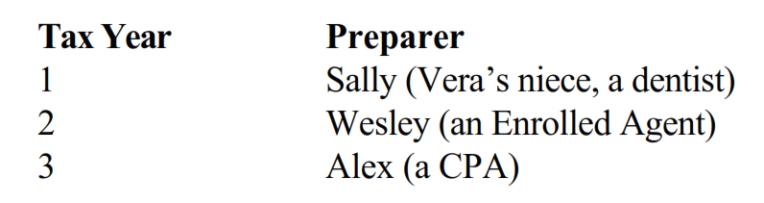 Vera wants help in appearing before the IRS Revenue Agent for the audit. Which of the following statements is correct?
 (Multiple Choice)
4.8/5 (91)
(91) The accuracy-related penalties typically relate to ________________ on the part of the taxpayer, or other understatements of tax.
(Short Answer)
4.8/5 (78)
(78) For each of the indicated tax penalties, indicate the appropriate taxpayer defense. A letter may be used more than once. Not all of the letters need be used.
a. Ignorance of the tax law
b. Reasonable basis
c. Reasonable cause
d. Complexity of the tax law
e. Substantial authority
f. Disclosure on return
-Failure to deposit withholding tax.
(Short Answer)
4.8/5 (79)
(79) CPA Norma and her client Colin hold a privilege of confidentiality from the IRS, as to their tax planning discussions about completing Colin's tax returns. The IRS cannot successfully subpoena records concerning these discussions.
(True/False)
4.9/5 (78)
(78) Match each of the following tax penalties with the type of tax penalty as specified by the Code. A letter can be used more than once. The correct solution may include more than one letter.
a. Taxpayer penalty
b. Tax preparer penalty
c. Appraiser's penalty
-Willful and reckless conduct.
(Short Answer)
4.9/5 (69)
(69) Freddie has been assessed a preparer penalty for willful and reckless conduct. When he completed Peggy's Federal income tax return, Freddie purposely omitted $100,000 of cash receipts that should have been reported as gross income. Freddie charged Peggy $4,000 to prepare the return. What is Freddie's preparer penalty?
(Multiple Choice)
4.8/5 (80)
(80) In a criminal tax fraud case, the burden is on the taxpayer to show that he or she was innocent "beyond the shadow of any reasonable doubt."
(True/False)
4.8/5 (82)
(82) 
Filters
- Essay(0)
- Multiple Choice(0)
- Short Answer(0)
- True False(0)
- Matching(0)