



 Chat with AI
Exam 21: Partnerships

Exam 1: An Introduction to Taxation and Understanding the Federal Tax Law211 Questions
Exam 2: Working with the Tax Law102 Questions
Exam 3: Computing the Tax180 Questions
Exam 4: Gross Income: Concepts and Inclusions125 Questions
Exam 5: Gross Income: Exclusions113 Questions
Exam 6: Deductions and Losses: In General156 Questions
Exam 7: Deductions and Losses: Certain Business Expenses and Losses94 Questions
Exam 8: Depreciation, Cost Recovery, Amortization, and Depletion120 Questions
Exam 9: Deductions: Employee and Self-Employed-Related Expenses153 Questions
Exam 10: Deductions and Losses: Certain Itemized Deductions104 Questions
Exam 11: Investor Losses130 Questions
Exam 12: Tax Credits and Payments111 Questions
Exam 13: Property Transactions: Determination of Gain or Loss, Basis Considerations, and Nontaxable Exchanges285 Questions
Exam 14: Property Transactions: Capital Gains and Losses, Section 1231, and Recapture Provisions167 Questions
Exam 15: Taxing Business Income60 Questions
Exam 16: Accounting Periods and Methods88 Questions
Exam 17: Corporations: Introduction and Operating Rules108 Questions
Exam 18: Corporations: Organization and Capital Structure109 Questions
Exam 19: Corporations: Distributions Not in Complete Liquidation185 Questions
Exam 20: Corporations: Distributions in Complete Liquidation and an Overview of Reorganizations71 Questions
Exam 21: Partnerships248 Questions
Exam 22: S Corporations129 Questions
Exam 23: Exempt Entities153 Questions
Exam 24: Multistate Corporate Taxation204 Questions
Exam 25: Taxation of International Transactions146 Questions
Exam 26: Tax Practice and Ethics184 Questions
Exam 27: The Federal Gift and Estate Taxes141 Questions
Exam 28: Income Taxation of Trusts and Estates161 Questions
Select questions type


In a proportionate liquidating distribution, RST Partnership distributes to partner Riley cash of $30,000, accounts receivable (basis of $0, fair market value of $40,000), and land (basis of $65,000, fair market value of $50,000). Riley's basis was $40,000 before the distribution. On the liquidation, Riley recognizes a gain of $0, and her basis is $10,000 in the land and $0 in the accounts receivable.
(True/False)
4.8/5  (84)
(84) An example of the aggregate concept of partnership taxation is that the partnership makes elections related to depreciation, tax credit calculations (except the foreign tax credit), and whether or not to claim a § 179 deduction.
(True/False)
5.0/5 (83)
(83) Jeordie and Kendis created the JK Partnership by contributing $100,000 each. The $200,000 cash was used by the partnership to acquire a depreciable asset. The partnership agreement provides that the partners' capital accounts will be maintained in accordance with Reg. § 1.704-1(b) (the "economic effect" Regulations) and that any partner with a deficit capital account will be required to restore that capital account when the partner's interest is liquidated. The partnership agreement provides that MACRS will be allocated 20% to Jeordie and 80% to Kendis. All other items of partnership income, gain, loss, deduction, and credit will be allocated equally between the partners. In the first year, MACRS is $40,000 and no other operating transactions occur. The property is sold at the end of the year for $160,000 and the partnership is liquidated immediately thereafter.
To satisfy the economic effect test, how much of the $160,000 cash (from the sale) is allocated each to Jeordie and Kendis?
(Essay)
4.9/5 (73)
(73) Seven years ago, Paul purchased residential rental estate that he has been depreciating as MACRS property over 27.5 years. This year, when his adjusted basis in the property was $250,000, Paul transferred the property to the newly formed PLA LLC in exchange for a one-third interest in the LLC. PLA incurred $10,000 of transfer taxes and fees related to the property. PLA must treat the $260,000 basis in the property, fees, and expenses, as new MACRS property depreciable over 27.5 years.
(True/False)
4.7/5 (84)
(84) The Greene Partnership had average annual gross receipts for the past three years of $24.8 million, and never has reported average annual gross receipts above $25 million. One of the partners is Jackson, Inc., a C corporation. Because Greene meets the average annual gross receipts test, it may use the cash method of accounting even though it has a partner that is a C corporation.
(True/False)
4.9/5 (67)
(67) Morgan and Kristen formed an equal partnership on August 1 of the current year. Morgan contributed $60,000 cash and land with a basis of $18,000 and a fair market value of $40,000. Kristen contributed equipment with a basis of $42,000 and a value of $100,000. Kristen and Morgan each have a basis of $100,000 in their partnership interests.
(True/False)
4.9/5 (69)
(69) Karli owns a 25% capital and profits interest in the calendar-year KJDV Partnership. Her adjusted basis for her partnership interest on July 1 of the current year is $200,000. On that date, she receives a proportionate current (nonliquidating) distribution of the following assets.
 a. Calculate Karli's recognized gain or loss on the distribution, if any.
b. Calculate Karli's basis in the inventory received.
c. Calculate Karli's basis in land received. The land is a capital asset.
d. Calculate Karli's basis for her partnership interest after the distribution.
a. Calculate Karli's recognized gain or loss on the distribution, if any.
b. Calculate Karli's basis in the inventory received.
c. Calculate Karli's basis in land received. The land is a capital asset.
d. Calculate Karli's basis for her partnership interest after the distribution. (Essay)
4.8/5 (81)
(81) A partner will have the same profit-sharing, loss-sharing, and capital-sharing ownership percentages.
(True/False)
4.8/5 (76)
(76) On August 31 of the current tax year, the balance sheet of the RBD General Partnership is as follows
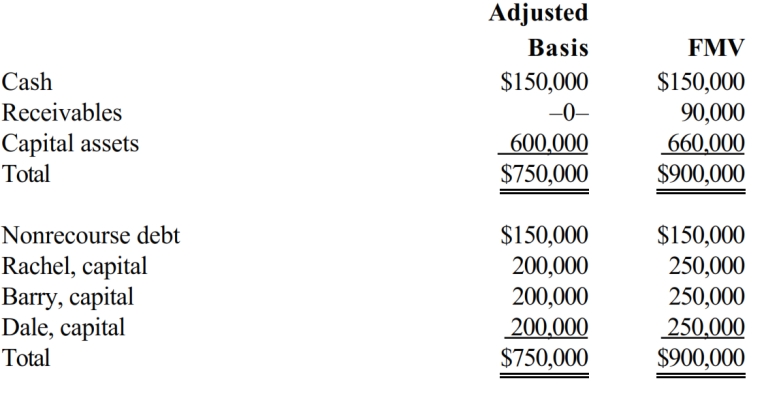 On that date, Rachel sells her one-third partnership interest to Lisa for $300,000, consisting of cash and relief of Rachel's share of the nonrecourse debt. The nonrecourse debt is shared equally among the partners. Rachel's outside basis for her partnership interest is $250,000 (including her share of partnership debt). How much capital gain and/or ordinary income will Rachel recognize on the sale?
 (Essay)
4.7/5 (89)
(89) Match each of the following statements with the terms below that provide the best definition.
a. Adjusted basis of each partnership asset.
b. Operating expenses incurred after entity is formed but before it begins doing business.
c. Each partner's basis in the partnership.
d. Reconciles book income to "taxable income."
e. Tax accounting election made by partnership.
f. Tax accounting calculation made by partner.
g. Tax accounting election made by partner.
h. Does not include liabilities.
i. Designed to prevent excessive deferral of taxation of partnership income.
j. Amount that may be received by partner for performance of services for the partnership.
k. Theory under which a partnership's recourse debt is shared among the partners.
l. Will eventually be allocated to partner making tax-free property contribution to partnership.
m. Partner's share of partnership items.
n. Must generally be satisfied by any allocation to the partners.
o. Justification for a tax year other than the required taxable year.
p. No correct match is provided.
-Guaranteed payment
(Short Answer)
4.9/5 (68)
(68) Harry's basis in his partnership interest was $10,000 at the beginning of the tax year. For the year, his share of the partnership's loss was $8,000, and he also received a distribution of $4,000. Harry can deduct an $8,000 loss, and he recognizes a gain of $2,000 on the distribution of cash in excess of his remaining basis.
(True/False)
4.7/5 (81)
(81) Match each of the following statements with the terms below that provide the best definition.
a. Adjusted basis of each partnership asset.
b. Operating expenses incurred after entity is formed but before it begins doing business.
c. Each partner's basis in the partnership.
d. Reconciles book income to "taxable income."
e. Tax accounting election made by partnership.
f. Tax accounting calculation made by partner.
g. Tax accounting election made by partner.
h. Does not include liabilities.
i. Designed to prevent excessive deferral of taxation of partnership income.
j. Amount that may be received by partner for performance of services for the partnership.
k. Theory under which a partnership's recourse debt is shared among the partners.
l. Will eventually be allocated to partner making tax-free property contribution to partnership.
m. Partner's share of partnership items.
n. Must generally be satisfied by any allocation to the partners.
o. Justification for a tax year other than the required taxable year.
p. No correct match is provided.
-Precontribution gain
(Short Answer)
4.7/5 (85)
(85) The partner (rather than the partnership) will make which one of the following elections?
(Multiple Choice)
4.8/5 (75)
(75) Which one of the following statements is TRUE regarding a partner's personal liability for partnership assets?
(Multiple Choice)
4.9/5 (78)
(78) During the current year, MAC Partnership reported the following items of receipts and expenditures: $600,000 sales, $80,000 utilities and rent, $200,000 salaries to employees, $20,000 guaranteed payment to partner Antonio, investment interest income of $4,000, a charitable contribution of $8,000, and a distribution of $30,000 to partner Carl. Antonio is a 25% general partner. Based on this information, what information will be shown on Antonio's Schedule K-1?
(Essay)
4.9/5 (73)
(73) In a proportionate liquidating distribution in which the partnership is liquidated, Bill received cash of $120,000, inventory (basis of $6,000, fair market value of $8,000), and a capital asset (basis and fair market value of $16,000). Immediately before the distribution, Bill's basis in the partnership interest was $90,000.
a. How much gain or loss will Bill recognize on the distribution?
b. What is Bill's basis in the inventory and the capital asset?
(Essay)
4.8/5 (76)
(76) Match each of the following statements with the terms below that provide the best definition.
a. Organizational choice of many large accounting firms.
b. Partner's percentage allocation of current operating income.
c. Might affect any two partners' tax liabilities in different ways.
d. Partnership in which partners are only liable for torts and malpractice.
e. Expense might be reported on either form 1065, page 1 or on Schedule K.
f. Transfer of asset to partnership followed by immediate distribution of cash to partner.
g. Must have at least one general and one limited partner.
h. Long-term capital gain might be recharacterized as ordinary income.
i. All partners are jointly and severally liable for entity debts.
j. Theory treating the partner and partnership as separate economic units.
k. Partner's basis in partnership interest after tax-free contribution of asset to partnership.
l. Partnership's basis in asset after tax-free contribution of asset to partnership.
m. One way to calculate a partner's economic interest in the partnership.
n. Owners are "members."
o. Theory treating the partnership as a collection of taxpayers joined in an agency relationship.
p. Participates in management.
q. Not liable for entity debts.
r. No correct match provided.
-General Partner
(Short Answer)
4.8/5 (77)
(77) Which of the following is a correct definition of a concept related to partnership taxation?
(Multiple Choice)
4.8/5 (78)
(78) Ryan is a 25% partner in the ROCC Partnership. At the beginning of the tax year, Ryan's basis in the partnership interest was $90,000, including his share of partnership liabilities. During the current year, ROCC reported net ordinary income of $100,000. In addition, ROCC distributed $10,000 to each of the partners ($40,000 total). At the end of the year, Ryan's share of partnership liabilities increased by $10,000. Ryan's basis in the partnership interest at the end of the year is:
(Multiple Choice)
4.8/5 (86)
(86) When property is contributed to a partnership in exchange for a capital and profits interest, when does the partner's holding period begin for the partnership interest?
(Multiple Choice)
4.9/5 (69)
(69) 
Filters
- Essay(0)
- Multiple Choice(0)
- Short Answer(0)
- True False(0)
- Matching(0)