



 Chat with AI
Exam 21: Partnerships

Exam 1: An Introduction to Taxation and Understanding the Federal Tax Law211 Questions
Exam 2: Working with the Tax Law102 Questions
Exam 3: Computing the Tax180 Questions
Exam 4: Gross Income: Concepts and Inclusions125 Questions
Exam 5: Gross Income: Exclusions113 Questions
Exam 6: Deductions and Losses: In General156 Questions
Exam 7: Deductions and Losses: Certain Business Expenses and Losses94 Questions
Exam 8: Depreciation, Cost Recovery, Amortization, and Depletion120 Questions
Exam 9: Deductions: Employee and Self-Employed-Related Expenses153 Questions
Exam 10: Deductions and Losses: Certain Itemized Deductions104 Questions
Exam 11: Investor Losses130 Questions
Exam 12: Tax Credits and Payments111 Questions
Exam 13: Property Transactions: Determination of Gain or Loss, Basis Considerations, and Nontaxable Exchanges285 Questions
Exam 14: Property Transactions: Capital Gains and Losses, Section 1231, and Recapture Provisions167 Questions
Exam 15: Taxing Business Income60 Questions
Exam 16: Accounting Periods and Methods88 Questions
Exam 17: Corporations: Introduction and Operating Rules108 Questions
Exam 18: Corporations: Organization and Capital Structure109 Questions
Exam 19: Corporations: Distributions Not in Complete Liquidation185 Questions
Exam 20: Corporations: Distributions in Complete Liquidation and an Overview of Reorganizations71 Questions
Exam 21: Partnerships248 Questions
Exam 22: S Corporations129 Questions
Exam 23: Exempt Entities153 Questions
Exam 24: Multistate Corporate Taxation204 Questions
Exam 25: Taxation of International Transactions146 Questions
Exam 26: Tax Practice and Ethics184 Questions
Exam 27: The Federal Gift and Estate Taxes141 Questions
Exam 28: Income Taxation of Trusts and Estates161 Questions
Select questions type


Match each of the following statements with the terms below that provide the best definition.
a. Adjusted basis of each partnership asset.
b. Operating expenses incurred after entity is formed but before it begins doing business.
c. Each partner's basis in the partnership.
d. Reconciles book income to "taxable income."
e. Tax accounting election made by partnership.
f. Tax accounting calculation made by partner.
g. Tax accounting election made by partner.
h. Does not include liabilities.
i. Designed to prevent excessive deferral of taxation of partnership income.
j. Amount that may be received by partner for performance of services for the partnership.
k. Theory under which a partnership's recourse debt is shared among the partners.
l. Will eventually be allocated to partner making tax-free property contribution to partnership.
m. Partner's share of partnership items.
n. Must generally be satisfied by any allocation to the partners.
o. Justification for a tax year other than the required taxable year.
p. No correct match is provided.
-Economic risk of loss
(Short Answer)
4.8/5  (79)
(79) Matt, a partner in the MB Partnership, receives a proportionate, current (nonliquidating) distribution of property having a fair market value of $16,000 and a partnership basis of $23,000. Matt's basis in the partnership is $10,000 before the distribution. In this situation, Matt will recognize no gain or loss. He takes a $10,000 basis in the property, and his basis in the partnership interest is reduced to zero.
(True/False)
4.8/5 (71)
(71) Lori, a partner in the JKL partnership, received a proportionate current (nonliquidating) distribution of $10,000 cash, unrealized receivables with a basis of $0 and a fair market value of $15,000, and land with a basis of $6,000 and a fair market value of $10,000. Her basis in the partnership interest immediately before the distributions was $14,000. She will recognize $0 gain on the distribution, and her basis in the receivables and land will be $0 and $4,000, respectively.
(True/False)
4.7/5 (89)
(89) A partnership must provide any information to the partners that the partners would need to calculate deductions not permitted at the partnership level, such as for oil and gas depletion or the corporate dividends received deduction.
(True/False)
4.8/5 (66)
(66) Compare the different tax results (gains, losses, basis) that might arise for a partner in a proportionate current (nonliquidating) distribution vs. a proportionate liquidating distribution, under the general tax rules.
(Essay)
4.9/5 (85)
(85) If a partnership allocates losses to the partners, the partners must first apply the passive loss limitations, then the basis limitation, and finally the at-risk limitations. If all three hurdles are met, the partner may deduct the loss.
(True/False)
4.8/5 (84)
(84) At the beginning of the year, Ryan's capital account balance in the RUS Partnership (in which Ryan owned a 40% interest) was $200,000. During the year Ryan contributed cash ($40,000) and property (basis = $20,000, fair market value = $30,000). RUS reported ordinary income of $100,000 and tax-exempt income of $6,000. At the end of the year, the partnership distributed $6,000 of cash to Ryan. On the Schedule K-1, the partnership shows that Ryan had a $50,000 share of nonrecourse LLC debt at the end of the year. Using the tax basis method, how much is Ryan's ending capital account balance?
(Multiple Choice)
4.9/5 (79)
(79) In a liquidating distribution, a partnership must distribute all of its property to all of its partners.
(True/False)
4.7/5 (77)
(77) Match each of the following statements with the terms below that provide the best definition.
a. Organizational choice of many large accounting firms.
b. Partner's percentage allocation of current operating income.
c. Might affect any two partners' tax liabilities in different ways.
d. Partnership in which partners are only liable for torts and malpractice.
e. Expense might be reported on either form 1065, page 1 or on Schedule K.
f. Transfer of asset to partnership followed by immediate distribution of cash to partner.
g. Must have at least one general and one limited partner.
h. Long-term capital gain might be recharacterized as ordinary income.
i. All partners are jointly and severally liable for entity debts.
j. Theory treating the partner and partnership as separate economic units.
k. Partner's basis in partnership interest after tax-free contribution of asset to partnership.
l. Partnership's basis in asset after tax-free contribution of asset to partnership.
m. One way to calculate a partner's economic interest in the partnership.
n. Owners are "members."
o. Theory treating the partnership as a collection of taxpayers joined in an agency relationship.
p. Participates in management.
q. Not liable for entity debts.
r. No correct match provided.
-Business interest
(Short Answer)
4.8/5 (90)
(90) Which of the following statements is true regarding the sale of a partnership interest?
(Multiple Choice)
5.0/5 (91)
(91) Hannah sells her 25% interest in the HIJK Partnership to Alyssa for $120,000 cash. At the end of the year prior to the sale, Hannah's basis in HIJK was $70,000. The partnership allocates $15,000 of income to Hannah for the portion of the year she was a partner. On the date of the sale, the partnership assets and the agreed fair market values were as follows.
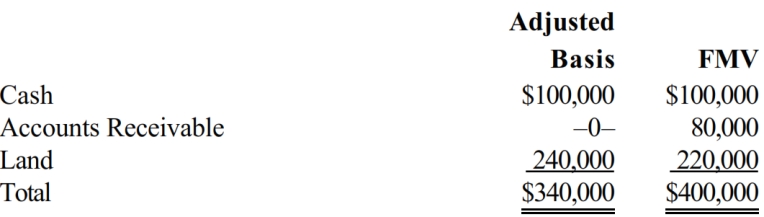 Determine the amount and character of any gain that Hannah recognizes on the sale.
 (Essay)
4.8/5 (69)
(69) The BAM Partnership distributed the following assets to partner Barbie in a proportionate nonliquidating distribution:
$10,000 cash, land parcel A (basis of $5,000, fair market value of $30,000) and land parcel B (basis of $25,000, fair market value of $30,000). Barbie's basis in her partnership interest was $40,000 immediately before the distribution. Barbie will allocate a basis of $15,000 each to the two land parcels, and her basis in her partnership interest will be reduced to $0.
(True/False)
4.9/5 (72)
(72) A limited partnership (LP) offers all partners protection from claims by the LP's creditors.
(True/False)
4.9/5 (92)
(92) Mark receives a proportionate current (nonliquidating) distribution. At the beginning of the partnership year, the basis of his partnership interest is $100,000. During the year, he received a cash distribution of $40,000 and a property distribution (basis of $30,000, fair market value of $25,000). In addition, Mark's share of partnership liabilities was reduced by $10,000 during the year. How much gain or loss does Mark recognize? what is his basis in the property he received? and what is his remaining basis in the partnership interest?
(Multiple Choice)
4.9/5 (82)
(82) The MOG Partnership reports ordinary income of $60,000, long-term capital gain of $12,000, and tax-exempt income of $12,000. The partnership agreement provides that Molly will receive all long-term capital gains and George will receive all tax-exempt interest income. Their allocation of ordinary income will be reduced accordingly, and Olivia will be allocated a proportionately greater share of ordinary income. (In other words, each partner will receive allocations totaling 1/3 of the total $84,000 of partnership income.) This allocation was agreed upon because Molly and George are in a high marginal tax bracket and Olivia is in a low marginal tax bracket.
a. Describe the elements that must be included in a partnership agreement in order for an allocation to have "economic effect."
b. Discuss whether or not the MOG allocation would be permitted and provide your reasoning.
(Essay)
4.7/5 (85)
(85) In a proportionate liquidating distribution, WYX Partnership distributes to partner William cash of $40,000, cash basis accounts receivable (basis of $0, fair market value of $10,000), and land (basis of $30,000, fair market value of $50,000). William's basis was $80,000 before the distribution. On the liquidation, William recognizes a $20,000 gain, and he takes a basis of $10,000 in the accounts receivable, and $50,000 in the land.
(True/False)
4.7/5 (75)
(75) If the partnership properly makes an election for treatment of a specific tax item, the partner is bound by that treatment.
(True/False)
4.9/5 (88)
(88) What are "syndication costs" and how are they treated for tax purposes?
(Essay)
4.9/5 (87)
(87) Match each of the following statements with the terms below that provide the best definition.
a. Organizational choice of many large accounting firms.
b. Partner's percentage allocation of current operating income.
c. Might affect any two partners' tax liabilities in different ways.
d. Partnership in which partners are only liable for torts and malpractice.
e. Expense might be reported on either form 1065, page 1 or on Schedule K.
f. Transfer of asset to partnership followed by immediate distribution of cash to partner.
g. Must have at least one general and one limited partner.
h. Long-term capital gain might be recharacterized as ordinary income.
i. All partners are jointly and severally liable for entity debts.
j. Theory treating the partner and partnership as separate economic units.
k. Partner's basis in partnership interest after tax-free contribution of asset to partnership.
l. Partnership's basis in asset after tax-free contribution of asset to partnership.
m. One way to calculate a partner's economic interest in the partnership.
n. Owners are "members."
o. Theory treating the partnership as a collection of taxpayers joined in an agency relationship.
p. Participates in management.
q. Not liable for entity debts.
r. No correct match provided.
-Limited liability company
(Short Answer)
4.8/5 (87)
(87) In a proportionate current (nonliquidating) distribution, cash is deemed to be distributed first, followed by capital and § 1231 assets, and last, unrealized receivables and inventory.
(True/False)
5.0/5 (83)
(83) 
Filters
- Essay(0)
- Multiple Choice(0)
- Short Answer(0)
- True False(0)
- Matching(0)