



 Chat with AI
Exam 11: Investor Losses

Exam 1: An Introduction to Taxation and Understanding the Federal Tax Law211 Questions
Exam 2: Working with the Tax Law102 Questions
Exam 3: Computing the Tax180 Questions
Exam 4: Gross Income: Concepts and Inclusions125 Questions
Exam 5: Gross Income: Exclusions113 Questions
Exam 6: Deductions and Losses: In General156 Questions
Exam 7: Deductions and Losses: Certain Business Expenses and Losses94 Questions
Exam 8: Depreciation, Cost Recovery, Amortization, and Depletion120 Questions
Exam 9: Deductions: Employee and Self-Employed-Related Expenses153 Questions
Exam 10: Deductions and Losses: Certain Itemized Deductions104 Questions
Exam 11: Investor Losses130 Questions
Exam 12: Tax Credits and Payments111 Questions
Exam 13: Property Transactions: Determination of Gain or Loss, Basis Considerations, and Nontaxable Exchanges285 Questions
Exam 14: Property Transactions: Capital Gains and Losses, Section 1231, and Recapture Provisions167 Questions
Exam 15: Taxing Business Income60 Questions
Exam 16: Accounting Periods and Methods88 Questions
Exam 17: Corporations: Introduction and Operating Rules108 Questions
Exam 18: Corporations: Organization and Capital Structure109 Questions
Exam 19: Corporations: Distributions Not in Complete Liquidation185 Questions
Exam 20: Corporations: Distributions in Complete Liquidation and an Overview of Reorganizations71 Questions
Exam 21: Partnerships248 Questions
Exam 22: S Corporations129 Questions
Exam 23: Exempt Entities153 Questions
Exam 24: Multistate Corporate Taxation204 Questions
Exam 25: Taxation of International Transactions146 Questions
Exam 26: Tax Practice and Ethics184 Questions
Exam 27: The Federal Gift and Estate Taxes141 Questions
Exam 28: Income Taxation of Trusts and Estates161 Questions
Select questions type


Several years ago, Joy acquired a passive activity. Until 2016, the activity was profitable. Joy's at-risk amount at the beginning of 2016 was $250,000. The activity produced losses of $100,000 in 2016, $80,000 in 2017, and $90,000 in 2018. During the same period, no passive activity income was recognized. How much is suspended under the at-risk rules and the passive activity loss rules at the beginning of 2019? 
(Short Answer)
4.7/5  (85)
(85) If an owner participates for more than 500 hours in a bicycle rental activity located at a beach resort, any loss from that activity is treated as an active loss that can offset active income.
(True/False)
4.8/5 (88)
(88) Maria, who owns a 50% interest in a restaurant, has been a material participant in the restaurant activity for the last 20 years. She retired from the restaurant at the end of last year and will not participate in the restaurant activity in the future. However, she continues to be a material participant in a retail store in which she is a 50% partner. The restaurant operations produce a loss for the current year, and Maria's share of the loss is $80,000. Her share of the income from the retail store is $150,000. She does not own interests in any other activities.
(Multiple Choice)
4.8/5 (79)
(79) Jon owns an apartment building in which he is a material participant and also owns a computer consulting business. Of the 2,000 hours he spends on these activities during the year, 55% of the time is spent operating the apartment building and 45% of the time is spent in the computer consulting business.
(Multiple Choice)
4.8/5 (72)
(72) Vail owns interests in a beauty salon, a natural foods store, and a tanning salon. Several full-time employees work at each of the enterprises. As of the end of November of the current year, Vail has worked 180 hours in the beauty salon, 220 hours at the natural foods store, and 80 hours at the tanning salon. These three ventures collectively will produce income. Vail also owns one other passive activity that is producing a loss (a limited partnership in which she has reported no participation). How should Vail plan her activities for the remainder of the year?
(Essay)
4.8/5 (100)
(100) Harry earned investment income of $18,500, incurred investment interest expense of $15,500, and other investment expenses of $9,000 during the current year. Harry may deduct $9,500 of investment interest expense this year and carry forward $6,000 to future years.
(True/False)
4.8/5 (70)
(70) Rachel acquired a passive activity several years ago. Until 2015, the activity was profitable, and Rachel's at-risk amount at the beginning of 2015 was $300,000. The activity produced losses of $80,000 in 2015, $50,000 in 2016, and $70,000 in 2017. In 2018, the activity produced income of $90,000. How much is Rachel's suspended passive activity loss at the beginning of 2019?
(Multiple Choice)
4.8/5 (75)
(75) During the current year, Ethan performs personal services as follows: 800 hours in his information technology consulting practice, 625 hours in a real estate development business, and 510 hours in a condominium leasing operation. He expects that losses will be realized from the two real estate ventures while his consulting practice will show a profit. Ethan files a joint return with his spouse whose salary is $125,000. The income and losses from the following ventures is considered active and not subject to the passive activity loss limitations:
(Multiple Choice)
4.8/5 (65)
(65) Dick participates in an activity for 90 hours during the year. He has no employees and there are no other participants. Dick is a material participant.
(True/False)
5.0/5 (75)
(75) Matt has three passive activities and has at-risk amounts in excess of $100,000 for each. During the year, the activities produced the following income (losses). 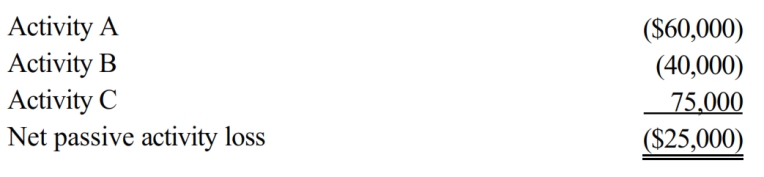 Matt's suspended losses are as follows:
 (Multiple Choice)
4.9/5 (66)
(66) 
Filters
- Essay(0)
- Multiple Choice(0)
- Short Answer(0)
- True False(0)
- Matching(0)