



 Chat with AI
Exam 11: Investor Losses

Exam 1: An Introduction to Taxation and Understanding the Federal Tax Law211 Questions
Exam 2: Working with the Tax Law102 Questions
Exam 3: Computing the Tax180 Questions
Exam 4: Gross Income: Concepts and Inclusions125 Questions
Exam 5: Gross Income: Exclusions113 Questions
Exam 6: Deductions and Losses: In General156 Questions
Exam 7: Deductions and Losses: Certain Business Expenses and Losses94 Questions
Exam 8: Depreciation, Cost Recovery, Amortization, and Depletion120 Questions
Exam 9: Deductions: Employee and Self-Employed-Related Expenses153 Questions
Exam 10: Deductions and Losses: Certain Itemized Deductions104 Questions
Exam 11: Investor Losses130 Questions
Exam 12: Tax Credits and Payments111 Questions
Exam 13: Property Transactions: Determination of Gain or Loss, Basis Considerations, and Nontaxable Exchanges285 Questions
Exam 14: Property Transactions: Capital Gains and Losses, Section 1231, and Recapture Provisions167 Questions
Exam 15: Taxing Business Income60 Questions
Exam 16: Accounting Periods and Methods88 Questions
Exam 17: Corporations: Introduction and Operating Rules108 Questions
Exam 18: Corporations: Organization and Capital Structure109 Questions
Exam 19: Corporations: Distributions Not in Complete Liquidation185 Questions
Exam 20: Corporations: Distributions in Complete Liquidation and an Overview of Reorganizations71 Questions
Exam 21: Partnerships248 Questions
Exam 22: S Corporations129 Questions
Exam 23: Exempt Entities153 Questions
Exam 24: Multistate Corporate Taxation204 Questions
Exam 25: Taxation of International Transactions146 Questions
Exam 26: Tax Practice and Ethics184 Questions
Exam 27: The Federal Gift and Estate Taxes141 Questions
Exam 28: Income Taxation of Trusts and Estates161 Questions
Select questions type


Joyce, an architect, earns $100,000 from her practice in the current year. In addition, she receives $35,000 in dividends, capital gains, and annuity income during the year. Further, she incurs a loss of $35,000 from an investment in a passive activity. Joyce's AGI for the year after considering the passive investment is $100,000.
(True/False)
4.9/5  (85)
(85) Green Corporation earns active income of $50,000 and receives $40,000 in dividends during the year. In addition, Green incurs a loss of $70,000 from an investment in a passive activity acquired several years ago. Consider the following two statements:
(1) Green's current deduction for passive activity losses is $50,000 if it is a closely held C corporation that is not a personal service corporation.
(2) Green's current deduction for passive activity losses is $0 if it is a personal service corporation. Which of the following answers is correct?
(Multiple Choice)
4.9/5 (88)
(88) Tess owns a building in which she rents apartments to tenants and operates a restaurant. Which of the following statements is incorrect?
(Multiple Choice)
4.9/5 (75)
(75) What special passive activity loss treatment is available to real estate activities?
(Essay)
4.8/5 (75)
(75) Rick, a computer consultant, owns a separate business (not real estate) in which he participates. He has one employee who works part-time in the business.
(Multiple Choice)
4.8/5 (90)
(90) A qualified real estate professional is allowed to treat income or loss from any real estate venture as active except for income or loss from a rental activity.
(True/False)
4.9/5 (79)
(79) Anne sells a rental house for $100,000 (adjusted basis of $55,000). During her ownership, $60,000 of losses have been suspended under the passive activity loss rules. Determine the tax treatment to Anne on the disposition of the property.
(Essay)
4.9/5 (81)
(81) Hugh has four passive activities which generate the following income and losses in the current year.
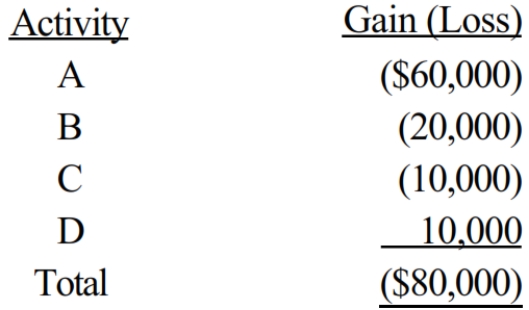 How much of the $80,000 net passive activity loss can Hugh deduct this year? Calculate the suspended losses (by activity).
 (Essay)
4.9/5 (82)
(82) Josie, an unmarried taxpayer, has $155,000 in salary, $10,000 in income from a limited partnership, and a $26,000 passive activity loss from a real estate rental activity in which she actively participates. If her modified adjusted gross income is $155,000, how much of the $26,000 loss is deductible?
(Multiple Choice)
4.9/5 (77)
(77) In 2018, Liam invested $100,000 for a 25% interest in a partnership involved in an activity in which he is a material participant. The partnership reported losses of $340,000 in 2018 and $180,000 in 2019 with Liam's share being $85,000 in 2018 and $45,000 in 2019. How much of the losses can Liam deduct?
(Multiple Choice)
4.9/5 (66)
(66) Josh has investments in two passive activities. Activity A, acquired three years ago, produces income in the current year of $60,000. Activity B, acquired last year, produces a loss of $100,000 in the current year. At the beginning of this year, Josh's at-risk amounts in Activities A and B are $10,000 and $100,000, respectively. What is the amount of Josh's suspended passive activity loss with respect to these activities at the end of the current year?
(Multiple Choice)
4.8/5 (87)
(87) In the current year, Lucile, who is single and has AGI of $90,000 before considering rental activities, is active in three separate real estate rental activities and is in the 22% tax bracket. She had $15,000 of losses from Activity A, $25,000 of losses from Activity B, and income of $20,000 from Activity C. She also had $3,100 of tax credits from Activity a. Calculate her deductions and credits currently allowed and the suspended losses and credits.
(Essay)
4.8/5 (89)
(89) In the current year, Louise invests $50,000 for a 20% interest in a passive activity. Her share of the loss this year is $10,000. If this is her only passive activity, the $10,000 loss from the activity this year is suspended for use in a future year.
(True/False)
5.0/5 (87)
(87) List the taxpayers that are subject to the passive activity loss rules and summarize the general impact of these rules on these taxpayers.
(Essay)
5.0/5 (81)
(81) Lindsey, an attorney, earns $125,000 from her law practice in the current year. In addition, she receives $50,000 in dividends and interest during the year. Further, she incurs a loss of $40,000 from an investment in a passive activity. What is Lindsey's AGI for the year after considering the passive investment?
(Essay)
4.9/5 (78)
(78) Stuart is the sole owner and a material participant in a business in which he has $50,000 at risk. If the business incurs a loss of $80,000 from operations, Stuart will be allowed the full amount as a deduction.
(True/False)
4.8/5 (77)
(77) Ramon incurred $83,100 of interest expense related to his investments this year. His investment income included $34,500 of interest and a $37,500 net capital gain on the sale of securities. Ramon has asked you to compute the amount of his deduction for investment interest, taking into consideration any options he might have. What is the maximum amount of Ramon's investment interest expense deduction in the current year?
(Multiple Choice)
4.9/5 (69)
(69) Identify how the passive activity loss rules broadly classify various types of income and losses. Provide examples of each category.
(Essay)
4.8/5 (81)
(81) Individuals with modified AGI of $100,000 can deduct against active or portfolio income losses of up to $25,000 from real estate rental activities in which they actively participate.
(True/False)
5.0/5 (84)
(84) Sandra acquired a passive activity three years ago. Until last year, the activity was profitable and her at-risk amount was $300,000. Last year, the activity produced a loss of $100,000, and in the current year, the loss is $50,000. Assuming Sandra has received no passive activity income in the current or prior years, her suspended passive activity loss from the activity is:
(Multiple Choice)
4.8/5 (75)
(75) 
Filters
- Essay(0)
- Multiple Choice(0)
- Short Answer(0)
- True False(0)
- Matching(0)