



 Chat with AI
Exam 11: Investor Losses

Exam 1: An Introduction to Taxation and Understanding the Federal Tax Law211 Questions
Exam 2: Working with the Tax Law102 Questions
Exam 3: Computing the Tax180 Questions
Exam 4: Gross Income: Concepts and Inclusions125 Questions
Exam 5: Gross Income: Exclusions113 Questions
Exam 6: Deductions and Losses: In General156 Questions
Exam 7: Deductions and Losses: Certain Business Expenses and Losses94 Questions
Exam 8: Depreciation, Cost Recovery, Amortization, and Depletion120 Questions
Exam 9: Deductions: Employee and Self-Employed-Related Expenses153 Questions
Exam 10: Deductions and Losses: Certain Itemized Deductions104 Questions
Exam 11: Investor Losses130 Questions
Exam 12: Tax Credits and Payments111 Questions
Exam 13: Property Transactions: Determination of Gain or Loss, Basis Considerations, and Nontaxable Exchanges285 Questions
Exam 14: Property Transactions: Capital Gains and Losses, Section 1231, and Recapture Provisions167 Questions
Exam 15: Taxing Business Income60 Questions
Exam 16: Accounting Periods and Methods88 Questions
Exam 17: Corporations: Introduction and Operating Rules108 Questions
Exam 18: Corporations: Organization and Capital Structure109 Questions
Exam 19: Corporations: Distributions Not in Complete Liquidation185 Questions
Exam 20: Corporations: Distributions in Complete Liquidation and an Overview of Reorganizations71 Questions
Exam 21: Partnerships248 Questions
Exam 22: S Corporations129 Questions
Exam 23: Exempt Entities153 Questions
Exam 24: Multistate Corporate Taxation204 Questions
Exam 25: Taxation of International Transactions146 Questions
Exam 26: Tax Practice and Ethics184 Questions
Exam 27: The Federal Gift and Estate Taxes141 Questions
Exam 28: Income Taxation of Trusts and Estates161 Questions
Select questions type


In the current year, Don has a $55,000 loss from a business he owns. His at-risk amount at the end of the year, prior to considering the current year loss, is $36,000. He will be allowed to deduct the $55,000 loss this year if he is a material participant in the business.
(True/False)
5.0/5  (79)
(79) Individuals can deduct from active or portfolio income losses of up to $25,000 from real estate rental activities in which they actively participate.
(True/False)
5.0/5 (80)
(80) Match the treatment for the following types of transactions.
a. The losses are allowed in the years in which gain is recognized.
b. Suspended losses are allowed to offset the income from the activity, other passive activities, or active income.
c. Suspended losses are allowed to the taxpayer to the extent they exceed the amount, if any, of the step-up in basis allowed.
d. Any suspended losses may be used in the current year.
e. The suspended losses are added to the basis of the property.
f. No correct choice is given.
-Treatment of suspended credits when passive activity is sold at a loss.
(Short Answer)
4.8/5 (82)
(82) Match the treatment for the following types of transactions.
a. The losses are allowed in the years in which gain is recognized.
b. Suspended losses are allowed to offset the income from the activity, other passive activities, or active income.
c. Suspended losses are allowed to the taxpayer to the extent they exceed the amount, if any, of the step-up in basis allowed.
d. Any suspended losses may be used in the current year.
e. The suspended losses are added to the basis of the property.
f. No correct choice is given.
-Treatment of an installment sale of a passive activity.
(Short Answer)
4.8/5 (87)
(87) Identify the types of income that are classified as investment income. Discuss the flexibility that a taxpayer has with respect to certain types of income that may potentially be considered investment income.
(Essay)
5.0/5 (90)
(90) Lloyd, a life insurance salesman, earns a $400,000 salary in the current year. As he works only 30 hours per week in this job, he has time to participate in several other businesses. He owns an ice cream parlor and a car repair shop in Tampa. He also owns an ice cream parlor and a car repair shop in Portland and a car repair shop in St. Louis. A preliminary analysis on December 1 of the current year shows projected income and losses for the various businesses as follows:
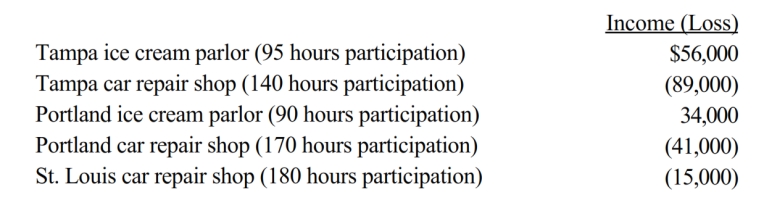 Lloyd has full-time employees at each of the five businesses listed above. Review all possible groupings for Lloyd's activities. Which grouping method and other strategies should Lloyd consider that will provide the greatest tax advantage?
 (Essay)
4.9/5 (75)
(75) Jackson Company incurs a $50,000 loss on a passive activity during the year. The company has active income of $34,000 and portfolio income of $24,000. If Jackson is a personal service corporation, it may deduct $34,000 of the passive activity loss.
(True/False)
4.8/5 (80)
(80) Ken has a $40,000 loss from an investment in a partnership in which he does not materially participate. He paid $30,000 for his interest. How much of the loss is disallowed by the at-risk rules? How much is disallowed by the passive activity loss rules?
(Essay)
4.8/5 (78)
(78) Roger owns and actively participates in the operations of an apartment building which produces a $40,000 loss during the year. He has AGI of $150,000 from an active business. He may deduct $25,000 of the loss.
(True/False)
4.9/5 (83)
(83) From January through November, Vern participated for 420 hours as a salesman in a partnership in which he owns a 50% interest. The partnership has four full-time employees. During December, Vern spends 110 hours cleaning the store and painting the walls in order to meet the material participation standards. Vern qualifies as a material participant.
(True/False)
4.8/5 (60)
(60) Match the term with the correct response. More than one response may be correct.
a. Taxpayer devotes time aggregating more than 500 hours in all significant participation activities during the year.
b. Participates in making management decisions in a significant and bonafide sense.
c. One in which the individual's participation equals more than 100 hours during the year.
d. Taxpayer devotes time in the activity which constitutes substantially all of the participation in the activity of all individuals.
e. Both options a. and d. are correct.
f. No correct choice is given.
-Active participation.
(Short Answer)
4.8/5 (73)
(73) This year Seth had investment income of $31,000, investment expenses of $28,000, and a long-term capital gain of $8,000 on an investment. In calculating his net investment income for the current year, Seth may deduct a maximum of $11,000 investment interest.
(True/False)
5.0/5 (85)
(85) Rita earns a salary of $150,000, and invests $40,000 for a 20% interest in a passive activity. Operations of the activity result in a loss of $250,000, of which Rita's share is $50,000. How is her loss characterized?
(Multiple Choice)
4.9/5 (79)
(79) Tomas participates for 300 hours in Activity A and 250 hours in Activity B, both of which are nonrental businesses.
Both activities are active.
(True/False)
4.9/5 (61)
(61) In 2018, Emily invests $120,000 in a limited partnership that is not a passive activity. During 2018, her share of the partnership loss is $90,000. In 2019, her share of the partnership loss is $50,000. How much can Emily deduct in 2018 and 2019?
(Essay)
4.8/5 (80)
(80) David earned investment income of $20,000, incurred investment interest expense of $12,000, and other investment expenses of $9,000 during the current year. David can deduct $12,000 of investment interest for this year.
(True/False)
4.9/5 (84)
(84) Identify from the list below the type of disposition of a passive activity where the taxpayer keeps the suspended losses of the disposed activity and utilizes them on a subsequent taxable disposition.
(Multiple Choice)
4.8/5 (78)
(78) Pablo, who is single, has $95,000 of salary, $10,000 of income from a limited partnership, and a $27,000 passive activity loss from a real estate rental activity in which he actively participates. His modified adjusted gross income is $95,000. Of the $27,000 loss, how much is deductible?
(Multiple Choice)
4.9/5 (59)
(59) Kate dies owning a passive activity with an adjusted basis of $100,000. Its fair market value at that date is $130,000. Suspended losses relating to the property were $45,000.
(Multiple Choice)
5.0/5 (86)
(86) Match the term with the correct response. More than one response may be correct.
a. Taxpayer devotes time aggregating more than 500 hours in all significant participation activities during the year.
b. Participates in making management decisions in a significant and bonafide sense.
c. One in which the individual's participation equals more than 100 hours during the year.
d. Taxpayer devotes time in the activity which constitutes substantially all of the participation in the activity of all individuals.
e. Both options a. and d. are correct.
f. No correct choice is given.
-Significant participation activity.
(Short Answer)
4.9/5 (86)
(86) 
Filters
- Essay(0)
- Multiple Choice(0)
- Short Answer(0)
- True False(0)
- Matching(0)