



 Chat with AI
Exam 18: Labor Markets

Exam 1: The Big Ideas253 Questions
Exam 2: The Power of Trade and Comparative239 Questions
Exam 3: Supply and Demand249 Questions
Exam 4: Equilibrium256 Questions
Exam 5: Elasticity and Its Applications271 Questions
Exam 6: Taxes and Subsidies225 Questions
Exam 7: The Price System275 Questions
Exam 8: Price Ceilings and Floors327 Questions
Exam 9: International Trade195 Questions
Exam 10: Externalities- When the Price Is Not Right273 Questions
Exam 11: Costs and Profit Maximization Under Competition217 Questions
Exam 12: Competition and the Invisible Hand144 Questions
Exam 13: Monopoly233 Questions
Exam 14: Price Discrimination262 Questions
Exam 15: Oligopoly and Game Theory218 Questions
Exam 16: Competing for Monopoly160 Questions
Exam 17: Monopolistic Competition and Advertising113 Questions
Exam 18: Labor Markets262 Questions
Exam 19: Public Goods and the Tragedy of the Commons244 Questions
Exam 20: Political Economy and Public Choice306 Questions
Exam 21: Economics, Ethics, and Public Policy241 Questions
Exam 22: Managing Incentives263 Questions
Exam 23: Stock Markets and Personal Finance271 Questions
Exam 24: Price Discrimination151 Questions
Exam 25: Consumer Choice145 Questions
Select questions type


Which of the following may NOT explain why tall people tend to have higher wages than short people?
(Multiple Choice)
4.7/5  (84)
(84) Compared with a similar job that requires little human capital labor market issues, a job that requires a large amount of human capital labor market issues will likely pay:
(Multiple Choice)
4.8/5 (68)
(68) Wages for low-skilled positions are typically higher in developed countries than wages for identical positions in less-developed countries. Which of the following explains why this is the case?
I. There is a greater supply of low-skilled labor in less-developed countries.
II. There is a greater demand for low-skilled labor in developed countries.
III. There is a greater demand for low-skilled labor in less-developed countries.
(Multiple Choice)
4.8/5 (94)
(94) If the price of output in an industry falls, firms in that industry will ______ labor.
(Multiple Choice)
4.8/5 (70)
(70) A crime scene cleaner earns about three to four times more than an office cleaner, even though neither job requires a college degree. This difference in wages:
(Multiple Choice)
4.9/5 (84)
(84) If Bob's wages ______ and he works ______ hours, his labor supply curve slopes downward.
(Multiple Choice)
4.9/5 (69)
(69) Figure: Marginal Product of Labor 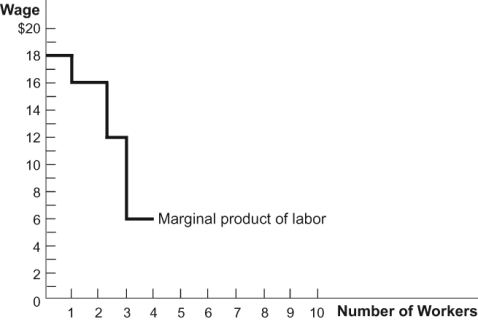 The firm in this figure will hire ______ worker(s) at a wage of $10 and 2 workers at a wage of _______.
 (Multiple Choice)
4.9/5 (84)
(84) If a union forms in a market that is currently in equilibrium:
(Multiple Choice)
4.9/5 (83)
(83) A firm should be willing to pay $20 to hire a worker with a marginal product of $15.
(True/False)
4.9/5 (77)
(77) With the aid of a graph, explain how unions raise wages in unionized industries.
(Essay)
4.8/5 (81)
(81) The advent of office computers is thought by some economists to have ______ the returns to education.
(Multiple Choice)
5.0/5 (83)
(83) Labor market issues give firms an incentive to increase safety only if:
(Multiple Choice)
4.8/5 (73)
(73) Economic growth will lead to safer workplaces, as workers use their increased wealth to buy more safety.
(True/False)
4.8/5 (64)
(64) Evidence from studies by some economists on professional basketball found there has been:
(Multiple Choice)
4.9/5 (80)
(80) Which of the following best explains why assembly-line workers in the United States earn significantly more than assembly-line workers in Mexico?
I. The supply of low-skilled laborers, such as those that work on assembly lines, is higher in Mexico.
II. The demand for assembly-line workers is higher in the United States.
III. Assembly-line workers are more productive in the United States.
(Multiple Choice)
4.9/5 (85)
(85) 
Filters
- Essay(0)
- Multiple Choice(0)
- Short Answer(0)
- True False(0)
- Matching(0)