



 Chat with AI
Exam 18: Labor Markets

Exam 1: The Big Ideas253 Questions
Exam 2: The Power of Trade and Comparative239 Questions
Exam 3: Supply and Demand249 Questions
Exam 4: Equilibrium256 Questions
Exam 5: Elasticity and Its Applications271 Questions
Exam 6: Taxes and Subsidies225 Questions
Exam 7: The Price System275 Questions
Exam 8: Price Ceilings and Floors327 Questions
Exam 9: International Trade195 Questions
Exam 10: Externalities- When the Price Is Not Right273 Questions
Exam 11: Costs and Profit Maximization Under Competition217 Questions
Exam 12: Competition and the Invisible Hand144 Questions
Exam 13: Monopoly233 Questions
Exam 14: Price Discrimination262 Questions
Exam 15: Oligopoly and Game Theory218 Questions
Exam 16: Competing for Monopoly160 Questions
Exam 17: Monopolistic Competition and Advertising113 Questions
Exam 18: Labor Markets262 Questions
Exam 19: Public Goods and the Tragedy of the Commons244 Questions
Exam 20: Political Economy and Public Choice306 Questions
Exam 21: Economics, Ethics, and Public Policy241 Questions
Exam 22: Managing Incentives263 Questions
Exam 23: Stock Markets and Personal Finance271 Questions
Exam 24: Price Discrimination151 Questions
Exam 25: Consumer Choice145 Questions
Select questions type


Unions raise wages by decreasing employment in the unionized industry.
(True/False)
4.8/5  (92)
(92) A janitor in the United States earns about $10 per hour while a typical janitor in India earns less than $1 per hour.
(True/False)
4.8/5 (72)
(72) Unions may ________ the wages of their members but they might ________ the wages of everyone else.
(Multiple Choice)
4.9/5 (76)
(76) Which of the following statements is TRUE?
I. Statistical discrimination is based on ill will toward a group because of their race, sex, nationality, or religion.
II. Statistical discrimination is judging people by the averages of the groups to which they belong.
III. As better ways of judging people develop, the merit of using statistical discrimination rises.
(Multiple Choice)
4.9/5 (82)
(82) Imagine that you could travel back in time to another era, bringing with you all the knowledge you have from the modern age. Your wage in the older era might be higher because people with your knowledge were in short supply then. But why might your wage also be lower?
(Multiple Choice)
4.8/5 (80)
(80) Clark starts a coffee shop and begins hiring employees. The first employee's marginal product of labor (MPL) is $128 an hour and the MPL for each employee beyond the first adds half of the previous employee's ($64 for the second, $32 for the third, etc.). If the market wage for employees is $7 an hour, how many employees should Clark hire?
(Multiple Choice)
4.8/5 (88)
(88) Which of the following types of discrimination tends to break down most easily?
(Multiple Choice)
4.8/5 (86)
(86) We often think of technology and labor as substitutes for each other, but technology can lead to the hiring of more labor if it:
(Multiple Choice)
4.9/5 (81)
(81) Aside from your skills and how hard you work, what does your marginal product of labor reflect?
(Multiple Choice)
4.9/5 (95)
(95) Figure: Cleaners' Wages 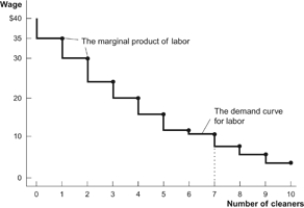 Refer to the figure. How many workers will this firm hire at a wage of $29?
 (Multiple Choice)
5.0/5 (77)
(77) There are two major theories of why education leads to higher earnings (though they are not mutually exclusive): signaling and the building of labor market issues. If the signaling theory is dominant, how would the average wage for college graduates change if everyone received a college degree?
(Multiple Choice)
4.9/5 (83)
(83) Janitors in India might make $1,000 per year, while they could easily earn $20,000 per year in the United States. How is this a forgone gain from trade?
(Multiple Choice)
4.9/5 (80)
(80) In economic development, "brain drain" refers to the tendency of a developing country's most skilled workers leaving to work in a wealthy country. Why can skilled foreign workers from poor countries make so much more money in wealthy countries?
(Multiple Choice)
4.9/5 (82)
(82) If higher wages give the incentive for some workers to work fewer hours:
(Multiple Choice)
4.8/5 (90)
(90) 
Filters
- Essay(0)
- Multiple Choice(0)
- Short Answer(0)
- True False(0)
- Matching(0)