



 Chat with AI
Exam 2: The Power of Trade and Comparative

Exam 1: The Big Ideas253 Questions
Exam 2: The Power of Trade and Comparative239 Questions
Exam 3: Supply and Demand249 Questions
Exam 4: Equilibrium256 Questions
Exam 5: Elasticity and Its Applications271 Questions
Exam 6: Taxes and Subsidies225 Questions
Exam 7: The Price System275 Questions
Exam 8: Price Ceilings and Floors327 Questions
Exam 9: International Trade195 Questions
Exam 10: Externalities- When the Price Is Not Right273 Questions
Exam 11: Costs and Profit Maximization Under Competition217 Questions
Exam 12: Competition and the Invisible Hand144 Questions
Exam 13: Monopoly233 Questions
Exam 14: Price Discrimination262 Questions
Exam 15: Oligopoly and Game Theory218 Questions
Exam 16: Competing for Monopoly160 Questions
Exam 17: Monopolistic Competition and Advertising113 Questions
Exam 18: Labor Markets262 Questions
Exam 19: Public Goods and the Tragedy of the Commons244 Questions
Exam 20: Political Economy and Public Choice306 Questions
Exam 21: Economics, Ethics, and Public Policy241 Questions
Exam 22: Managing Incentives263 Questions
Exam 23: Stock Markets and Personal Finance271 Questions
Exam 24: Price Discrimination151 Questions
Exam 25: Consumer Choice145 Questions
Select questions type


A country or individual that is best at doing something should always undertake that activity to maximize gains from trade.
(True/False)
4.7/5  (81)
(81) U.S. pharmaceutical companies sell drugs to Kenya, and Kenyan farmers sell flowers to the U.S. This pattern of trade suggests that the U.S. is the low-opportunity-cost producer of drugs and Kenya is the low-opportunity-cost producer of flowers.
(True/False)
4.9/5 (70)
(70) Use the following to answer questions:
Figure: Comparative Advantage 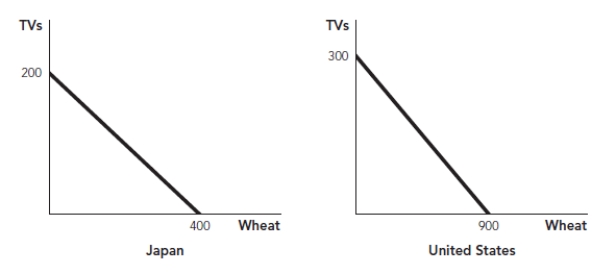 -(Figure: Comparative Advantage) The figure illustrates both the U.S. and Japanese production possibilities frontiers for TVs and wheat. Based on this information, which of the following is TRUE?
 (Multiple Choice)
4.8/5 (74)
(74) Babe Ruth could produce two home runs in a week of play as a fielder or one win in a week of play as a pitcher. What was his opportunity cost for a week of pitching?
(Multiple Choice)
4.9/5 (71)
(71) Conan O'Brien hosts the Conan show and Andy Richter, his sidekick, writes for it. Conan needs 4 hours to rehearse and host a good show. It takes Andy 10 hours to do the same. Conan writes one usable joke in an hour, but Andy needs 2 hours to do the same. Andy's opportunity cost of rehearsing and hosting a show is:
(Multiple Choice)
5.0/5 (78)
(78) Angela and Ed are married. Angela can do $40 worth of household chores per hour, and Ed can do $15 worth of household chores per hour. In the labor market, Ed can earn $30/hour and Angela can earn $40/hour. The theory of comparative advantage suggests that:
(Multiple Choice)
4.8/5 (71)
(71) Specialization in its comparative advantage and trading with other nations benefits a country in terms of its total output, but not individuals when it comes to their wages.
(True/False)
4.9/5 (59)
(59) If the goal of education were solely to support economic growth, the ideal graduate would be a:
(Multiple Choice)
4.9/5 (82)
(82) Trades are considered zero-sum transactions since when one person gains, the other loses an equal amount.
(True/False)
4.9/5 (75)
(75) Use the following to answer questions:
Figure: PPF Nickel & Textiles  -(Figure: PPF Nickel & Textiles) Refer to the figure. How many tons of textiles does Australia give up to produce one ton of nickel?
 (Multiple Choice)
4.8/5 (79)
(79) Large cities should have more professional closet organizers than small cities.
(True/False)
4.7/5 (85)
(85) According to the theory of comparative advantage, a country specializes in producing goods with lower opportunity costs than in another country.
(True/False)
4.8/5 (75)
(75) Fourteenth-century potters in the Chinese city of Jingdezhen developed the technology to heat a kiln at 1,300 degrees Celsius and produce porcelain, or "china," which was particularly popular in Persia where the Koran forbade serving food on gold or silver and wealthy families were anxious for a legal way to impress their dinner guests. The potters also imported Persian cobalt to create the blue dye for the porcelain (local cobalt was not as bold in color). Which advantage(s) from trade is(are) illustrated in this passage?
(Multiple Choice)
4.9/5 (82)
(82) Both Maria and Jorge bake cookies and bread, but Maria spends less time baking each batch of cookies and each loaf of bread than Jorge does. Which of the following is TRUE?
(Multiple Choice)
4.9/5 (63)
(63) Each of 100 people receives a random item from a grocery store and assigns it a value between 1 (low) and 10 (high). They trade those items among themselves for items they prefer rather than those they randomly received and then assign a second value (again, 1 to 10) to the item that they end up with after the trading concludes. How would the sum of those values before trading compare with the sum after trading?
(Multiple Choice)
4.8/5 (72)
(72) 
Filters
- Essay(0)
- Multiple Choice(0)
- Short Answer(0)
- True False(0)
- Matching(0)