



 Chat with AI
Exam 2: The Power of Trade and Comparative

Exam 1: The Big Ideas253 Questions
Exam 2: The Power of Trade and Comparative239 Questions
Exam 3: Supply and Demand249 Questions
Exam 4: Equilibrium256 Questions
Exam 5: Elasticity and Its Applications271 Questions
Exam 6: Taxes and Subsidies225 Questions
Exam 7: The Price System275 Questions
Exam 8: Price Ceilings and Floors327 Questions
Exam 9: International Trade195 Questions
Exam 10: Externalities- When the Price Is Not Right273 Questions
Exam 11: Costs and Profit Maximization Under Competition217 Questions
Exam 12: Competition and the Invisible Hand144 Questions
Exam 13: Monopoly233 Questions
Exam 14: Price Discrimination262 Questions
Exam 15: Oligopoly and Game Theory218 Questions
Exam 16: Competing for Monopoly160 Questions
Exam 17: Monopolistic Competition and Advertising113 Questions
Exam 18: Labor Markets262 Questions
Exam 19: Public Goods and the Tragedy of the Commons244 Questions
Exam 20: Political Economy and Public Choice306 Questions
Exam 21: Economics, Ethics, and Public Policy241 Questions
Exam 22: Managing Incentives263 Questions
Exam 23: Stock Markets and Personal Finance271 Questions
Exam 24: Price Discrimination151 Questions
Exam 25: Consumer Choice145 Questions
Select questions type


Use the following to answer questions:
Figure: PPF Mexico & United States  -(Figure: PPF Mexico & United States) Use the figure in which both Mexico and the United States each have 24 units of labor. The opportunity costs of producing one computer are:
 (Multiple Choice)
4.8/5  (79)
(79) Specialization and the division of knowledge decreased with the fall of the Berlin Wall and the opening of China's economy to the world.
(True/False)
4.8/5 (85)
(85) The U.S. interstate highway system probably allowed more people in small communities to become full-time interior decorators.
(True/False)
4.7/5 (86)
(86) Specializing in one's comparative advantage and trading with others will make individuals better off, but may not make countries better off.
(True/False)
4.7/5 (79)
(79) Suppose France can produce four phones or three computers with one unit of labor, and Sweden can produce one phone or two computers with one unit of labor. If France can trade only with Sweden, then the theory of comparative advantage suggests that:
(Multiple Choice)
4.9/5 (81)
(81) The relationship between trade and specialization is best characterized as follows:
(Multiple Choice)
4.9/5 (80)
(80) Anita is a wonderful baker and can bake 10 cakes in a day, but then has no time left to make cookies. If she bakes only cookies, she can make 200 cookies in a day. John can make equally delicious cakes and cookies but can only make seven cakes or 100 cookies in a day. Based on this information, which of the following statements is true?
(Multiple Choice)
5.0/5 (65)
(65) Use the following to answer questions:
Figure: Steel and Lumber 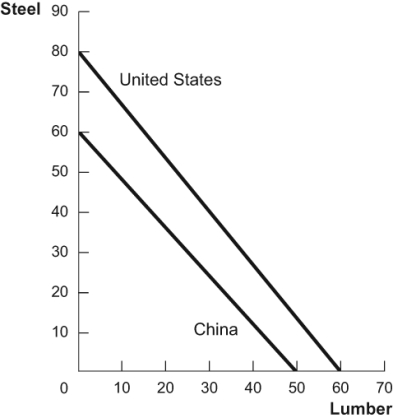 -(Figure: Steel and Lumber) In the PPF diagram, the United States has a comparative advantage in ______ and an absolute advantage in ______.
 (Multiple Choice)
4.9/5 (82)
(82) A rock carving from ancient Norway depicts two identical people doing different jobs in the same boat: one uses a bow to hunt while the other paddles. How does this early example illustrate the benefits of trade?
(Multiple Choice)
4.8/5 (79)
(79) Your professor hires a teaching assistant to grade student assignments even though he may do the task faster and perhaps more accurately. How can you explain this behavior using the theory of comparative advantage?
(Essay)
4.8/5 (76)
(76) Briefly describe a few activities that a typical student might do on any given day that reflect the effects of globalization.
(Essay)
4.8/5 (86)
(86) Which of the following statements is TRUE?
I. Compared with a modern economy, the division of knowledge is greater in a primitive economy because every family is self-sufficient: growing their own food, making their own clothes, and constructing their own shelter.
II. Nobody understands the entire process of producing even the simplest products, like a lead pencil, in a modern economy.
III. The collapse of communism and the opening of the Chinese economy to the rest of the world have increased the division of knowledge, leading to increased world output.
(Multiple Choice)
4.8/5 (70)
(70) Involuntary trades increase value in the same way voluntary trades do.
(True/False)
4.8/5 (82)
(82) Jack and Jill work at a bakery. In one hour, Jack can decorate either 5 ice-cream cakes or 2 wedding cakes. In one hour, Jill can decorate either 4 ice-cream cakes or 1 wedding cake. According to this scenario, which of the following outcomes will benefit both Jack and Jill the most?
(Multiple Choice)
4.9/5 (80)
(80) The principles of comparative advantage, specialization, and trade apply to:
I. individuals.
II. communities.
III. regions.
IV. nations.
(Multiple Choice)
4.7/5 (80)
(80) Comparative advantage is determined by which of the following?
(Multiple Choice)
4.7/5 (88)
(88) In a two-country world of Japan and South Korea, suppose Japan can produce 600 radios or 300 TV sets in one day with all its available resources, while South Korea can produce 100 radios or 200 TV sets in one day with all its available resources. According to the theory of comparative advantage, what would be the possible gain in this world if the two countries specialize and trade with each other?
(Essay)
4.8/5 (78)
(78) 
Filters
- Essay(0)
- Multiple Choice(0)
- Short Answer(0)
- True False(0)
- Matching(0)