



 Chat with AI
Exam 19: Open-Economy Macroeconomics

Exam 1: First Principles233 Questions
Exam 2: Economic Models319 Questions
Exam 3: Supply and Demand292 Questions
Exam 5: International Trade 5274 Questions
Exam 6: Macroeconomics: the Big Picture168 Questions
Exam 7: Gdp and Cpi: Tracking the Macroeconomy434 Questions
Exam 8: Unemployment and Inflation354 Questions
Exam 9: Long-Run Economic Growth316 Questions
Exam 10: Savings, Investment Spending, and the Financial System402 Questions
Exam 13: Fiscal Policy Appendix Taxes and the Multiplier382 Questions
Exam 14: Money, Banking, and the Federal Reserve System468 Questions
Exam 15: Monetary Policy359 Questions
Exam 16: Inflation, Disinflation, and Deflation240 Questions
Exam 17: Crises and Consequences214 Questions
Exam 18: Events and Ideas322 Questions
Exam 19: Open-Economy Macroeconomics467 Questions
Exam 20: Graphs in Economics75 Questions
Exam 21: toward a Fuller Understanding of Present Value36 Questions
Select questions type


An exchange rate regime is a rule governing policy for the exchange rate.
(True/False)
4.9/5  (74)
(74) Use the following to answer questions :
Scenario: Gizmovia
The Republic of Gizmovia wants to maintain the exchange rate of its currency, the gizmo, at $0.50, but the current exchange rate for the gizmo is $0.40.
-(Scenario: Gizmovia) Look at the scenario Gizmovia. If Gizmovia uses exchange market intervention to increase the value of its currency to $0.50, it should _____ gizmos and _____ dollars in the foreign exchange market.
(Multiple Choice)
4.9/5 (88)
(88) If a country wishes to raise the exchange rate above its equilibrium value in the foreign exchange market, it will notice:
(Multiple Choice)
5.0/5 (90)
(90) The primary economic disadvantage of adopting the euro for Britain is:
(Multiple Choice)
4.8/5 (78)
(78) Use the following to answer questions :
Figure: Change in the Demand for U.S. Dollars  -(Figure: Change in the Demand for U.S. Dollars) Look at the figure Change in the Demand for U.S. Dollars. A flow of capital from Europe to the United States would cause a movement in this foreign exchange market that is best represented by the shift from:
 (Multiple Choice)
4.9/5 (73)
(73) Suppose that the United States and Canada are the only trading partners in the world. What will happen to the value of the U.S. dollar if the U.S. Congress passes more restrictive import policies? Explain.
(Essay)
4.9/5 (76)
(76) A floating exchange rate:
I. leaves monetary policy available for domestic stabilization.
II. is less expensive to maintain than a fixed exchange rate.
(Multiple Choice)
4.7/5 (71)
(71) A reduction in the value of a currency that is set under a fixed exchange rate regime is a(n):
(Multiple Choice)
4.8/5 (68)
(68) Suppose the yen falls from ¥800 to ¥1,200 to the dollar and the price level in Japan increases by 50% but there is no change in the price level in the United States. Which of the following is TRUE?
(Multiple Choice)
5.0/5 (79)
(79) A system in which exchange rates are set by government policy is a ____ system.
(Multiple Choice)
4.8/5 (67)
(67) When purchasing power parity is lower than the nominal exchange rate, over time one can expect:
(Multiple Choice)
5.0/5 (92)
(92) The real exchange rate between the U.S. dollar and the Indian rupee is the:
(Multiple Choice)
4.9/5 (80)
(80) All other things equal, a contractionary monetary policy will cause the domestic currency to appreciate.
(True/False)
4.7/5 (83)
(83) In countries with rapidly growing economies, like China and India, the demand for loanable funds is _____ and interest rates are _____ than in countries with slowly growing economies.
(Multiple Choice)
4.7/5 (74)
(74) The benefits of fixed exchange rates served as one of the motivations for the international system of fixed rates established after World War II.
(True/False)
4.8/5 (58)
(58) Since governments control the quantity of the currency of their country, they have more control over exchange rates than other prices.
(True/False)
4.8/5 (88)
(88) A country wants to maintain a fixed exchange rate with the dollar, but at the current exchange rate its currency is in excess. The country can adopt all of the following policies to maintain its exchange rate EXCEPT:
(Multiple Choice)
4.9/5 (84)
(84) Explain the impact of an expansionary monetary policy in the United States, where exchange rates are floating.
(Essay)
4.9/5 (87)
(87) Use the following to answer questions :
Figure: The Loanable Funds Model in the U.S. Market 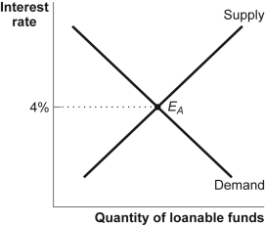 -(Figure: The Loanable Funds Model in the U.S. Market) Look at the figure The Loanable Funds Model in the U.S. Market. If the actual interest rate is equal to 4% in the U.S. market, then the quantity supplied of loanable funds will be _____ the quantity of loanable funds demanded.
 (Multiple Choice)
4.7/5 (84)
(84) 
Filters
- Essay(0)
- Multiple Choice(0)
- Short Answer(0)
- True False(0)
- Matching(0)