



 Chat with AI
Exam 19: Open-Economy Macroeconomics

Exam 1: First Principles233 Questions
Exam 2: Economic Models319 Questions
Exam 3: Supply and Demand292 Questions
Exam 5: International Trade 5274 Questions
Exam 6: Macroeconomics: the Big Picture168 Questions
Exam 7: Gdp and Cpi: Tracking the Macroeconomy434 Questions
Exam 8: Unemployment and Inflation354 Questions
Exam 9: Long-Run Economic Growth316 Questions
Exam 10: Savings, Investment Spending, and the Financial System402 Questions
Exam 13: Fiscal Policy Appendix Taxes and the Multiplier382 Questions
Exam 14: Money, Banking, and the Federal Reserve System468 Questions
Exam 15: Monetary Policy359 Questions
Exam 16: Inflation, Disinflation, and Deflation240 Questions
Exam 17: Crises and Consequences214 Questions
Exam 18: Events and Ideas322 Questions
Exam 19: Open-Economy Macroeconomics467 Questions
Exam 20: Graphs in Economics75 Questions
Exam 21: toward a Fuller Understanding of Present Value36 Questions
Select questions type


Donald owns several hotels in U.S. tourism destinations. Much of Donald's hotel revenue comes from Europeans. Suppose the U.S. dollar depreciates against the euro. Explain how this will affect Donald's hotel business.
(Essay)
4.9/5  (97)
(97) If the exchange rate is ¥200 per U.S. dollar, the U.S. price level is 120, and the Japanese price level is 600, then the real exchange rate is:
(Multiple Choice)
4.8/5 (84)
(84) The Venezuelan bolivar trades at a fixed exchange rate. If Venezuela uses monetary policy to change the exchange rate of the bolivar from $0.16 to $0.20, the bolivar has:
(Multiple Choice)
5.0/5 (81)
(81) Foreign exchange controls, unlike tariffs and quotas, do not distort incentives for trade between countries.
(True/False)
4.9/5 (79)
(79) A country has a floating exchange rate if the government lets the exchange rate go wherever the market may take it.
(True/False)
4.8/5 (97)
(97) If the dollar value of the pound falls, then the dollar has depreciated.
(True/False)
4.8/5 (69)
(69) An advantage to floating exchange rates is that they help:
(Multiple Choice)
4.9/5 (74)
(74) All countries must have either a fixed or floating exchange rate, since there are no possible compromises between the two policies.
(True/False)
4.9/5 (89)
(89) Use the following to answer questions :
Scenario: Exchange Rates
The value of a euro goes from US$1.25 to US$1.50.
-(Scenario: Exchange Rates) Look at the scenario Exchange Rates. In Germany, exports will _____ and imports will _____.
(Multiple Choice)
4.9/5 (70)
(70) If a country fixes its exchange rate, it loses its ability to use monetary policy for macroeconomic stabilization.
(True/False)
4.8/5 (71)
(71) If the target exchange rate of a fixed currency is below the equilibrium exchange rate, to reach the target rate, the government should limit the ability of foreigners to buy its currency.
(True/False)
4.9/5 (95)
(95) All else equal, if the Federal Reserve decreases the money supply, interest rates will _____ and the dollar will _____ against other currencies.
(Multiple Choice)
4.7/5 (81)
(81) A country has a financial account surplus if the balance on the:
(Multiple Choice)
4.8/5 (77)
(77) If the United States exports $100 billion of goods and services and imports $150 billion of goods and services and there is no other factor income or transfers, the balance on the current account is:
(Multiple Choice)
4.8/5 (79)
(79) Use the following to answer questions:
Figure: International Capital Flows 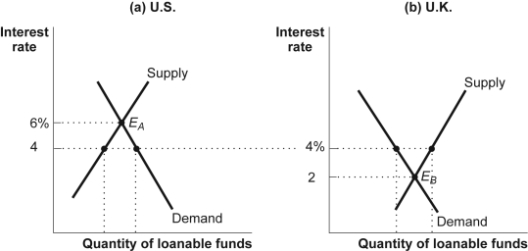 -(Figure: International Capital Flows) Look at the figure International Capital Flows. At an interest rate of 4%, the quantity of loanable funds demanded by British borrowers is _____ the quantity of loanable funds supplied by British lenders.
 (Multiple Choice)
4.9/5 (84)
(84) If the target exchange rate of a fixed currency is above the equilibrium exchange rate, to reach the target rate, the government should raise interest rates.
(True/False)
4.7/5 (76)
(76) 
Filters
- Essay(0)
- Multiple Choice(0)
- Short Answer(0)
- True False(0)
- Matching(0)